


TL;DR:
- Preventing curly hair breakage depends primarily on minimizing mechanical stress and friction throughout your routine, not just increasing moisture. Using tools like wide-tooth combs, microfiber towels, lightweight oils, and leave-in conditioners helps protect vulnerable curl structures from damage. Consistent gentle detangling, low-friction drying methods, careful protective styling, regular trims, and proper product layering are essential for maintaining curl strength and length.
Preventing curly hair breakage is defined by one principle above all others: reducing mechanical stress and friction at every stage of your routine, not just adding more moisture. The tools that make the biggest difference are wide-tooth combs, microfiber towels, lightweight oils like argan or jojoba, and leave-in conditioners. Breakage prevention relies on reducing grooming force and friction consistently over time, not on a single product fix. Your curls are structurally more vulnerable than straight hair because each bend in the strand is a potential stress point. Building a routine that protects those points is what separates hair that retains length from hair that seems to never grow.
How to prevent curly hair breakage during detangling
Detangling is the single highest-risk moment in your entire hair care routine. Wet, conditioned detangling is the most effective approach for curly hair because water and conditioner reduce resistance between strands. Attempting to detangle dry curls forces you to pull through knots with far more tension than the hair can handle without snapping.
Here is the correct detangling sequence:
- Saturate your hair with water before applying any product. Dry strands have almost no flexibility.
- Apply a generous amount of conditioner or a detangling conditioner to each section. The slip this creates is what allows knots to release without force.
- Finger detangle first. Work through each section with your fingers to loosen the largest knots before any tool touches your hair.
- Follow with a wide-tooth comb, starting at the ends and working upward toward the roots in small increments.
- Work in sections. Dividing your hair into four to six sections keeps each portion manageable and prevents you from pulling tension across the entire head.
Detangling with conditioner slip and sectioning reduces the tensile stress on each strand, keeping it below the threshold where it snaps. Skipping the conditioner step is the most common reason detangling causes breakage even when people think they are being careful.
Pro Tip: Always detangle from the ends upward, never from the roots down. Starting at the roots compresses knots downward and multiplies the force needed to release them.
What drying techniques protect curly hair from breakage?
The way you dry your hair matters as much as how you wash it. Wet hair is mechanically weaker than dry hair, which means the friction from a rough terry cloth towel can cause real cuticle damage at the exact moment your strands are most vulnerable. The cuticle is the outer protective layer of each strand. Once it is roughed up, the inner cortex is exposed and breakage follows.
The right approach to drying comes down to a few non-negotiable habits:
- Swap your terry cloth towel for a microfiber towel or an old cotton T-shirt. Both materials have a much smoother surface that does not catch and snag the curl pattern.
- Blot or scrunch, never rub. Rubbing creates friction in every direction. Scrunching compresses the curl upward and removes water without disturbing the strand’s structure.
- Avoid wrapping your hair tightly in any towel for extended periods. The tension at the hairline and nape is enough to cause traction breakage over time.
You can find more detail on friction-free drying methods that work specifically for textured hair types.
Pro Tip: Try the “plopping” technique. Lay a microfiber towel or cotton T-shirt flat, flip your wet hair forward onto it, then wrap the fabric around your curls and secure it on top of your head for 15–20 minutes. This removes excess water while keeping the curl pattern intact and eliminating friction entirely.

How do styling choices and protective styles affect curly hair breakage?
Protective styles like braids, twists, and buns are genuinely effective at reducing daily manipulation. Less daily handling means fewer opportunities for mechanical stress. The problem is that a protective style installed incorrectly causes more damage than no protective style at all.
Installation tension and friction during takedown are what separate protective styles that prevent breakage from those that cause it. Styles pulled tight at the scalp create traction alopecia over time, a form of breakage and hair loss that starts at the edges and temples. If your scalp hurts after installation, that is not normal. It is a warning sign.
Protective styles that work well for curly and coily hair include:
- Loose two-strand twists that sit without tension at the root
- Flat twists or cornrows installed with medium-sized sections and no added pulling
- Buns and updos secured with a satin scrunchie rather than a tight elastic band
- Braids with extensions, provided the extensions are not too heavy and the installation is low tension
Refreshing your style matters as much as the initial installation. Protective styles must be refreshed regularly to avoid matting, product buildup, and scalp stress. When it is time to remove a protective style, apply a generous amount of conditioner or oil to each section before unraveling. Rushing the takedown without slip is one of the most common causes of breakage that people mistakenly blame on the style itself.
Why is regular trimming essential for preventing breakage?
Split ends are not a cosmetic problem. They are a structural one. Once a strand splits at the end, that split travels up the shaft unless you remove it. Split ends cannot be permanently repaired by any product, regardless of what the label claims. Products that promise to seal split ends create a temporary smoothing effect, but the underlying damage remains and continues to spread.
Trimming is the only effective long-term intervention for split-end-related breakage. The recommended frequency is every 6–8 weeks, though your specific curl type and damage level will influence that schedule. Type 4 coils, which have the tightest curl pattern and the most bends per inch, often need more frequent trims than type 2 waves.
Signs your hair needs a trim right now:
- Single-strand knots that appear repeatedly at the ends of your curls
- Rough or frayed texture at the tips even after conditioning
- Tangles that form immediately after detangling, especially at the ends
- Visible splitting when you hold a strand up to light
Breakage at the ends creates the illusion that your hair is not growing because damaged ends snap at a steady rate, canceling out new growth. Consistent trimming is what allows length retention to actually show up.
Which products and routines best support preventing breakage in curly hair?
Product choice and wash frequency are where most people either support or undermine everything else they are doing. Curly hair should be washed 2–3 times per week with sulfate-free cleansers. Sulfates strip the natural oils that keep curls flexible. Without those oils, strands become brittle and break under normal handling.
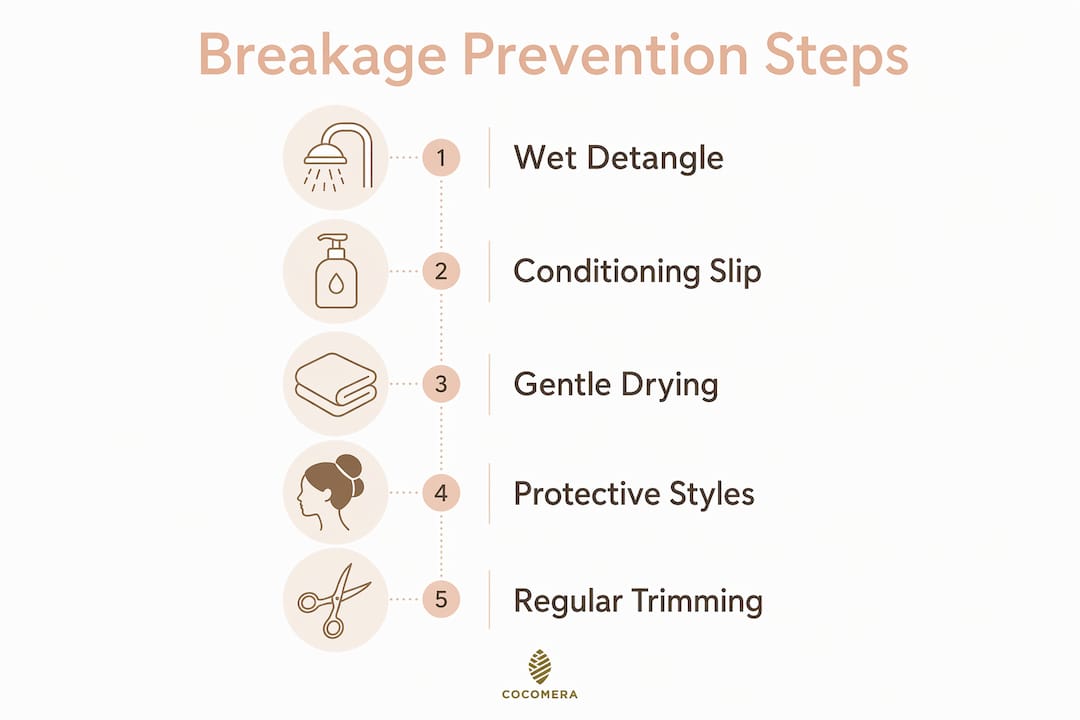
The layering order of your products matters as much as the products themselves. Sealing ends with oils like argan or jojoba after applying a leave-in conditioner locks moisture into the strand and reduces friction at the most vulnerable part of the hair. Think of it as a two-step lock: the leave-in adds moisture, and the oil keeps it there.
Minimize heat styling frequency and always use a heat protectant when you do apply heat. The lowest effective temperature setting is the right one, not the highest. High heat degrades the protein structure of the hair, making it permanently weaker.
| Product Type | Purpose | Key Benefit for Breakage Prevention |
|---|---|---|
| Sulfate-free shampoo | Gentle cleansing | Preserves natural oils and moisture balance |
| Deep conditioner | Weekly moisture treatment | Improves elasticity and strand flexibility |
| Leave-in conditioner | Daily moisture layer | Reduces friction and adds slip for handling |
| Sealing oil (argan, jojoba) | Locks in moisture | Protects ends and reduces brittleness |
| Heat protectant | Pre-heat styling barrier | Prevents cuticle damage from thermal tools |
Deep conditioning weekly is not optional for curly hair. Deep conditioning improves moisture retention and elasticity, which directly affects how much stress a strand can absorb before it breaks. A strand with good elasticity stretches under tension and returns to its shape. A dry, brittle strand snaps.
One often-overlooked curly hair maintenance tip is refreshing your style between wash days by reactivating existing product with water rather than applying new layers. Refreshing with water instead of new product reduces unnecessary handling and the cumulative mechanical stress that comes with it. You can also read more about wash day workflow to build a routine that protects your curls from start to finish.
Key takeaways
Preventing curly hair breakage requires consistent reduction of mechanical stress and friction at every stage of your routine, from detangling to drying to styling.
| Point | Details |
|---|---|
| Detangle wet with conditioner | Apply conditioner first, finger detangle, then use a wide-tooth comb in sections to minimize strand stress. |
| Use low-friction drying tools | Replace terry cloth towels with microfiber or cotton T-shirts and blot rather than rub. |
| Install protective styles with low tension | Tight installation causes traction breakage; always use slip during takedown to avoid damage. |
| Trim every 6–8 weeks | Split ends travel up the shaft and cannot be repaired by products; trimming is the only real fix. |
| Layer products correctly | Apply leave-in conditioner first, then seal with argan or jojoba oil to lock in moisture and protect ends. |
What Cocomera has learned about breakage prevention
The most common mistake I see is treating breakage as a moisture problem alone. People add more products, more oils, more deep conditioning treatments, and still see breakage. The real issue is almost always mechanical. It happens in the two minutes of rough towel drying or the five minutes of detangling without enough conditioner slip.
The moments that matter most are the wet phases. Wet hair is at its weakest, and that is exactly when most people rush. Slowing down during detangling and drying is not a minor adjustment. It is the adjustment that changes everything.
Protective styling is genuinely powerful, but only when the installation is honest about tension. I have seen more breakage caused by tight braids than by no protective style at all. The style is not the problem. The technique is.
Consistency is what actually builds stronger curls over time. One good wash day does not undo months of rough handling. But three months of gentle detangling, low-friction drying, and regular trims will show up in your hair in a way that no single product ever will. Patience is not passive. It is the strategy.
— Cocomera
Build your breakage-prevention routine with Cocomera
Cocomera curates hair care products specifically for wavy, curly, coily, and afro hair types, so you are not sorting through products designed for straight hair and hoping something works.
For breakage prevention, the most useful starting points are deep conditioning treatments that restore elasticity and curl creams and leave-ins that add the slip your detangling routine needs. If you are still using a standard brush or comb, Cocomera also carries wide-tooth combs and brushes built for textured hair. Every product in the store is chosen with your specific curl type in mind, whether you are a type 2 wave or a type 4 coil. Browse the full range at Cocomera and find what fits your routine.
FAQ
Why does curly hair break more easily than straight hair?
Curly hair has more bends per strand, and each bend is a structural stress point where the cuticle is thinner. This makes curly hair more vulnerable to mechanical damage from combing, rubbing, and tension.
How often should you detangle curly hair?
Detangle curly hair once per wash session, only when wet and coated with conditioner. Daily dry detangling causes cumulative mechanical damage that leads to significant breakage over time.
Do split end repair products actually work?
No product permanently repairs a split end. Products that claim to seal splits create a temporary smoothing effect only. Trimming every 6–8 weeks is the only way to stop split ends from traveling further up the strand.
What is the best way to dry curly hair without causing breakage?
Blot or scrunch hair dry using a microfiber towel or cotton T-shirt instead of a terry cloth towel. The plopping technique, where you wrap wet curls in a flat microfiber towel for 15–20 minutes, removes water with zero friction.
Can protective styles cause breakage instead of preventing it?
Yes, when installed with too much tension or removed without conditioner slip. Tight installation causes traction breakage at the roots, and dry takedown snaps strands at the ends. Low tension and slip-assisted removal are what make protective styles effective.


