


TL;DR:
- Heat styling tools cause irreversible damage to textured hair by breaking keratin bonds and lifting cuticles, which leaves strands porous, frizzy, and prone to breakage. Avoiding heat and opting for heat-free methods like air drying and protective styles help preserve curl integrity and promote healthy growth over time. A consistent routine with proper products and a heat-free period of at least three months can lead to noticeable improvement and stronger, more resilient curls.
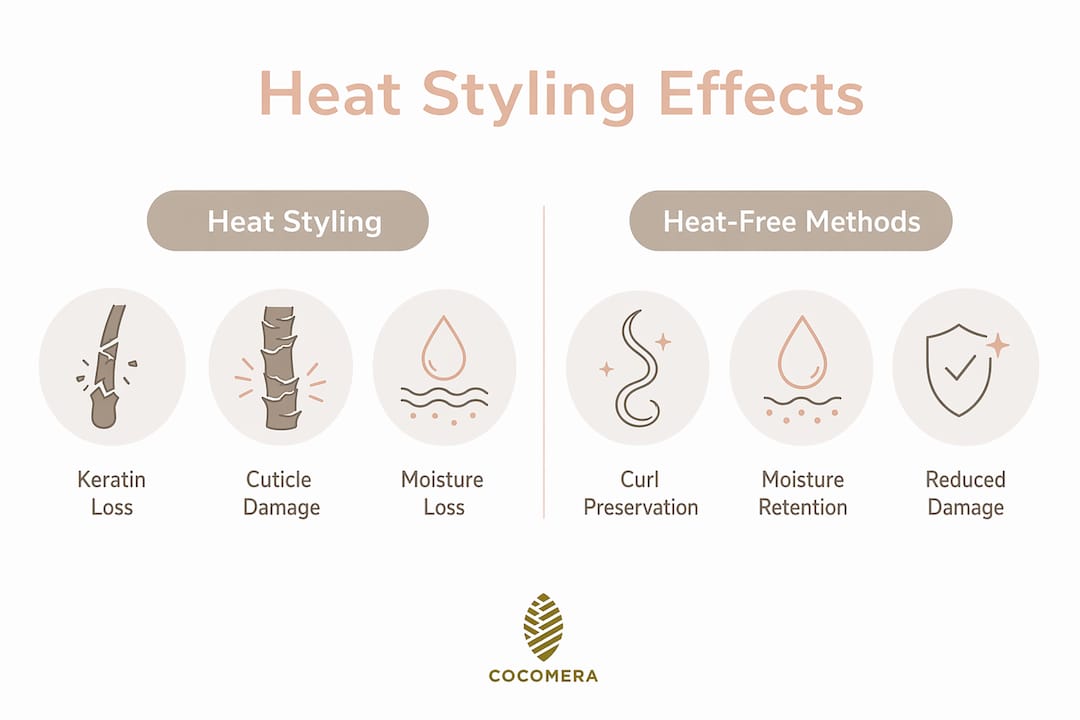
Heat styling tools, including flat irons and blow dryers, cause permanent damage to textured hair by breaking down keratin proteins and stripping the protective barriers that keep curls healthy, defined, and moisturized. For wavy, curly, coily, and afro hair types, the consequences of repeated heat exposure are not cosmetic inconveniences. They are structural failures that compound with every session. Understanding why avoid heat styling is the first step toward protecting the integrity of your curls long term.
Why does heat styling damage textured hair so deeply?
The damage begins at the molecular level. Keratin bond breakdown occurs at temperatures above 300°F, causing permanent loss of hair strength and elasticity. Textured hair is especially vulnerable because its natural curl pattern creates bend points where thermal stress concentrates, making each coil a potential fracture site. Research on textured hair thermal susceptibility confirms that the microfibrils inside curly and coily strands are more prone to disruption from heat than straight hair structures.
The cuticle, the outermost protective layer of each strand, takes serious damage even at moderate temperatures. Blow-drying at 70°C causes cuticle scale lifting and cracking, reducing hair gloss by over 30%. That number matters because gloss loss signals the destruction of the 18-MEA lipid layer, the hydrophobic coating that keeps moisture inside the strand and friction low. Once that layer is gone, no conditioner fully restores it.
Styling wet textured hair with heat creates a separate and particularly destructive problem. Steam bubbles form inside the hair shaft when moisture vaporizes under a flat iron or high-heat dryer, weakening the internal structure and causing premature breakage. Dyson engineers describe this as thermal shock, and it is irreversible. The strand does not recover from internal bubble formation.
Key structural damage mechanisms in textured hair:
- Keratin denaturation above 300°F removes the protein scaffolding that gives hair its tensile strength
- Cuticle scale lifting increases surface friction, causing tangles and breakage during detangling
- 18-MEA lipid loss converts the hair surface from moisture-repellent to porous, permanently altering how the strand behaves
- Microfibril separation at curl bend points disrupts the spring structure of coils, leading to curl loosening or “heat training”
- Internal steam bubbles from wet heat styling cause structural collapse that no treatment can reverse
Pro Tip: Always stretch or rough-dry textured hair to at least 80% dry before applying any direct heat tool. This single habit eliminates the steam bubble risk entirely.
What are the visible signs of heat styling damage?
Heat damage does not announce itself all at once. It accumulates across weeks and months, and by the time the signs are obvious, significant structural loss has already occurred.
The most recognizable symptoms follow a predictable progression:
- Increased dryness and brittleness. The loss of 18-MEA lipids disrupts the hydrophobic barrier, making the strand permanently porous. Moisture enters and exits rapidly, leaving hair that feels dry hours after deep conditioning.
- Persistent frizz. Lifted cuticle scales catch on each other and on environmental humidity, creating frizz that no serum fully controls. Learn more about managing this with frizz control strategies built for curly and coily textures.
- Split ends and mid-shaft breakage. Cracked cuticles split longitudinally, and the damage travels up the strand if not trimmed promptly.
- Apparent thinning near the scalp. Heat damage mimics hair loss by causing breakage close to the root, creating the appearance of reduced density. The follicles are intact, but the strands snap before they can grow to visible length.
- Altered curl pattern. Coils that once bounced back now hang limp or refuse to form. This is heat training, the result of repeated microfibril disruption at the curl’s natural bend points.
“Heat damage is cumulative and irreversible. Protein treatments and deep conditioners improve surface feel, but they cannot rebuild broken keratin bonds. The only true correction is cutting off the affected hair and growing healthy strands from the root.”
Color-treated textured hair faces compounding risks. Heat accelerates color fade by opening the cuticle and allowing pigment molecules to escape. Higher porosity from heat damage also means color processes unevenly, making future treatments harder to predict and control.
How does heat styling compare to heat-free alternatives?
The risks of heat styling and the benefits of heat-free methods are not equally matched. For textured hair specifically, the gap is wide.
| Method | Effect on curl structure | Moisture impact | Damage risk |
|---|---|---|---|
| Flat iron (above 300°F) | Permanent curl loosening, microfibril disruption | Severe moisture loss, lipid layer destruction | High, irreversible |
| Blow dryer (no diffuser, high heat) | Cuticle lifting, frizz increase | Significant dehydration | High, cumulative |
| Diffuser (low heat setting) | Minimal curl disruption | Low moisture loss | Low when used correctly |
| Air drying | No structural impact | Moisture retained naturally | None |
| Protective styling (braids, twists) | Curl pattern preserved | Moisture sealed in | None |
| Wet styling techniques | Curl definition enhanced | Hydration locked in | None |
Air drying is the gold standard for curl preservation. Wet styling for textured hair using techniques like the praying hands method, shingling, or finger coiling delivers definition without any thermal risk. Protective styles like braids, twists, and bantu knots go further by reducing daily manipulation entirely.
Heat protectants occupy a middle ground. Protectant sprays and creams form a barrier that slows heat conduction and distributes temperature more evenly across the strand. They reduce damage but do not eliminate it. Consistent use before every heat session meaningfully lowers cumulative risk, but they are not a license to use high heat daily.
Advanced protective technologies are also emerging. OSK, an organic silicon-modified keratin compound, forms a thermoresponsive protective film on the hair surface that improves tensile strength and hydrophobicity under heat stress. This class of treatment represents a meaningful step forward for those who cannot eliminate heat entirely.
Pro Tip: When using a diffuser, set your dryer to medium heat and low airflow. High airflow disrupts the curl clump and creates frizz even at safe temperatures.
What practical strategies reduce heat damage for textured hair?
Protecting textured hair from heat damage requires a consistent system, not occasional precautions. The following practices, applied together, produce measurable results.
- Limit heat styling frequency. Frequent styling above 300°F accelerates keratin denaturation with each session. Aim for heat styling no more than once every two weeks, and consider heat-free weeks as a default.
- Never apply direct heat to wet hair. Styling wet textured hair with heat creates internal steam bubbles that cause irreversible breakage. Always pre-dry to at least 80% before using a flat iron or wand.
- Apply heat protectant every single time. Skipping protectant even once during a high-heat session causes disproportionate damage. Use a product formulated for textured hair, as thicker curl patterns require more even distribution.
- Use the lowest effective temperature. Fine or low-density textured hair responds to 300°F or below. Coarser type 4 hair may need up to 380°F, but higher is rarely necessary and always riskier.
- Incorporate protein and moisture treatments weekly. Hydrolyzed keratin and amino acid treatments temporarily fill gaps in the cuticle and improve elasticity. Pair them with moisture-locking techniques to extend the benefit between wash days.
- Trim regularly. Split ends travel. Removing them every 8 to 12 weeks prevents damage from migrating up the shaft and causing more extensive breakage.
- Commit to a heat-free recovery period. Clinical guidance recommends at least three months without heat to allow the scalp to produce healthy new growth. Full replacement of damaged hair takes 6 to 12 months of consistent new growth.
A consistent hair care routine built around these habits protects your curls between heat sessions and gives new growth the best environment to thrive.
Key takeaways
Avoiding heat styling is the single most effective action textured hair individuals can take to preserve curl integrity, moisture retention, and long-term hair health.
| Point | Details |
|---|---|
| Heat causes irreversible damage | Keratin breakdown above 300°F cannot be repaired by treatments; only trimming removes it. |
| Wet heat styling is the highest risk | Steam bubbles form inside strands and cause structural collapse that no product reverses. |
| 18-MEA lipid loss drives frizz | Once the hydrophobic layer is gone, porosity increases permanently regardless of conditioning. |
| Heat-free methods preserve curl pattern | Air drying, diffusing on low, and protective styling maintain curl structure without thermal risk. |
| Recovery takes 6 to 12 months | A minimum three-month heat-free period is needed before new, healthy growth replaces damaged strands. |
What Cocomera has learned about heat and textured hair
The most common misconception we see is the belief that a good deep conditioner can undo heat damage. It cannot. Conditioning improves the feel of damaged hair, which is genuinely useful, but it does not rebuild broken keratin bonds or restore the 18-MEA lipid layer. Treating those two things as equivalent leads people to keep heat styling with false confidence, and the damage compounds quietly until it becomes impossible to ignore.
Textured hair is not inherently fragile. Type 2, 3, and 4 curl patterns are structurally sophisticated. The bend points that create those beautiful coils are also the exact locations where heat stress concentrates most intensely. That is not a flaw in the hair. It is a reason to treat it with more precision, not more heat.
The transition away from heat styling is genuinely difficult for many people. Curl definition feels unpredictable at first. Wash days take longer. The results look different from what years of heat styling trained you to expect. What we have observed, both in the research and in the experience of the textured hair community, is that the payoff arrives around the three-month mark. Curl pattern begins to recover. Breakage decreases. Moisture retention improves. The hair starts to behave like itself again.
The goal is not perfection. It is giving your curls enough breathing room to show you what they are actually capable of.
— Cocomera
Protect your curls with the right products
Reducing heat styling works best when you have the right products to support heat-free definition and repair. At Cocomera, every product is curated specifically for wavy, curly, coily, and afro hair types. Browse styling products for curly hair designed to deliver definition, hold, and frizz control without a flat iron in sight. For strands already showing signs of damage, the hair treatments collection includes protein-rich and moisture-focused options formulated to strengthen textured hair from the inside out. Pair them with a strengthening shampoo to build a complete routine that supports recovery and long-term curl health.
FAQ
What temperature damages textured hair?
Keratin bonds break down permanently at temperatures above 300°F. Daily use of tools at this temperature or higher causes cumulative, irreversible damage to curl structure and hair strength.
Can heat damage be repaired without cutting?
Heat damage cannot be fully repaired. Protein treatments improve surface feel temporarily, but broken keratin bonds and destroyed lipid layers require trimming the affected hair and growing new, healthy strands to replace them.
Why is textured hair more vulnerable to heat than straight hair?
Textured hair’s natural curl bend points concentrate thermal stress in specific locations along the strand, making microfibrils more susceptible to disruption and curl loosening than in straight hair types.
Does air drying actually help curls?
Air drying preserves the curl’s natural structure by eliminating thermal shock entirely. Combined with wet styling techniques like shingling or the praying hands method, it delivers definition and moisture retention that heat styling consistently undermines.
How long does it take to recover from heat damage?
Recovery requires a minimum of three months without heat to allow healthy new growth, with full replacement taking 6 to 12 months depending on hair growth rate and the extent of existing damage.


