


TL;DR:
- The natural hair movement is a cultural and political effort by Black communities promoting acceptance of afro-textured hair and resistance to Eurocentric beauty standards. It originated in the 1960s as a form of activism symbolizing pride and autonomy, with a recent resurgence fueled by social media platforms. Despite legal protections like the CROWN Act, discrimination and internal biases persist, highlighting ongoing challenges and evolving conversations about inclusivity and self-acceptance.
The natural hair movement is far more than a haircare trend. At its core, what is natural hair movement really about? It’s a cultural and political movement led by Black and African-diaspora communities that encourages embracing afro-textured hair in its natural state rather than conforming to Eurocentric beauty standards through chemical straightening. The movement carries deep roots in identity, resistance, and self-acceptance. Understanding where it came from, how it evolved, and why it still matters today changes how you see every curl, coil, and twist.
Table of Contents
Key takeaways
| Point | Details |
|---|---|
| More than haircare | The natural hair movement is a cultural and political movement centered on identity and self-acceptance, not just styling routines. |
| Rooted in activism | The movement originated in the 1960s alongside Civil Rights and Black Power, when natural styles became symbols of resistance and pride. |
| Modern digital resurgence | YouTube creators and social media drove a major revival from 2010 to 2016, expanding education and visibility for all curl types. |
| Legal protections exist | The CROWN Act, created in 2019, protects against hair-based discrimination in workplaces and schools, though biases persist. |
| Autonomy defines it | The movement opposes Eurocentric beauty norms as default, not all styling choices. Personal freedom and self-definition are central. |
What is natural hair movement and where it began
To understand the natural hair movement, you have to go back to the 1960s United States. This was not simply a moment when Black people decided to stop using relaxers. It was a deliberate act of resistance woven into one of the most charged political climates in American history.
As the Civil Rights Movement gained momentum and the Black Power era took shape, natural hairstyles like the Afro became visible symbols of pride, resistance, and cultural identity. Wearing your hair in its natural texture was a statement. It said, loudly and clearly, that Black beauty did not need to be modified to be valid.
This period gave rise to the “Black is Beautiful” philosophy, a cultural affirmation that pushed back against decades of messaging that framed Blackness as inferior or in need of correction. Hair was central to that affirmation. Activists, artists, and everyday people chose the Afro not just for aesthetic reasons but as a politics of style, a way to assert agency in a system designed to deny it.
“Hair is not just hair. In the Black community, it has always carried the weight of history, belonging, and survival.”
Key ways hair functioned as activism during this era:
-
The Afro represented a rejection of assimilation and an embrace of African heritage
-
Natural styles were worn publicly by prominent Civil Rights figures and Black Panthers, amplifying their symbolic power
-
Straightening hair, which had long been framed as necessary for respectability and employment, was reframed as capitulation to white supremacist beauty standards
-
Community spaces like barbershops and salons became sites of political conversation tied directly to how hair was styled and worn
This is where the foundation of the natural hair movement was laid. Not in a product launch or a magazine editorial, but in the streets, courtrooms, and communities of Black America.
The digital resurgence that changed everything
The natural hair movement didn’t disappear after the 1970s, but it entered a quieter period as relaxers became widely marketed and normalized. Then, around 2010, something shifted dramatically.
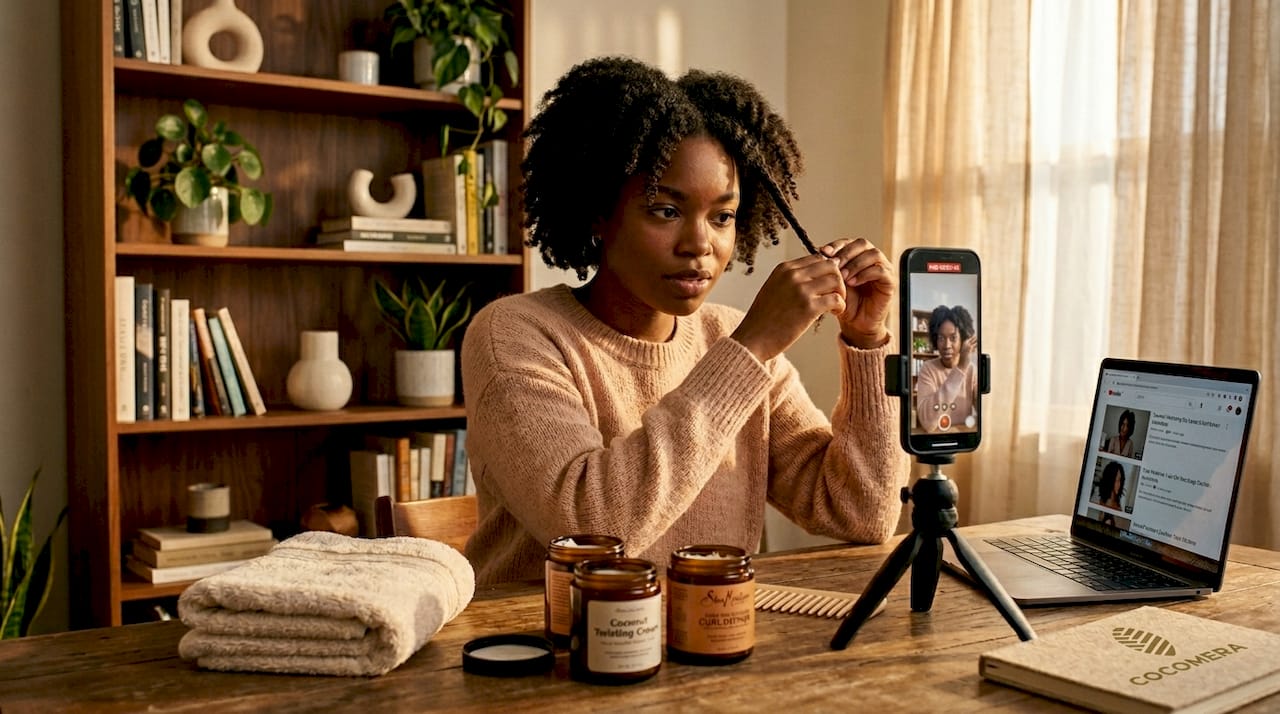
YouTube creators began sharing tutorials on transitioning from relaxed to natural hair, identifying curl types, and building wash day routines for coils and kinks. For the first time, people with 4C hair or tightly coiled 3B curls could find someone who looked like them explaining exactly how to care for their specific texture. The access was genuinely new and transformative.
This wave of education and visibility peaked around 2016. The movement went mainstream. Natural hair became more represented in advertising, on runways, and in media. The phrase “embracing natural hair” entered the cultural conversation broadly, and the natural hair community grew into a powerful, supportive ecosystem online.
Here’s how that digital transformation unfolded in practical terms:
-
Creators on YouTube built massive followings by demystifying textured hair care for beginners
-
Instagram and Pinterest filled with imagery celebrating all curl types, from loose waves to tight coils
-
Brands began formulating and marketing natural hair products specifically for type 3 and type 4 hair
-
“Big chop” videos, where people cut off their relaxed ends to start fresh, went viral and inspired thousands to do the same
-
Facebook groups and later TikTok communities provided peer support for people navigating their natural hair journey
But the resurgence brought complications too. As the market expanded, marketing often spotlighted looser curls as the aspirational ideal, sidelining tighter coiled textures. People with 4A, 4B, and 4C hair frequently felt their experiences were underrepresented even within a movement meant for them. Internalized texturism, the bias that favors looser curl patterns over tighter ones, became a documented tension within the community itself.
Pro Tip: If you’re new to natural hair care, focus on understanding your specific curl type rather than following generic routines. What works beautifully for a type 3A curl can leave a 4C curl dry and brittle.
Workplace discrimination and the CROWN Act
One of the sharpest measures of how far the natural hair movement still has to go is what happens in professional environments. The reality is that for many Black professionals, wearing natural hair at work has come with real consequences.
Studies show that natural hair is 2.5x more likely to be perceived as unprofessional compared to straight hair. That number sits uncomfortably in a country that presents itself as a meritocracy. It means that for many Black women and men, the decision to wear locs, twists, braids, or an Afro to a job interview is a calculated risk, not a free expression of identity.
| Scenario | Reality for Black professionals |
|---|---|
| Job interviews | Natural hairstyles often perceived as less professional, affecting hiring outcomes |
| Workplace dress codes | Policies frequently ban or restrict locs, braids, and afros without explicit justification |
| School environments | Black students disciplined or excluded for wearing natural protective styles |
| Sports and performance | Athletes penalized or pressured to alter natural hair to comply with appearance rules |
The CROWN Act, created in 2019, stands for “Creating a Respectful and Open World for Natural Hair.” It was designed specifically to protect people from discrimination based on hair texture and protective hairstyles. Since its creation, it has been adopted at the state level across the U.S., though a federal version still faces political resistance.
The law matters. But laws change behavior before they change minds, and workplace discrimination still manifests through microaggressions, unsolicited touching of hair, comments framed as curiosity, and subtle professional penalties that are harder to prove or litigate.
“Legislation tells employers what they cannot do. Community and culture shift what they should celebrate.”
What “natural” actually means in the movement
Here is where a lot of people get confused, and the confusion matters. The natural hair movement is not a rule book about what you can and cannot do with your hair. It does not demand that everyone stop coloring, blow-drying, or even heat styling. That misunderstanding does real harm because it makes people feel judged for choices that are entirely their own.
The movement’s actual position is more nuanced. Being “natural” within the movement means rejecting chemical relaxers as the default, as the thing you must do to be acceptable in professional or social settings. It is about opposing the idea that textured, coiled, or kinky hair is inherently problematic or needs to be “fixed.”
| Common misconception | What the movement actually says |
|---|---|
| Natural hair means never using heat | Heat styling is a personal choice, not a betrayal of the movement |
| Protective styles are the only valid option | All styles are valid; the point is choice, not compliance |
| Natural hair requires no products | Textured hair often needs specific moisture and care routines |
| The movement is anti-styling | It’s anti-coercion into Eurocentric beauty norms, not anti-expression |
The movement also grapples with questions about who is centered in its narratives. When looser curl textures dominate the imagery and marketing of natural hair brands and media, it quietly signals that some forms of “natural” are more desirable than others. That internal debate pushes the movement toward a more genuinely inclusive understanding: every texture is valid, every curl type deserves care and representation.
Pro Tip: If you have multi-textured hair or find that your curl pattern varies across your head, build your routine around the neediest section of your hair, usually the tightest coils.
How professional education is catching up
For decades, cosmetology schools in the United States largely taught hair techniques on straight, European hair types. A trained stylist could graduate without ever learning how to properly care for or style afro-textured hair. That gap had consequences. It created what researchers call “hair deserts,” areas where Black clients cannot find a single competent, trustworthy stylist for their natural hair.
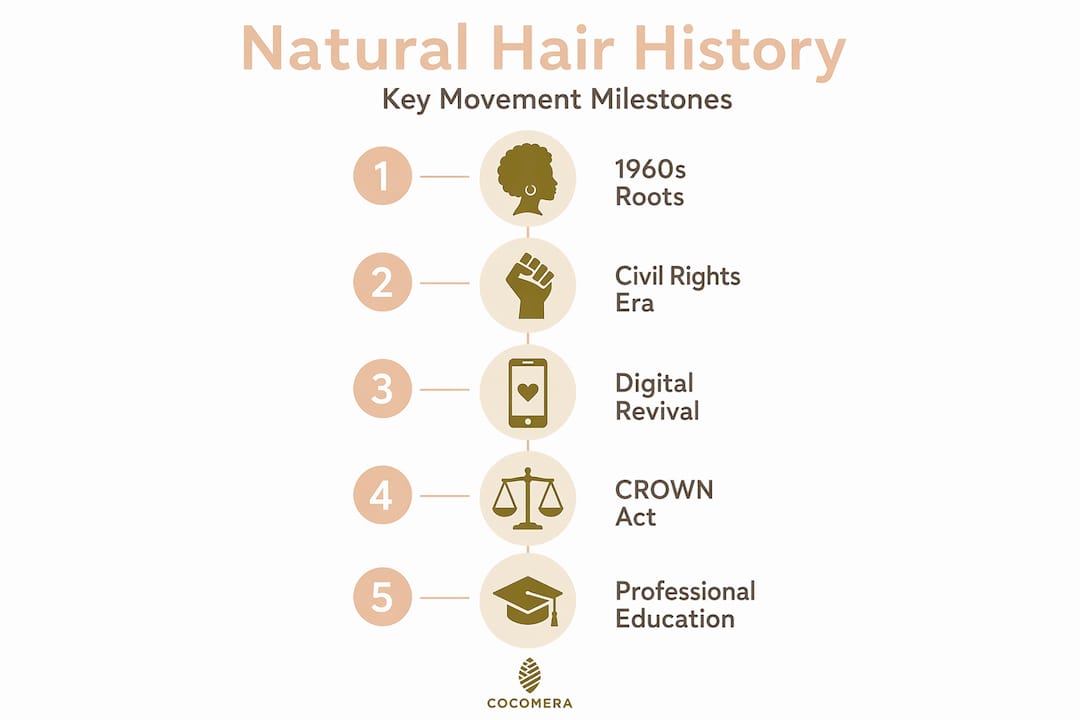
That is changing. New York State now mandates that cosmetology schools include textured hair care in their curriculum starting in 2026. This is a structural change, not a cultural gesture. It means the next generation of licensed stylists will be trained to work confidently with curly, coily, and afro hair from day one.
The benefits go beyond the salon chair. Improved education on textured hair increases client confidence and reduces the psychological tax of searching for a stylist who won’t damage your hair or treat your texture as an inconvenience. It also reduces the friction that can make some people feel like their hair is simply too difficult to maintain without straightening, which is exactly the pressure the natural hair movement has always pushed back against.
For people embracing natural hair right now, practical knowledge matters enormously. Learning how to care for natural hair with the right techniques, ingredients, and products specific to your texture is what turns “going natural” from a stressful overhaul into a genuinely joyful routine. You can start by exploring afro hair styling guidance designed specifically for type 3 and type 4 curls to build a foundation that actually works for your hair.
My take on where the movement stands today
I’ve been watching the natural hair movement evolve for years, and what strikes me most is how it refuses to stay simple. Every time it reaches a peak of visibility, something pulls it back into complexity. That’s not a failure. It’s proof that the movement is alive and honest.
What I’ve found most true is that the movement’s greatest challenge isn’t external anymore. The biases that live inside the community, the quiet preference for certain curl types, the exhaustion of constantly defending your hair choices, and the pressure to be “natural enough” are just as limiting as anything coming from outside. Real progress means confronting those too.
I also think the focus on legislation, while necessary, sometimes distracts from the deeper work of changing how people feel about their own hair privately. The CROWN Act protects you at work. But it cannot protect you from the moment you look in the mirror and reach for a relaxer because you’ve internalized that your texture is too much. That work is personal, generational, and slower than any law.
What gives me genuine hope is the younger generation. They’re growing up with YouTube channels, social media communities, and Cocomera-style resources that center textured hair as something to love and understand rather than manage and minimize. They’re less likely to see their coils as a problem to be solved. That shift, quiet as it is, may be the most durable change of all.
— Cocomera
Care for your natural hair with products made for your texture
Understanding the natural hair movement is the beginning. Living it daily, with the right care and tools, is where it becomes personal.
At Cocomera, every product in our collection is chosen specifically for wavy, curly, coily, and afro hair types. No filler brands, no products adapted from straight hair formulas. Whether you’re looking for styling products for curls, nourishing hair treatments, strengthening shampoos, or oils designed for afro hair, you’ll find options that respect your texture’s needs. Caring for natural hair should feel empowering, not overwhelming. We’ve made it easier to find what works for your specific curl type, all in one place.
FAQ
What is the natural hair movement in simple terms?
The natural hair movement is a cultural and political movement, primarily within Black and African-diaspora communities, that encourages people to wear their hair in its natural afro-textured state and reject chemical straightening as a beauty standard imposed by Eurocentric norms.
When did the natural hair movement start?
The movement originated in the 1960s and 1970s in the United States, closely tied to the Civil Rights and Black Power movements, when natural hairstyles like the Afro became symbols of pride and political resistance.
What is the CROWN Act and how does it relate to natural hair?
The CROWN Act, created in 2019, is legislation that protects people from discrimination based on natural hair texture and protective hairstyles like braids and locs in workplaces and schools.
Is the natural hair movement only for people with afro-textured hair?
The movement originated within Black and African-diaspora communities, but its principles of embracing your natural texture and rejecting coercive beauty norms resonate across many communities with textured or curly hair.
Does going natural mean you can never use heat or styling products?
No. The natural hair movement opposes the coercion to chemically straighten hair, not all forms of styling. Personal choice, including heat, color, and protective styles, is fully compatible with the movement’s core values.


