



Glycerin is one of the most effective ingredients you can add to a curly or textured hair routine — when it’s diluted correctly and matched to your climate. Start with a low-concentration glycerin spray on damp hair in moderate humidity, and you’ll likely see softer, more defined curls within a few wash days. If your hair feels sticky, puffs up fast in humid air, or turns straw-like in dry weather, those are clear signals to adjust your concentration or switch to a glycerin-balanced formula instead of a DIY blend.
- Good sign: Curls clump, feel soft, and hold definition through the day.
- Stop signal: Hair feels tacky, frizzes within an hour, or dries out faster than usual.
- First step: Try a leave-in conditioner or curl cream that lists glycerin mid-label (not first), then seal with a light oil.
Pro Tip: Before committing to a full-head application, test your glycerin spray on a two-inch section near your nape. One wash day of data beats a week of guessing.
Key Takeaways
Glycerin works for curly and textured hair when it’s diluted, applied to damp hair, and matched to your climate — those three conditions determine whether it hydrates or backfires.
| Point | Details |
|---|---|
| Dilute before use | Start at 2–5% glycerin in water or aloe; never apply neat glycerin directly to hair. |
| Apply to damp hair | Glycerin needs moisture to bind to — dry hair application pulls moisture out rather than in. |
| Seal with oil | Always follow a glycerin leave-in with a hair oil or butter to lock moisture inside the shaft. |
| Watch your climate | Moderate humidity is the sweet spot; adjust concentration or formula in very dry or very humid conditions. |
| Cocomera’s approach | Cocomera’s styling and treatment collections offer glycerin-balanced formulas with built-in emollients and film-formers suited to all curl types. |
Table of Contents
- What glycerin (glycerol) actually is and why it’s in your products
- How glycerin behaves on curly hair
- The real benefits glycerin delivers for curls and coils
- When glycerin dries out or frizzes your hair
- How to use glycerin on curly hair: recipes, application, and troubleshooting
- Glycerin versus castor oil and hyaluronic acid: which does what
- How to read a label and pick the right glycerin product
- Cocomera’s curl-type routines and how to test glycerin safely
- Our take on glycerin and textured hair
- Glycerin-friendly products at Cocomera: where to start
- Sources
What glycerin (glycerol) actually is and why it’s in your products
Glycerin, also called glycerol, is a colorless, syrupy liquid that functions as a humectant: it attracts water molecules and holds them near the surface it’s applied to. Cosmetic chemists have used it for well over a century because it’s inexpensive, chemically stable, and widely tolerated across skin and hair types. It’s also water-soluble, which means it rinses out cleanly without buildup — a key reason it’s compatible with the Curly Girl (CG) method, where avoiding non-water-soluble residue matters.
Beyond moisture, glycerin serves a secondary role as a viscosity modifier. It thickens formulas slightly and improves the spreadability of leave-ins, conditioners, and styling gels. As Vogue notes, its ubiquity in cleansers, serums, and moisturizers comes down to that combination: it does multiple jobs at a low cost, and its position on an INCI ingredient list gives you a rough read on how much of it is actually in the product.
You’ll find glycerin in:
- Leave-in conditioners — where it provides ongoing moisture pull between wash days.
- Styling gels and curl creams — where it aids definition and slip.
- Rinse-out conditioners and masks — where it boosts slip for detangling and short-term hydration.
- Spritz and refresher sprays — where it’s diluted in water or aloe to revive second-day curls.
How glycerin behaves on curly hair
Glycerin pulls water toward the hair surface. In moderate humidity, that’s exactly what you want: moisture from the air moves into the hair shaft, the cuticle softens, and curls form with more definition and less friction. The problem is that glycerin doesn’t distinguish between pulling water in and pulling water out — it follows the humidity gradient.
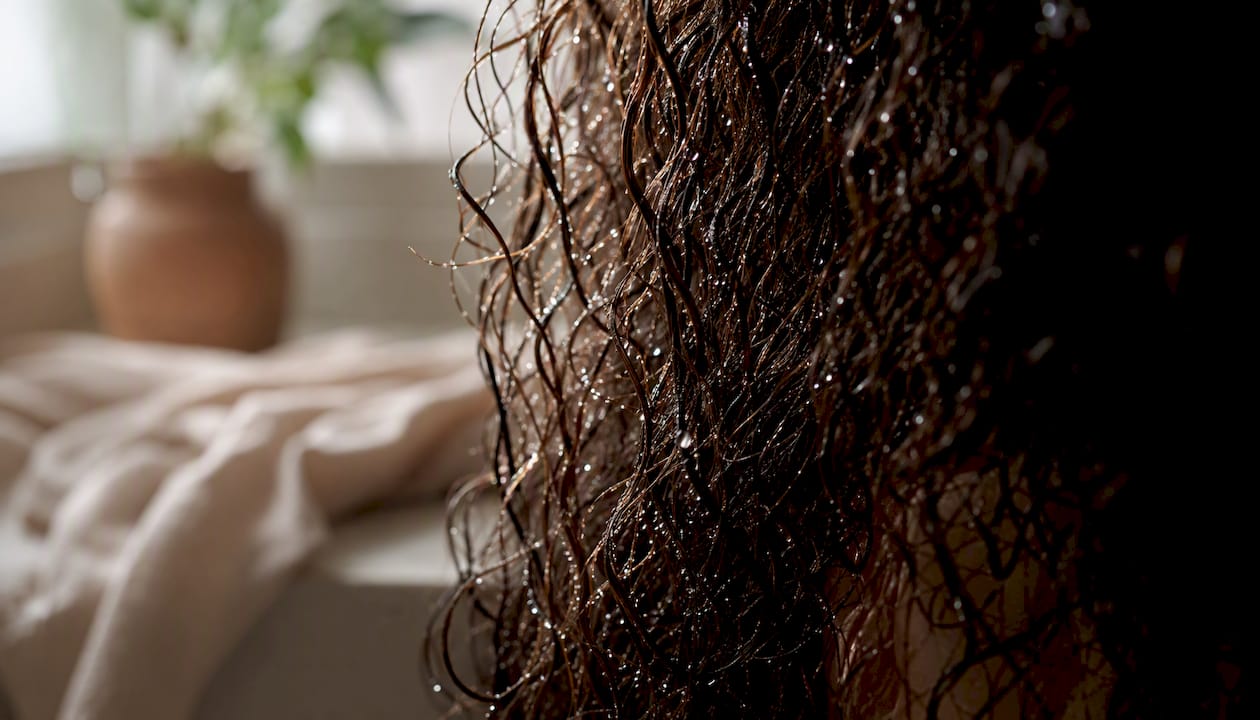
In very dry air (low dew points, typically below about 30°F / -1°C), glycerin can draw moisture from inside the hair shaft toward the drier surrounding air, leaving strands brittle and straw-like. Curly-hair practitioners confirm both effects: glycerin improves curl definition in balanced formulas but can swell hair in high humidity or dehydrate it in very dry air.
Porosity matters here too. High-porosity hair (raised, damaged cuticles) absorbs glycerin quickly but also loses moisture fast, so it benefits from glycerin paired with a sealing occlusive. Low-porosity hair (tight, flat cuticles) may resist glycerin uptake initially, meaning lighter dilutions and heat-assisted application (a warm towel or hooded dryer) tend to work better.
The practical rule: moderate humidity is the sweet spot where glycerin performs most predictably for most curl types.
The real benefits glycerin delivers for curls and coils
When the conditions are right, glycerin earns its place in a curly hair routine. Here’s what you can actually expect:
- Moisture retention: Glycerin draws water to the hair surface and slows its evaporation, keeping strands hydrated longer between wash days.
- Improved elasticity: Well-hydrated hair stretches without snapping. You’ll notice fewer broken strands when detangling after a glycerin-containing leave-in.
- Curl clumping and definition: Glycerin adds a light hold that encourages individual curls to group together rather than separate into frizz. Most noticeable right after a co-wash when hair is still damp.
- Slip for detangling: The syrupy texture of glycerin reduces friction between strands, making wide-tooth combing or finger-detangling significantly easier on wet hair.
- Reduced breakage: Softer, more pliable strands handle manipulation better. This benefit shows up most clearly in tight coils (type 4) that are prone to dryness-related snapping.
One thing worth knowing: these benefits are formula-dependent. Glycerin alone, applied neat, behaves very differently than glycerin inside a balanced leave-in or curl cream that also contains emollients, film-formers, and proteins. The co-ingredients shape how glycerin performs almost as much as the glycerin itself.
When glycerin dries out or frizzes your hair
Glycerin can dry or puff hair when humidity is outside a moderate window or when the concentration is too high. That’s not a reason to avoid it — it’s a reason to use it thoughtfully.
The dew point is the most reliable climate signal; very dry air may cause glycerin to pull moisture out of your hair, while high humidity may cause excess moisture absorption and frizz. Most people with curly hair get consistent results in moderate humidity conditions.
Watch for these symptoms:
- Sticky or tacky feel after drying: too much glycerin, or applied to hair that was too wet.
- Rapid frizzing within an hour of styling: humidity is too high for the concentration you’re using.
- Straw-like dryness by day two: air is too dry and glycerin is pulling moisture out rather than in.
Two additional cautions worth knowing. First, glycerin conducts heat more readily than silicones, which means using heat tools over glycerin-coated hair can accelerate internal moisture evaporation and increase damage risk. Always layer an insulating occlusive (a butter or heavier oil) before any heat. Second, if your hair is freshly color-treated, especially with semi-permanent dye, glycerin can dissolve loosely bound surface colorants. Wait one to two washes after a permanent color service, and be cautious with semi-permanent shades entirely.
How to use glycerin on curly hair: recipes, application, and troubleshooting
One rule covers most mistakes: dilute glycerin, never use it neat, apply it to damp hair, and seal afterward. Everything else is adjustment.
Three beginner recipes
**1.
- 1 cup distilled or filtered water
- 1–2 teaspoons vegetable glycerin
- Optional: 2 tablespoons aloe vera juice for extra slip
Shake before each use. Mist onto second-day curls or damp freshly washed hair.
**2.
- ½ cup aloe vera juice
- ½ cup distilled water
- 1 tablespoon glycerin
- 5–10 drops of a lightweight oil (jojoba or argan)
Apply section by section to soaking-wet hair after rinsing out conditioner. Healthline’s glycerin guide confirms that diluted sprays combining glycerin with water or aloe are among the most practical DIY applications.
**3.
- 3 tablespoons deep conditioner or plain conditioner
- 1 tablespoon glycerin
- 1 tablespoon honey (optional, adds humectant layering)
Apply to clean, damp hair, cover with a plastic cap for 15–20 minutes, then rinse thoroughly. Use this for a deep treatment once or twice a month, not weekly.
Application order
- Shampoo or co-wash, rinse fully.
- Apply conditioner, detangle, rinse (or leave a small amount in for low-porosity hair).
- While hair is still dripping wet, apply your glycerin spray or leave-in blend section by section.
- Rake or smooth through each section to distribute evenly.
- Apply your styler (gel or curl cream) on top to lock in shape.
- Seal with a hair oil to slow moisture evaporation, especially in dry climates.
- Diffuse or air-dry without touching.
Troubleshooting
- Sticky residue: Reduce glycerin concentration or apply to wetter hair so it distributes more evenly.
- Frizz despite glycerin: Add a film-forming styler (a gel with a hold polymer) over the glycerin layer to lock the cuticle down.
- Winter dryness: Layer a butter or heavier occlusive over your glycerin leave-in before sealing with oil. Experts recommend pairing glycerin with an occlusive in very dry environments to prevent net water loss.
- No visible effect: Check your water quality. Hard water with high mineral content can interfere with glycerin’s ability to bind moisture effectively. Try a chelating shampoo before your next glycerin application.
Frequency isn’t fixed. Test glycerin on two consecutive wash days, then skip it on the third and compare. Let your hair’s response guide the schedule rather than a calendar.
Pro Tip: Keep a simple wash-day log for four sessions: note the humidity reading, the products used, and how your hair felt at hour one and hour twenty-four. Patterns show up fast.
Glycerin versus castor oil and hyaluronic acid: which does what
Glycerin attracts water; castor oil seals it. They perform different jobs, and they often work best together.
| Feature | Glycerin (humectant) | Castor oil (occlusive) | Hyaluronic acid (humectant) |
|---|---|---|---|
| Primary action | Draws water to hair surface | Seals moisture inside the shaft | Draws water, holds large amounts |
| Best humidity | Moderate humidity | Any — seals regardless of climate | Moderate to high |
| Best for porosity | Works across types; high-porosity benefits most | High-porosity hair especially | Low-to-normal porosity |
| Typical texture effect | Soft, defined, light hold | Heavy, smoothing, anti-frizz | Soft, plump, no hold |
| When to combine | Use glycerin first, seal with castor oil in dry climates | Layer over any humectant in cold or dry air | Use alongside glycerin for layered moisture pull |
The practical takeaway: reach for a humectant like glycerin when your hair needs moisture pulled in. Reach for an occlusive like castor oil when you need to keep that moisture from escaping. In most climates, you need both in the same routine — glycerin in the leave-in, oil in the sealing step.
Hyaluronic acid is a lighter humectant that works well for low-porosity hair that finds glycerin too heavy. It holds water effectively but tends to perform better in higher humidity than glycerin does in dry air.
How to read a label and pick the right glycerin product
Judge the whole formula, not just the presence of glycerin. Two products listing glycerin near the top can behave very differently depending on their emollients, film-formers, and overall balance, as formulation-focused writers point out.
Label-reading checklist:
- INCI position: Glycerin listed after water and a few other ingredients (positions 3–6) is typically in a useful working concentration. Glycerin listed first or second means it’s very high — likely too concentrated for direct use in dry climates.
- Look for co-ingredients: Occlusives (shea butter, mango butter, castor oil), film-formers (polyquaternium compounds, flaxseed extract), and proteins alongside glycerin usually mean a more balanced, climate-forgiving formula.
- Avoid: Products where glycerin is the only humectant and there’s no occlusive or film-former — these tend to underperform in both very dry and very humid conditions.
- Neat glycerin: Never use undiluted glycerin directly on hair. It’s too concentrated and can pull moisture in the wrong direction.
Climate-based guidance:
- Cold or dry climates: Look for glycerin paired with a butter or heavier oil in the same formula. The occlusive component prevents the glycerin from drawing moisture out of the hair shaft when ambient humidity drops.
- Hot or humid climates: Look for glycerin paired with a film-former or a medium-hold gel. The film-former locks the cuticle and prevents excess atmospheric moisture from causing swelling.
Curly Girl compatibility: Glycerin is water-soluble and rinse-friendly, making it CG-compatible by default. Check the rest of the formula’s ingredients for CG compliance — glycerin itself won’t be the problem.
Cocomera’s curl-type routines and how to test glycerin safely
Pick one template, run it for two to four wash days, then compare results before changing anything.
Type 2 (wavy hair)
Waves tend to be lower porosity and can go limp with too much product weight. Skip the oil seal unless your climate is very dry. A curly hair routine guide can help you map where glycerin fits in your existing steps.
Type 3A–3C (loose to medium curls)
This range benefits most from glycerin. Seal with a lightweight oil. In humid summers, reduce the glycerin concentration or switch to a gel that includes a film-former to manage swelling.
Type 4A–4C (tight coils)
Tight coils are often high-porosity and lose moisture quickly. A hair mask with glycerin once or twice a month adds a deeper hydration layer that carries through multiple wash days.
A/B trial protocol
Run two consecutive wash days with glycerin, then one without. Track:
- Relative humidity at the time of styling (a free weather app gives dew point)
- Product order and amounts used
- Curl definition at hour one and hour twenty-four
- Frizz level, elasticity (does a curl spring back when stretched?), and any breakage during detangling
After four wash days, you’ll have enough data to know whether glycerin is helping, hurting, or simply needs a concentration adjustment.
Pro Tip: If you’re color-treated, wait at least two wash days after a fresh dye before introducing glycerin into your routine. Semi-permanent color is especially vulnerable to glycerin’s solvent effect on loosely bound surface pigments.
Our take on glycerin and textured hair
The conventional wisdom on glycerin tends to split into two camps: “it’s a miracle ingredient” or “it ruins curls.” Both are too simple. Glycerin is a tool, and like any tool, its usefulness depends entirely on how you use it.
What Cocomera consistently sees across curl types is that the failure mode is almost never glycerin itself — it’s glycerin used at the wrong concentration, in the wrong climate, without a sealing step. Neat glycerin applied to dry hair in January in a dry climate is genuinely hard to get right.
The experiment worth trying: split your hair into two sections on your next wash day. Check both at hour one and hour twenty-four. The difference, if there is one, tells you more about your hair’s actual response than any ingredient list analysis.
Glycerin-friendly products at Cocomera: where to start
The fastest path to getting glycerin to work for your curls is starting with a product that’s already formulated correctly — glycerin balanced with emollients and a film-former — rather than building a DIY blend from scratch.
At Cocomera, the styling products collection includes curl creams and gels where glycerin is paired with the co-ingredients that make it climate-stable. For the sealing step, the hair oil collection covers everything from lightweight options for type 2 waves to heavier butters for type 4 coils. If your hair needs a deeper reset before you start layering humectants, the hair treatments collection has masks designed for textured hair that work well as a glycerin-compatible foundation step.
Browse the collections, check the INCI lists using the label-reading checklist above, and start with one product rather than overhauling your whole routine at once. If you’re unsure which category fits your curl type, Cocomera’s product pages include curl-type guidance to help you narrow it down.
Sources
The sources below were selected for their combination of dermatological grounding, curly-hair practitioner experience, and formulation context — the three angles that matter most when evaluating an ingredient like glycerin.
- Glycerin For Hair: DIY, Tips, & More
- Is glycerin good or bad for curly hair?
- Glycerin skin
- Glycerin skincare benefits
- Glycerin


