


Most people with curly, coily, or afro hair have a drawer full of oils and creams they swear by, yet their hair still feels dry, brittle, or impossible to detangle. The problem usually is not the products themselves but the assumption that all oils and creams work the same way. They do not. Emollients are one of the most misunderstood categories in textured hair care, and knowing how they actually function can completely change how your curls respond to every product you use. This guide breaks down exactly what emollients are, the science behind them, and how to use them strategically for real results.
Table of Contents
- What are emollients and why do they matter?
- The science behind emollients: how they work with curly and coily hair
- Penetrating vs. sealing emollients: getting the balance right
- Building your moisture routine: LOC, LCO, and product choices
- What most people miss about emollients and natural hair routines
- Find the best emollient-rich products for your textured hair
- Frequently asked questions
Key Takeaways
| Point | Details |
|---|---|
| Emollients reduce friction | Emollient oils and butters make detangling and styling easier by decreasing hair friction. |
| Moisture retention is key | Emollients help lock in moisture, protecting curls from dryness and breakage during washing or heat styling. |
| Balance is essential | Choosing the right type and amount of emollient for your hair’s porosity prevents buildup or excessive dryness. |
| Routine matters most | Consistent use of emollients within a proper routine—like LOC or LCO—maximizes curl health and definition. |
What are emollients and why do they matter?
An emollient is any substance that softens and smooths a surface by filling in gaps and reducing friction. In hair care, that surface is your hair shaft. Emollients are typically oils, butters, and certain conditioning agents that coat or penetrate the hair fiber to make it more pliable, shiny, and easier to manage.
For textured hair, emollients are not optional extras. Wavy, curly, coily, and afro hair types have a natural spiral or zigzag structure that makes it harder for sebum (your scalp’s natural oil) to travel down the hair shaft. That structure also creates more points where strands rub against each other. The result is higher friction, faster moisture loss, and more breakage risk compared to straight hair types.
Emollients address all three of those issues directly. As confirmed by haircare science, emollients like oils and butters provide lubrication for detangling, seal moisture, reduce friction, and add shine. That is a lot of work for one ingredient category to do, which is why choosing the right ones matters.
Here is what emollients specifically do for textured hair:
- Lubricate the hair surface so strands glide past each other instead of snagging
- Reduce friction by up to 50%, which dramatically lowers breakage during detangling
- Add a layer of shine by filling in microscopic gaps on the cuticle
- Support moisture retention by slowing down evaporation from the hair shaft
- Improve softness and elasticity, making curls more resilient and defined
Pro Tip: Do not confuse emollients with moisturizers. Moisturizers (humectants) draw water into the hair. Emollients keep that water from escaping. You need both, but they do different jobs. Check out best hair moisturizers for a deeper look at how to use them together.
The science behind emollients: how they work with curly and coily hair
Textured hair is structurally different from straight hair in ways that go beyond appearance. The cuticle, the outer protective layer of each strand, tends to be more lifted on curly and coily hair because the curl pattern creates irregular angles along the shaft. Lifted cuticles mean water escapes faster and friction between strands is higher. This is why hair needs moisture more actively managed in curly and coily routines than in straight hair routines.
Emollients physically interact with the cuticle in two ways. Some smaller molecules penetrate into the cortex (the inner part of the hair) to reinforce it from the inside. Others coat the outer surface, smoothing the cuticle layers down like tiles on a roof. Both mechanisms reduce water loss and friction.
Research backs this up with impressive numbers. A novel emollient compound reduced inner hair water loss after thermal treatment to just 3 to 4% compared to 7.5% in untreated hair. That is nearly half the water loss, which translates directly to softer, more hydrated curls after wash day and styling.
“Cationic conditioning agents and fatty alcohols in emollient-rich conditioners flatten the cuticle, improve slip by 40 to 60%, and reduce breakage. This is especially important in hard water areas like much of Europe, where mineral deposits actively roughen the cuticle.”
That last point is worth sitting with. If you live in Stockholm, London, Amsterdam, or most of central Europe, your tap water is likely hard, meaning it contains dissolved calcium and magnesium minerals. Those minerals deposit on your hair with every wash, stiffening the cuticle and making emollients even more critical to combat that effect. This is not a minor variable. It is one of the biggest reasons why routines that work for someone in a soft water region can feel completely different on your hair.
The formulation of your conditioner and styling products also matters. Products that combine fatty alcohols (like cetyl or stearyl alcohol) with cationic agents (positively charged molecules that bind to negatively charged hair) deliver emollient benefits much more effectively than pure oils used alone. When you see these ingredients on a label, that is a sign the product is designed to genuinely smooth and condition, not just sit on the surface.
| Factor | Effect on textured hair | How emollients help |
|---|---|---|
| Hard water | Roughens cuticle, causes stiffness | Smooth cuticle, counteract mineral buildup |
| Lifted cuticle | Faster water evaporation | Flatten and seal the surface |
| High strand friction | Breakage during detangling | Lubricate and add slip |
| Thermal treatment | Inner water loss up to 7.5% | Reduce loss to 3 to 4% |
Penetrating vs. sealing emollients: getting the balance right
Now that the science is clear, here is where it gets practical. Not all emollients work the same way, and using the wrong type for your hair’s needs can actually make things worse.
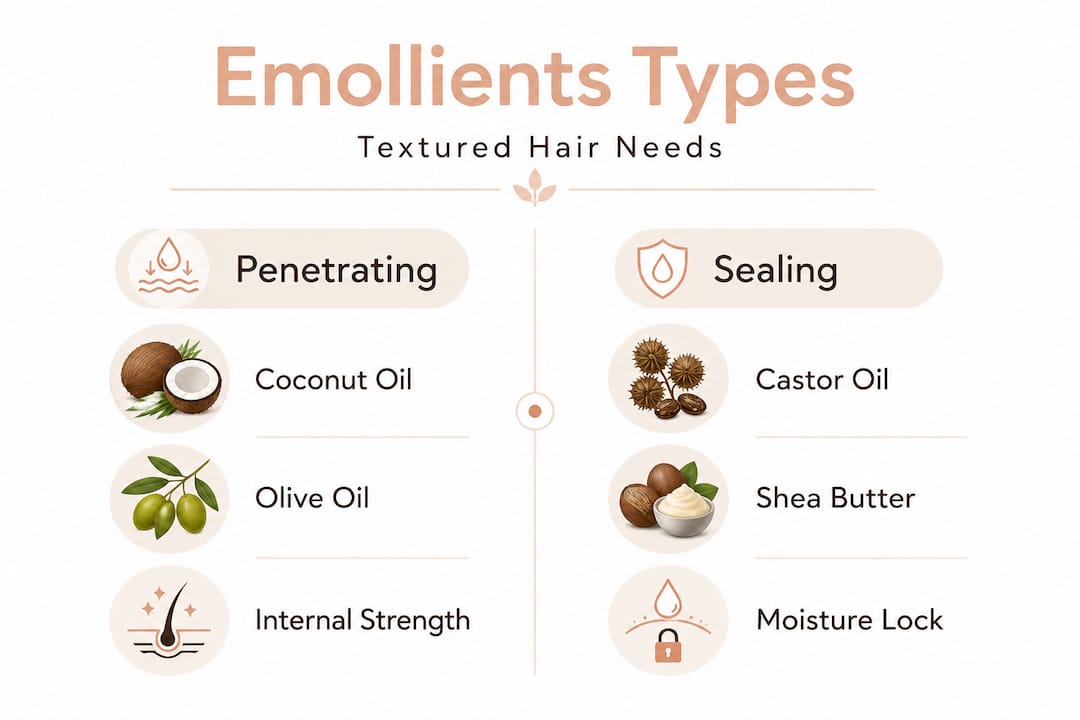
Penetrating emollients are small enough molecularly to pass through the cuticle and get into the cortex. Coconut oil is the most researched example. It actually reduces protein loss from the hair fiber, making it stronger over time. Olive oil and avocado oil also have some penetrating ability. These work best applied before washing or on damp hair.

Sealing emollients are too large to penetrate. Instead they form a film over the surface, trapping moisture inside. Castor oil, shea butter, and most heavy butters fall into this category. They are excellent as a final step in a routine to lock everything in. However, they can also create serious buildup if over-applied, especially on fine or low-porosity hair.
As explained in single-ingredient hair care, penetrating emollients strengthen hair internally while sealing ones lock moisture externally. Over-use causes buildup in fine or low-porosity hair, while under-use leads to dryness and breakage in coily hair types.
| Emollient type | Examples | Best for | Application |
|---|---|---|---|
| Penetrating | Coconut, olive, avocado | All porosity types, pre-poo | Before or during wash |
| Sealing | Castor, shea, mango butter | Low to normal porosity, final step | After leave-in or cream |
| Lightweight | Jojoba, grapeseed, argan | Fine hair, high porosity | Any step, use sparingly |
Signs you are using too much emollient:
- Hair feels greasy or heavy even after washing
- Curls look flat or limp instead of bouncy
- Products stop absorbing well
- You need to clarify more often than once every two weeks
Signs you are using too little:
- Hair feels rough or crunchy even after conditioning
- Detangling takes forever and causes visible breakage
- Hair dries out within hours of styling
- Split ends appear more frequently
Pro Tip: Your hair’s porosity is the single most useful guide for emollient choice. High-porosity hair (often chemically treated or heat-damaged) absorbs products fast but loses moisture just as fast, so it benefits from heavier sealing emollients. Low-porosity hair repels products initially, so lighter emollients applied with gentle heat work best. Explore oils for curly hair to find the right match for your porosity level.
If you have multi-textured hair, meaning different curl patterns in different sections, you may need to use different emollients on different parts of your head. That is completely normal and worth experimenting with.
Building your moisture routine: LOC, LCO, and product choices
With all the theory in place, here is how to actually structure your routine. The most effective frameworks for textured hair are the LOC and LCO methods. Both use layers of products to build moisture and then lock it in. Emollients are the critical middle and final layers.
As outlined in advanced coily hair management, emollients work alongside humectants and occlusives in LOC or LCO routines. The letters break down like this:
L = Leave-in conditioner (provides humectants and some light emollients, forms the moisture base) O = Oil (penetrating or sealing emollient, depending on your hair type) C = Cream (rich emollient or butter-based product that seals everything in)
In the LCO version, the cream comes before the oil. This works better for high-porosity or coarser hair that needs heavier cream-based moisture before sealing.
Here is a step-by-step routine you can follow on wash day:
- Shampoo or co-wash on soaking wet hair. This opens the cuticle slightly and cleans away buildup so emollients can actually do their job.
- Deep condition with an emollient-rich conditioner containing fatty alcohols. Leave it on for 15 to 30 minutes. Apply a little heat with a shower cap for extra penetration.
- Apply leave-in conditioner to damp (not dripping) hair. This is your humectant layer. Spread evenly through sections.
- Apply a penetrating oil like coconut or olive oil while the leave-in is still wet. It helps drive the moisture deeper into the shaft.
- Seal with a cream or butter on top. For fine hair, keep this layer light. For coarser or very dry hair, be more generous.
- Style as usual with a gel or defining product if you use one.
For daily or between-wash refresh days, you can simplify to just a spritz of water followed by a small amount of a lightweight sealing oil on dry or slightly damp hair.
Pro Tip: Adapt your routine to the season. In cold Scandinavian winters or dry indoor heating environments, you will likely need heavier sealing emollients. In warm or humid summer months, lighter options prevent that weighed-down feeling. Your curls will tell you what they need; the key is listening and adjusting rather than following the same routine year-round. Get more curly hair care tips to build a flexible routine. When you are ready to test some products, curl creams for textured hair are a great place to start.
What most people miss about emollients and natural hair routines
Here is an honest take after seeing what actually drives results for textured hair: most people focus on which emollient to use, when the bigger question is how they are using it and in what context.
The internet is full of ingredient breakdown videos and “top 10 oils for 4c hair” lists. That information is useful, but it can create a fixation on the perfect product rather than on the conditions around the product. The truth is, the same castor oil that transforms someone’s wash-and-go in Lagos will behave completely differently on hair washed in hard water in Gothenburg, air-dried in cold temperatures, and sealed in a dry indoor environment.
This matters for you specifically because the European context is genuinely different from most of the content you will find online. A large portion of curly hair content is created in North America or tropical regions. Why moisture is not optional for textured hair in Europe has everything to do with your local water quality and climate, not just your curl pattern.
The most transformative thing you can do is treat your routine as an ongoing experiment rather than a fixed formula. Keep one or two consistent emollients as your base, then tweak based on how your hair responds across seasons, after color or heat treatments, and as your hair grows. Consistency beats novelty every time. Chasing every new product that goes viral is one of the biggest reasons routines fail.
One more thing most guides will not say outright: you do not need expensive products to get great results with emollients. A simple jojoba or olive oil used correctly and consistently will outperform a luxury serum used carelessly. The framework matters more than the price tag.
Find the best emollient-rich products for your textured hair
If you are ready to build a routine that actually holds moisture, the right product selection makes the process so much easier.
At Cocomera, we have curated a selection of oils, masks, and treatments specifically chosen for wavy, curly, coily, and afro hair types living in Europe. No guesswork, no sifting through products that were never designed for your hair. Whether you are starting with penetrating oils or looking for a rich sealing cream, you can browse hair oils for curly hair to find the right emollient match for your porosity and curl type. Need an intensive moisture reset? Explore hair masks for hydration for deep conditioning options that combine humectants and emollients in one step. For targeted concerns like breakage or heat damage, targeted hair treatments have options built specifically to repair and protect textured hair.
Frequently asked questions
Which emollients are best for low-porosity hair?
Low-porosity hair benefits most from lighter emollients like jojoba or grapeseed oil, since heavier butters sit on the surface and cause buildup rather than absorbing effectively.
How do emollients help with detangling curly or afro hair?
Emollients add lubrication to the hair shaft and reduce friction by up to 50%, which makes combing, finger detangling, and section work significantly easier and less damaging.
What is the LOC method and how do emollients fit in?
The LOC method stands for Leave-in, Oil, and Cream. Emollients are applied as both the oil and cream steps to lock in moisture after the water-based leave-in has been absorbed.
Can I use too much emollient if my hair is fine?
Yes, heavy emollients on fine or low-porosity hair cause product buildup that weighs curls down, reduces volume, and makes the hair feel greasy even right after washing.
Recommended
- Why hair needs moisture: essential guide for textured curls – Cocomera
- Best ingredients for textured hair: curly, coily & afro – Cocomera
- Curly hair care tips for healthy textured hair - Cocomera
- Best oils for curly hair: science, porosity & results – Cocomera
- Moisturizers: the essential role in your skincare routine – Bare Label™ Beauty


