


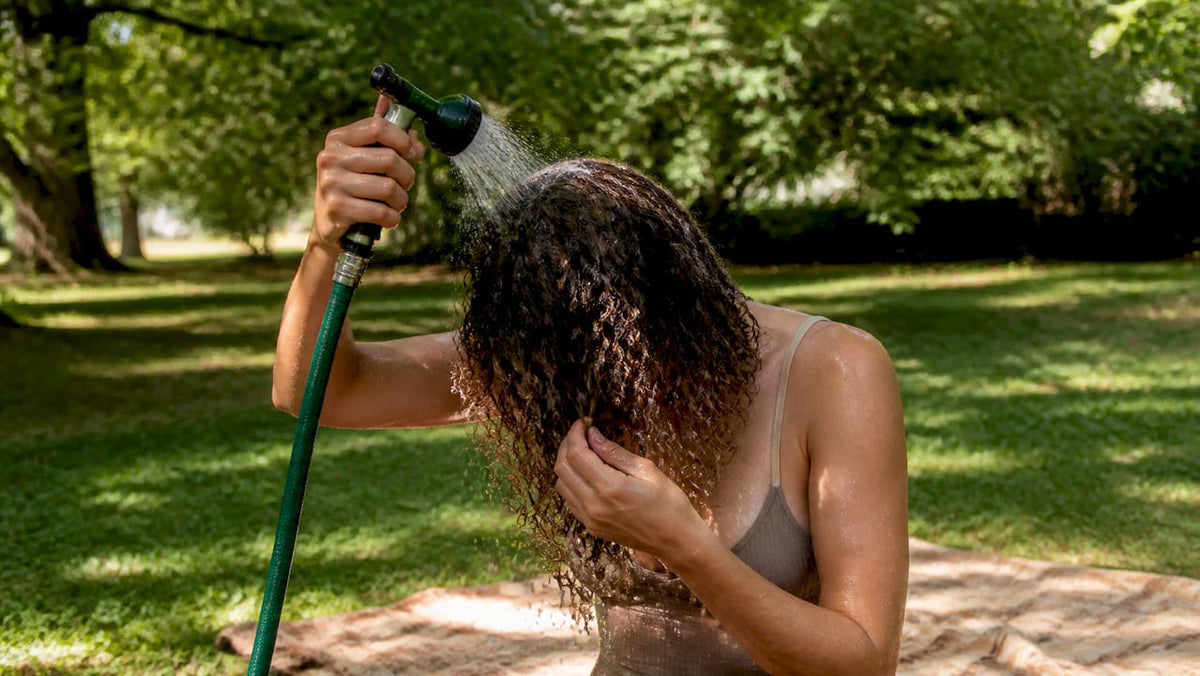
Rinse your hair with fresh water the moment you leave the pool, then follow up with a chelating or clarifying cleanse if you can feel residue building up on your strands. That combination is the fastest way to reverse klorskadat lockigt hår before it turns into breakage or dryness. The American Academy of Dermatology and Healthline both back a moisture-first approach for curls, and Cocomera builds its swim-recovery routines around the same logic: remove the residue, then rebuild the moisture chlorine stripped away.
Do this in the first few minutes:
- Rinse thoroughly under a shower or hose, working water through every section of your curls.
- Detangle gently with your fingers or a wide-tooth comb before the hair dries and residue locks in.
- Apply a leave-in conditioner while hair is still soaking wet to trap moisture before it evaporates.
Pro Tip: Carry a small spray bottle of water and leave-in conditioner in your pool bag. Rinsing curls even 10 minutes before you get to a real shower cuts a lot of the damage.
Key Takeaways
Chlorine-damaged curls recover fastest with an immediate fresh water rinse, followed by targeted cleansing, deep moisture, and consistent nighttime protection.
| Point | Details |
|---|---|
| Rinse immediately | Fresh water within minutes of leaving the pool removes most surface chlorine and residue. |
| Match your cleanser to buildup | Use a chelating shampoo only for visible stiffness or discoloration; otherwise stick to gentle, sulfate-free cleansers. |
| Moisture before protein | Chlorine strips oils and raises porosity, so most swimmers need hydration, not protein, to recover. |
| Style on soaking-wet hair | Layering leave-in, cream, and gel on wet curls locks in more definition than styling dry hair. |
| Protect curls overnight | Silk or satin bonnets and pillowcases reduce the friction and moisture loss that slow recovery. |
| Shop swim-ready essentials | Cocomera’s leave-ins and stylers, including the Innersense Whipped Creme Texturizer and The Doux Mousse Def Texture Foam, support curls through the full repair cycle. |
Table of Contents
- What To Do in the First 5 to 15 Minutes After Swimming
- Should You Use a Clarifying Shampoo or a Gentle Cleanse?
- Deep Hydration Treatments That Repair Swim-Damaged Curls
- Styling and Drying Without Undoing the Repair
- Preventing Chlorine Damage Before Your Next Swim
- Ingredients That Help vs. Ingredients That Hurt
- Warning Signs You Need Professional Help
- Nighttime Habits That Speed Up Recovery
- How Chlorine Actually Damages Curl Structure
- Natural Remedies Worth Trying Between Salon Visits
- Weighing Commercial Products for Curl Repair
- How Often Should You Wash and Condition After Swimming?
- Why Pool Water Chemistry Makes Some Damage Worse Than Others
- Cocomera Picks for Repairing Swim-Damaged Curls
- Sources
What To Do in the First 5 to 15 Minutes After Swimming
Chlorine and pool minerals raise the pH of your hair, lift the cuticle, and leave behind a stiff film that makes curls feel like straw. Rinsing fast matters because that film hardens as hair dries, and once it sets, it takes more product and more scrubbing to remove.
- Wet your hair fully with clean, fresh water, focusing on roots and ends equally.
- Work in a small amount of conditioner or leave-in to act as a barrier while you finish rinsing.
- Squeeze out excess water with your hands, then blot with a microfiber towel or old cotton t-shirt.
- Avoid rubbing curls dry with a regular towel. Friction roughs up the cuticle further.
If you swam without a cap or pre-wet hair, this step matters even more, since dry curls absorb pool water and chemicals faster than wet ones.
Pro Tip: If a shower isn’t available poolside, a full dunk in a lake or the ocean on the way home is better than nothing. Any fresh or clean water rinse beats letting chlorine sit and dry on your strands.
Should You Use a Clarifying Shampoo or a Gentle Cleanse?
Chelating and clarifying shampoos strip mineral deposits and chlorine buildup that a regular cleanser can’t touch. Gentle, sulfate-free cleansers are better for regular washing because curly hair is naturally drier and more prone to breakage, and stripping it too often backfires, according to Healthline.
Use the following as your decision rule:
- Reach for a chelating shampoo if your hair feels stiff, looks dull or slightly discolored, or you’ve swum more than once in the past week.
- Stick with a gentle, moisturizing cleanser if you swim occasionally and your curls still feel soft and pliable.
- Co-wash between full washes to maintain moisture without stripping curls daily, a method Healthline recommends for swimmers specifically.
Dermatologists recommend washing curly hair at minimum every 2 to 3 weeks unless heavy exposure or scalp buildup demands more frequent cleansing. When you do use a chelating treatment, dilute it, focus application on roots and lengths where buildup collects, and follow immediately with a deep conditioner. Limit chelating washes to once every one to two weeks, even during peak swim season, so you’re removing residue without stripping the moisture your curls need to recover.
Deep Hydration Treatments That Repair Swim-Damaged Curls
Whether you need protein or moisture first comes down to how your hair feels. Curls that feel gummy, stretchy, or limp when wet usually need protein. Curls that feel dry, rough, or brittle need moisture. Chlorine exposure almost always tilts toward the moisture side, since chlorine’s main effect is stripping natural oils and raising cuticle porosity.
Follow this sequence for the best results:
- Clarify first if there’s visible buildup or stiffness (skip this step if hair isn’t heavily affected).
- Apply a deep mask and let it sit for 20 to 30 minutes, ideally under a shower cap for gentle heat.
- Follow with a leave-in conditioner while hair is still damp.
- Seal with a lightweight oil or butter to lock moisture in before styling.
Look for humectants like glycerin and aloe vera, fatty emollients like shea butter and argan oil, and hydrolyzed proteins used sparingly. Skip harsh sulfates and drying alcohols, which compound the damage chlorine already started. Bond-building treatments can help hair that’s seen repeated chlorine and heat exposure, but pair them with a hydrating mask, and consider following safe procedures outlined in Keratin Bond Removal: Safe Steps for Healthy Hair, since bond builders work best alongside moisture, not instead of it.
Pro Tip: If your curls squeak when wet after rinsing, that’s a sign of excess protein or leftover buildup, not clean hair. Real clean curls feel soft, not stiff.
Styling and Drying Without Undoing the Repair
Apply your styling products to hair that’s still soaking wet, not just damp. Allure points to this timing as one of the biggest factors in curl definition, often outperforming a full product swap. Layer a liquid leave-in, then a cream, then a light gel or mousse depending on how much hold you want.
- Plop hair in a microfiber towel or cotton t-shirt for 10 to 20 minutes to encourage clumping without friction.
- Diffuse on low heat if you’re blow-drying, holding curls upward instead of letting them hang.
- Detangle with your fingers or a wide-tooth comb, always starting from the ends and working up.
- Skip regular brushes on wet curls. They break up curl clumps and create frizz.
Reviewing how to layer products correctly helps you figure out how much of each step your specific curl pattern actually needs.
Pro Tip: Use a golf-ball-sized amount of cream and a coin-sized amount of gel for shoulder-length curls. Too much product weighs curls down and can trap moisture instead of sealing it in.
Preventing Chlorine Damage Before Your Next Swim
Wet hair absorbs less pool water than dry hair, so soak your curls with clean water before you get in the pool. Follow that with a leave-in conditioner or a light oil to create a barrier between your strands and the chlorine.
- Wear a swim cap designed for textured hair, and tuck curls in loosely to avoid crushing your curl pattern.
- Apply a leave-in or oil as a barrier every single time, not just on heavy swim days.
- Keep a pool bag stocked with a leave-in, a microfiber towel, and a travel-size clarifying shampoo if you swim more than once a week.
A protective barrier before you swim makes the post-swim rinse and cleanse routine far more effective, since there’s simply less chlorine left to remove.
Ingredients That Help vs. Ingredients That Hurt
Reading labels fast matters when you’re standing in an aisle trying to decide what will actually help your curls recover.
Seek these:
- Glycerin and aloe vera for humectant moisture
- Shea butter and argan oil for sealing and softness
- Cetyl and stearyl alcohol (fatty alcohols, not drying ones)
- Hydrolyzed proteins, used once every few weeks at most
Avoid these:
- Sulfates like sodium lauryl sulfate, which strip oils curls can’t spare
- Short-chain alcohols like isopropyl or SD alcohol, which dry hair further
- Heavy mineral oils that sit on the cuticle without absorbing
There’s no single formula that works for every curl pattern. The AAD advises tracking how your hair responds to moisture-heavy ingredients and adjusting deep conditioning frequency based on that feedback rather than following a fixed routine.
Warning Signs You Need Professional Help
Most chlorine damaged curly hair recovers with consistent home care over two to four weeks. But some signs call for more than a deep conditioner.
- Persistent stiffness that doesn’t soften after multiple treatments
- Breakage that leaves visible short pieces or thinning at the ends
- Greenish tint or unusual discoloration that won’t wash out
- Scalp redness, itching, or flaking that lingers
A stylist can offer a trim to remove damaged ends or an in-salon bond-building treatment for structural repair. Scalp irritation or an allergic-looking reaction is worth a dermatologist visit rather than more home remedies.
Nighttime Habits That Speed Up Recovery
What happens while you sleep matters almost as much as what you do in the shower. A silk or satin bonnet or pillowcase reduces the friction that causes breakage and slows the moisture loss that makes chlorine damage worse overnight, according to Byrdie.
- Apply a light oil or cream to ends before bed to reseal moisture lost during the day.
- Loosely pineapple your curls or braid them to prevent flattening and tangling overnight.
- Swap cotton pillowcases for silk or satin, since cotton pulls moisture out of hair fibers.
- Stick to a weekly deep conditioning schedule and limit heat styling while curls are recovering.
Learning how to protect curls at night turns a one-time repair treatment into a routine that actually holds.
Pro Tip: If your bonnet keeps slipping off, try a lightweight satin scrunchie to loosely secure curls first, then pull the bonnet over the top. It stays put through a full night’s sleep.
How Chlorine Actually Damages Curl Structure
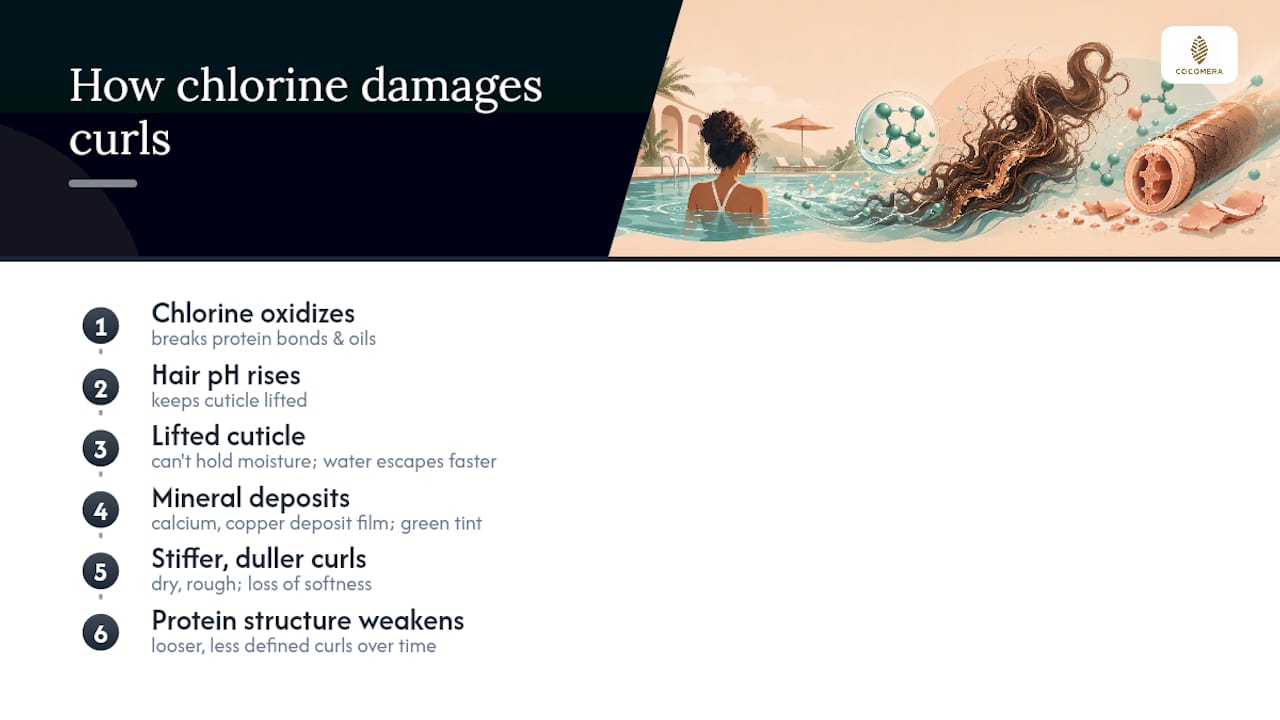
Chlorine works as an oxidizer. It breaks down the protein bonds and natural oils that hold your cuticle layer flat and your curl pattern intact. Curly hair already has a raised cuticle structure compared to straight hair, since the curl shape means the cuticle can’t lie as smoothly along the shaft. That makes curls naturally more porous, and more porous hair absorbs chlorine and pool minerals faster than straight, low-porosity strands do.
Repeated exposure raises hair’s pH, which keeps the cuticle lifted even after you’ve left the pool. A lifted cuticle can’t hold moisture the way a flat one does, so water escapes faster than it did before, and curls that were once soft turn dry and rough within a swim season. Pool minerals like calcium and copper compound the problem by depositing a film on the hair shaft, which is what causes the greenish tint some swimmers notice on lighter hair colors.
This combination of raised pH, cuticle damage, and mineral buildup explains why chlorine-exposed curls feel stiffer and look duller than curls exposed to fresh water alone. The curl pattern itself doesn’t change permanently from a few swims, but repeated exposure without a recovery routine gradually weakens the protein structure that gives curls their spring, leading to looser, less defined curls over time. That’s the real risk for regular swimmers who skip cleansing and moisture steps.
Natural Remedies Worth Trying Between Salon Visits
Not every repair step requires a product from a bottle. Apple cider vinegar diluted with water works as a mild, natural clarifier that helps close the cuticle and balance pH after heavy chlorine exposure, without the harshness of a sulfate shampoo. Mix roughly one part vinegar to four parts water, pour it through rinsed hair, and follow immediately with conditioner.
Coconut oil or olive oil applied before swimming can act as a light barrier, since oil is somewhat water-repellent and slows how much pool water your hair absorbs. Applied after swimming as a pre-shampoo treatment, the same oils can help loosen mineral buildup before you cleanse. Aloe vera gel, either fresh or store-bought, brings humectant moisture back into dry strands and works well layered under a leave-in.
A honey and conditioner mask, using roughly a tablespoon of honey mixed into a conditioner, taps into honey’s natural humectant properties for an at-home deep treatment when you don’t have a commercial mask on hand. Avocado mashed into a mask does something similar, adding fatty acids that mimic the emollients found in shea or argan oil.
These remedies work best as a bridge between real treatments, not a replacement for a consistent routine. They’re useful when you’ve swum unexpectedly and don’t have your usual products, or when you want to stretch time between deep conditioning sessions without your curls drying out.
Weighing Commercial Products for Curl Repair
Not all curl products handle chlorine damage the same way, and picking the wrong one can leave curls feeling coated instead of repaired. Clarifying shampoos remove buildup fast but can leave curls feeling stripped if used too often, so they work best as an occasional reset rather than a weekly step. Moisturizing, sulfate-free cleansers are gentler day-to-day but won’t touch heavy mineral residue on their own, which means swimmers need both types in rotation rather than picking just one.
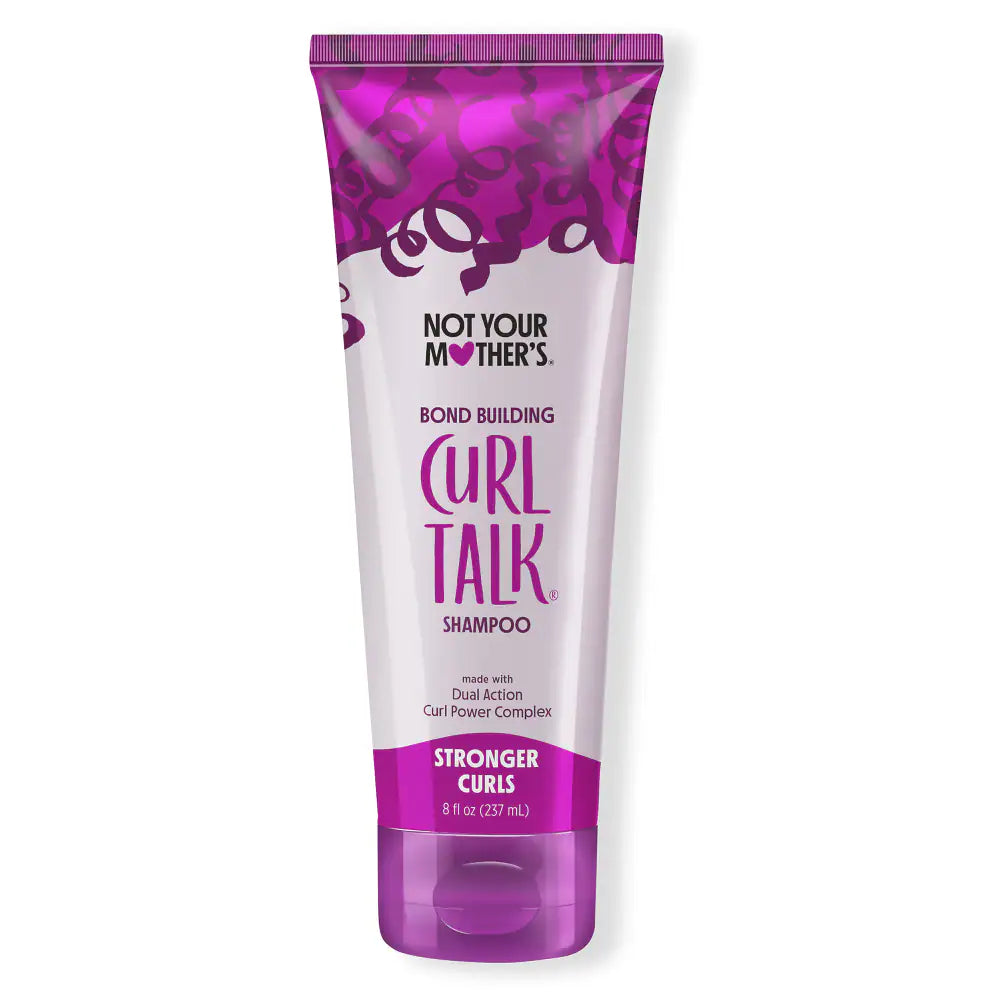
Bond-building treatments, the kind built around technology similar to Olaplex, can genuinely help hair with structural damage from repeated chlorine and heat exposure. The tradeoff is that they work best layered into a moisture-first routine, since InStyle notes bond builders address structure, not hydration, and skipping the moisture step afterward can leave curls feeling stiff again.
Leave-in conditioners with strong slip make detangling after a swim far easier and double as a protective barrier before you get in the pool next time. Heavier butters and creams give more definition and hold but can weigh down finer or looser curl patterns if applied too generously. Lightweight mousses and foams give hold without the heaviness, which matters most for readers with looser curl types who found that creams alone left hair limp by the end of the day.
The right combination usually means a clarifying option for occasional resets, a daily moisturizing cleanser, a weekly mask, and a leave-in you use every time your hair gets wet, whether from a shower or a pool.
How Often Should You Wash and Condition After Swimming?
Frequency depends on how often you swim, not on a fixed weekly schedule. Swimmers hitting the pool daily or several times a week should rinse with fresh water every single time and follow with a full cleanse and deep condition once or twice weekly, saving the chelating step specifically for visible buildup.
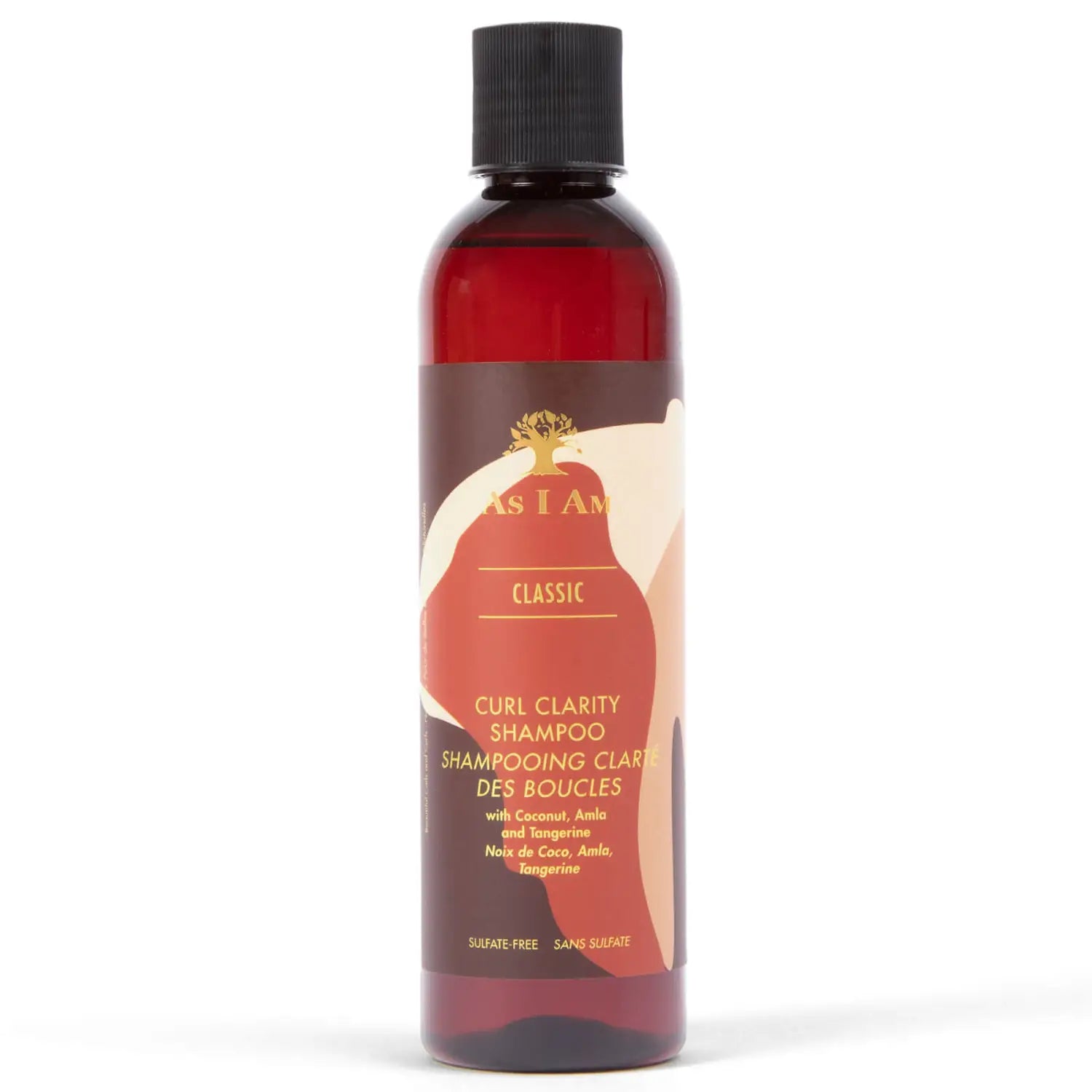
Occasional swimmers, maybe once a week or less, can often get away with a fresh water rinse and a leave-in refresh after each swim, saving a full wash day for their regular schedule. Dermatologists’ guidance to wash curly hair at minimum every 2 to 3 weeks still applies here. Swimming doesn’t mean washing more often with shampoo. It means rinsing more often with plain water.
Co-washing fits neatly into a swim schedule, since it lets you refresh moisture on the days between full washes without the drying effect of daily shampooing, a practice Healthline recommends specifically for people balancing frequent water exposure with curl health. A realistic weekly rhythm for a regular swimmer looks something like: rinse after every swim, co-wash twice, full cleanse and mask once, and reserve the clarifying shampoo for once every week or two depending on how visible the buildup gets.
Why Pool Water Chemistry Makes Some Damage Worse Than Others
Not all pools damage hair equally, and the difference often comes down to maintenance rather than the chlorine itself. Pools with poorly balanced pH run more acidic or more alkaline than the ideal range, and both extremes make chlorine more aggressive toward hair’s cuticle. Overchlorinated pools, often the result of inconsistent maintenance rather than intentional overuse, deposit more residue and push hair’s pH further from its natural balance.
Hard water pools, or those with high mineral content feeding into the system, add copper and calcium into the mix, which is what causes the greenish cast some swimmers notice, especially on lighter or previously colored hair. There’s not much a swimmer can do to control a public pool’s maintenance schedule, but rinsing before and after swimming reduces how much of that unbalanced water actually reaches the hair shaft and sits there.
Home pool owners have more control and can request regular water testing to keep pH in a range that’s gentler on skin and hair. For everyone else, the practical takeaway is the same regardless of pool quality: pre-wetting hair, using a protective barrier, and rinsing immediately afterward matters more when pool maintenance is inconsistent, which is most of the time for public and shared pools.
Why This Routine Works for Curly Hair
Curls have a naturally raised cuticle, which makes them more porous and more prone to losing moisture than straight hair. Every step in this routine, from the rinse to the nighttime bonnet, exists to close that gap. Cocomera builds its recommendations around textured hair specifically, because generic haircare rarely accounts for how curls actually behave.
Cocomera Picks for Repairing Swim-Damaged Curls
Once you’ve rinsed and cleansed, the right leave-in and styler decide whether your curls bounce back or stay limp. The Innersense Inner Peace Whipped Creme Texturizer works well as that leave-in layer, whipped light enough to add definition without weighing down recovering curls, and gentle enough for daily use while hair rebuilds moisture.
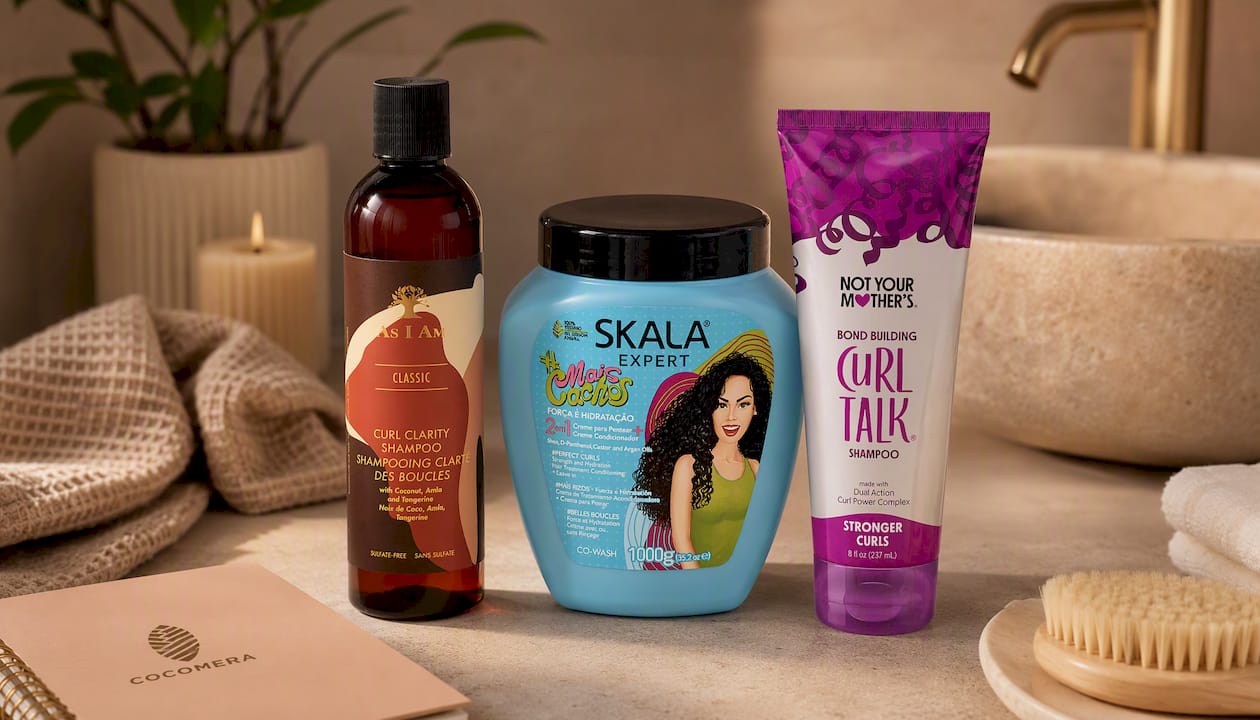
For readers with looser curl patterns who found heavier creams left hair flat, The Doux Mousse Def Texture Foam gives hold and definition without the heaviness, making it a solid pick for the styling step right after a deep treatment. Pair either one with a hydrating hair mask for the weekly deep conditioning stage, and keep a hair oil on hand for sealing moisture in before bed or before your next swim. Browse the full styling collection to build out a routine suited to your specific curl pattern, and start restocking your pool bag before your next swim.
Sources
- 6 curly hair care tips from dermatologists
- How to take care of curly hair: Washing, brushing, and styling
- Best curly hair products
- Best curl creams


