


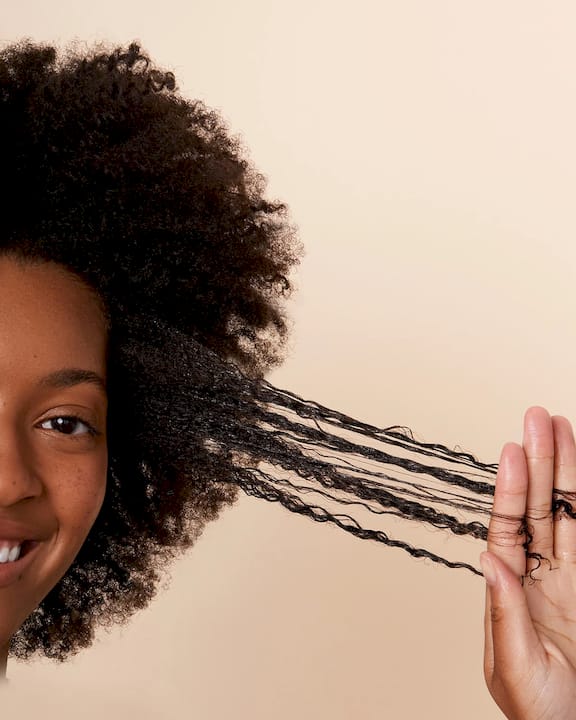
Maintaining moisture balance for curly and textured hair comes down to one principle: add water first, then seal it in before it escapes. Apply a humectant-based product to damp hair, follow with a cream or emollient, and finish with a light oil or occlusive to lock everything in place. That sequence, repeated consistently, is what separates hair that stays soft from hair that feels dry again by noon.
Here’s what to do right now:
-
Wet or dampen your hair before applying any leave-in or moisturizing product
-
Apply a humectant-based leave-in (look for glycerin, hyaluronic acid, or aloe vera) while hair is still damp
-
Layer a cream or emollient over the leave-in to add slip and softness
-
Seal with a light oil (jojoba, argan, or sealant butter) to slow water evaporation
-
Refresh daily with a water mist and a small amount of leave-in; do a full wash-day routine every 1–2 weeks depending on your curl type
One red flag to watch: if your hair feels limp, stretchy, or almost gummy after moisturizing, that’s a sign of protein overload or excessive moisture without enough structural support. Stop adding heavy creams and introduce a light protein treatment before continuing.
Table of Contents
-
Hydration vs. moisturization: what’s the difference and why does it matter?
-
Protein vs. moisture: how do you know what your hair actually needs?
-
What does a practical daily, weekly, and monthly routine look like?
-
Which ingredients actually help, and which ones work against you?
-
Why repairing the lipid barrier is the foundation of everything
-
Why moisture balance sits at the center of everything Cocomera does
Why does moisture balance fail for curly and textured hair?
Curly and coily hair is structurally more prone to dryness than straight hair. The twists and bends in each strand make it harder for the scalp’s natural oils to travel down the hair shaft, so the ends and mid-lengths are almost always the driest parts. That’s the baseline. What makes it worse is a combination of environmental, routine, and behavioral factors that most people don’t connect to their hair problems until the damage is already visible.
Environmental drivers hit hard in winter and in climate-controlled spaces. Central heating drops indoor humidity significantly, and air conditioning does the same in summer. Hot showers strip the lipid barrier from both the scalp and hair shaft. The AAD recommends limiting shower temperature to lukewarm and keeping wash time short to reduce natural lipid depletion.
Routine errors are often the bigger culprit. Harsh sulfate shampoos strip moisture faster than it can be replaced. Applying oils or sealants to completely dry hair doesn’t seal anything in — there’s no water present to retain. Incorrect product order (sealer before humectant, or skipping leave-in entirely) means the routine looks complete but doesn’t actually work. High-porosity hair, which is common after chemical processing or repeated heat use, loses moisture faster than low-porosity hair because the cuticle layer is raised and gaps are larger.
Behavioral patterns compound the problem quietly. Washing too often without conditioning thoroughly, skipping leave-ins because they feel heavy, or relying only on styling products that contain drying alcohols all chip away at hydration over time.
Pro Tip: If you can only change one habit, switch from hot to lukewarm water for washing. It’s the single lowest-effort change with the most immediate impact on how long your hair holds moisture after wash day.
Hydration vs. moisturization: what’s the difference and why does it matter?
These two terms get used interchangeably, but they describe different things. Getting them confused is the most common reason a routine fails even when someone is using good products.
Hydration means adding water to the hair or skin. Humectants are the ingredients that do this — they attract water molecules from the air or from deeper layers and pull them into the hair shaft. Common humectants include glycerin, hyaluronic acid (HA), aloe vera, and urea. They work best when applied to damp hair or skin because they need water present to function.
Moisturization means preventing that water from leaving. Emollients and occlusives handle this. Emollients (ceramides, fatty acids, plant oils) smooth the cuticle and fill gaps in the hair shaft. Occlusives (petrolatum, squalane, shea butter, heavier oils) sit on top and physically slow evaporation. According to StatPearls, moisturizers work by combining these categories to increase water content and reduce transepidermal water loss (TEWL).
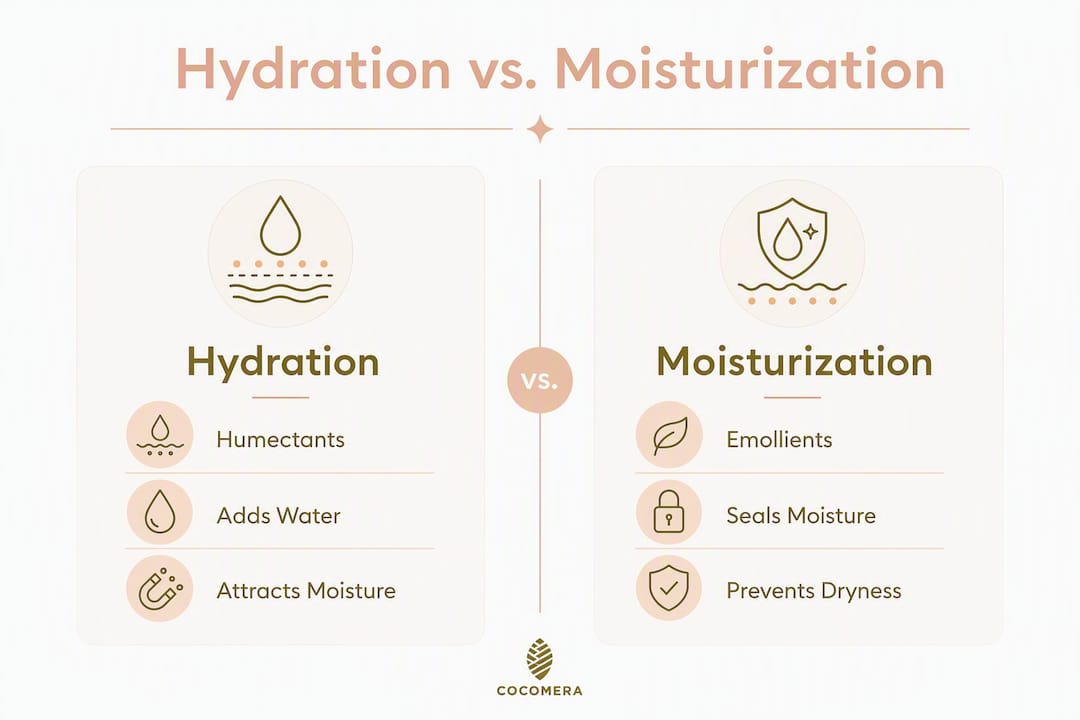
The correct application order runs thinnest to thickest:
| Step | Category | Examples | Function |
|---|---|---|---|
| 1 | Humectant | Glycerin, HA, aloe vera | Draws water into the hair shaft |
| 2 | Emollient | Ceramides, fatty acids, plant oils | Smooths cuticle, adds softness |
| 3 | Occlusive | Shea butter, squalane, petrolatum | Seals moisture in, slows TEWL |
The damp-hair rule is non-negotiable. Applying humectants to dry hair can actually pull water out of deeper layers, making dehydration worse. Research confirms that humectants increase water content but can raise TEWL without a sealing layer on top. Apply to damp hair, then seal immediately.
Climate caveat on glycerin: In very dry climates or during winter months with low indoor humidity, glycerin can pull moisture out of your hair instead of from the air. If you live somewhere with consistently low humidity, look for formulas where glycerin is lower on the ingredient list, or layer a stronger occlusive on top to compensate. In humid climates, glycerin performs excellently.
Drinking enough water and eating healthy fats supports overall hydration systemically, but topical steps are what actually repair the hair shaft and scalp barrier in the short term. Both matter, but you can’t drink your way to moisturized ends.
Protein vs. moisture: how do you know what your hair actually needs?
This is where most people get stuck. Too much moisture without protein leaves hair soft but weak. Too much protein without moisture leaves it stiff and prone to snapping. The goal is balance, and the way to find it is through a simple at-home test.
How to do the strand stretch test
-
Take a single wet strand of hair from your comb or brush after washing
-
Hold it between two fingers and gently stretch it
-
If it stretches a little and then springs back, your moisture-protein balance is good
-
If it stretches a lot and doesn’t spring back (feels like taffy), your hair needs more protein
-
If it snaps immediately with little stretch, your hair needs more moisture or is over-proteinated
Signs your hair needs protein
-
Feels limp, mushy, or overly soft when wet
-
Loses curl definition even with styling products
-
Breaks easily despite feeling soft
-
Takes a long time to dry
Signs your hair needs moisture
-
Feels rough, brittle, or straw-like
-
Snaps when you try to detangle
-
Looks dull and lacks shine
-
Frizzes heavily even in low humidity
How to rebalance
-
Moisture deficit: Add a deep conditioning treatment on your next wash day. Use a product rich in emollients and humectants. Repeat weekly for 2–4 weeks.
-
Protein deficit: Use a light protein treatment (hydrolyzed wheat protein, rice protein, or keratin) once every 2–4 weeks. Follow immediately with a moisturizing conditioner to prevent stiffness.
-
After a protein treatment: Always follow with moisture. Protein treatments temporarily tighten the cuticle, and moisture softens it back to a workable texture.
If you’re unsure, start with moisture. Over-moisturized hair is easier to correct than over-proteinated hair, which can take several wash days to recover from.
What does a practical daily, weekly, and monthly routine look like?
Consistency matters more than any single product. The routines below are templates — adjust the frequency based on your curl type (type 2 wavy hair needs less product than type 4 coily hair) and your hair’s porosity.
Daily micro-routine
-
Mist hair lightly with water or a diluted leave-in spray
-
Apply a small amount of leave-in conditioner or curl cream to any dry sections
-
Seal with a drop of oil on the ends
-
Style or refresh curls as needed; protective styles reduce how often you need to refresh
Skip the daily refresh if your hair still feels soft and defined. Over-wetting can cause hygral fatigue in some hair types, particularly low-porosity hair.
Wash-day routine (every 1–2 weeks)
The LOC and LCO methods are the two most common approaches for textured hair:
-
LOC (Liquid, Oil, Cream): Apply leave-in first, then a light oil to pre-seal, then a cream on top. Works well for high-porosity hair because the oil layer helps slow moisture loss before the cream is applied.
-
LCO (Liquid, Cream, Oil): Apply leave-in, then cream, then seal with oil last. Often preferred for low-porosity hair because the cream absorbs more easily without the oil barrier underneath.
A full wash-day workflow for coily hair typically runs: gentle sulfate-free shampoo or co-wash → rinse-out conditioner with finger detangling → leave-in while hair is dripping wet → cream → oil seal → style.
Apply products in sections to make sure every strand gets covered. A heat cap or steamer during deep conditioning opens the cuticle and improves absorption, especially for low-porosity hair.
Weekly deep conditioning
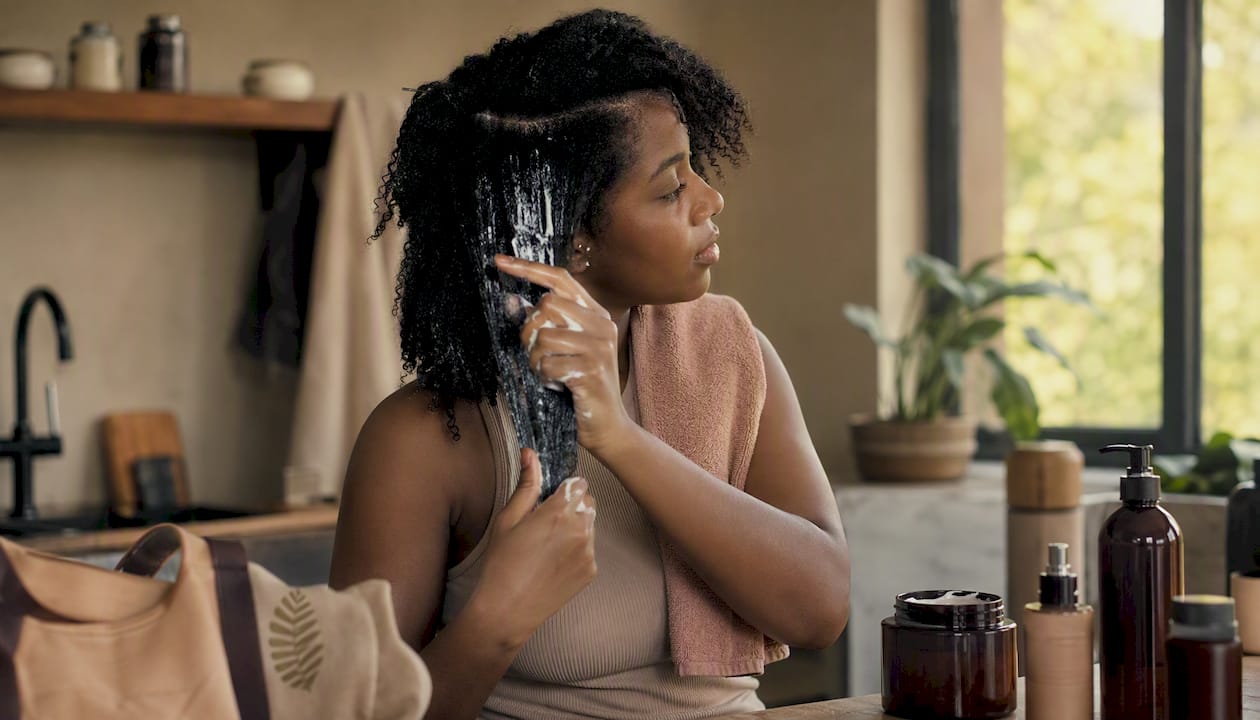
Slot a deep conditioner in on wash day once a week. Use heat (a heat cap or warm towel) for 15–30 minutes. Alternate between a moisturizing deep conditioner and a protein-rich one every other week if your hair needs both.
Monthly maintenance
-
Clarify once a month with a clarifying shampoo to remove product buildup that blocks moisture absorption
-
Consider a stronger protein treatment (like a keratin mask or bond-building treatment) if you use heat or color regularly
-
Trim split ends every 8–12 weeks; split ends wick moisture away from healthy hair
Which ingredients actually help, and which ones work against you?
Reading a product label is a skill. Here’s a quick reference for what to look for and what to avoid, with notes on when context matters.
Ingredients that support moisture balance
| Category | Ingredients | Best for |
|---|---|---|
| Humectants | Glycerin, hyaluronic acid, aloe vera, panthenol, urea | Drawing water into the hair shaft; use on damp hair |
| Emollients | Ceramides, fatty acids, avocado oil, olive oil, argan oil | Smoothing the cuticle, adding softness and slip |
| Occlusives | Shea butter, squalane, castor oil, petrolatum | Sealing moisture in; use as the final layer |
| Barrier-repair lipids | Ceramides, cholesterol, free fatty acids | Repairing damaged cuticle and scalp barrier |
StatPearls confirms that ceramides, cholesterol, and free fatty acids are the primary lipids responsible for barrier repair, making ceramide-rich products particularly useful for chemically processed or heat-damaged hair.
Ingredients to use cautiously or avoid
-
Sulfates (sodium lauryl sulfate, sodium laureth sulfate): Effective cleansers but strip natural oils aggressively. Use a sulfate-free shampoo for regular wash days; reserve sulfates for monthly clarifying only.
-
Drying alcohols (alcohol denat., isopropyl alcohol, propanol): Evaporate quickly and pull moisture out. Avoid in leave-ins and stylers. Fatty alcohols (cetyl alcohol, stearyl alcohol) are fine — they’re emollients, not drying agents.
-
Heavy silicones (dimethicone, amodimethicone without a sulfate-free cleanser): Build up on the hair shaft over time and block moisture absorption. If you use silicone-based products, clarify regularly.
Climate and porosity notes: In low-humidity environments, lightweight occlusives like squalane or jojoba oil work better than heavy butters, which can feel sticky without enough moisture underneath. In summer or humid climates, a lighter cream and minimal oil is usually enough. For a deeper look at how the skincare layering workflow applies to product order, the same thin-to-thick principle holds for both skin and hair.
How to read a label: Look for products that list a humectant in the top five ingredients, an emollient in the middle, and an occlusive toward the end. A product that does all three is a genuine multi-tasker. If glycerin is the first ingredient and there’s no oil or butter anywhere on the label, it’s a hydrator without a seal — useful, but not complete on its own.
How long before you see results, and what should you track?
Realistic timelines prevent frustration. Here’s what to expect:
-
1–2 weeks: Hair feels softer after wash day, frizz reduces slightly, and the stretch test shows more elasticity
-
4–8 weeks: Barrier repair progresses, breakage decreases noticeably, and curl definition improves with less product
-
2–3 months: Routine feels normalized, hair responds predictably to products, and overall health is visibly improved
Track progress with a simple photo log taken on wash day in the same lighting. Check the stretch test weekly. Note how long your hair stays soft between wash days — that window should gradually extend as your routine improves.
Budget expectations:
-
Basic setup (leave-in + sealing oil): $15–$30 per month depending on hair length and density
-
Intermediate setup (leave-in + cream + oil + weekly deep conditioner): $30–$60 per month
-
Full routine (all of the above + protein treatment + clarifying shampoo): $50–$80 per month
These are rough ranges. Many people find that using fewer, better-formulated products costs less than cycling through many mediocre ones.
Fast troubleshooting: what’s going wrong and how to fix it
Even a solid routine hits snags. Here are the most common problems and their corrective steps:
-
Hair feels dry again within a day or two: You’re likely sealing over dry hair or using too little product. Dampen hair before applying leave-in, and increase the amount of cream or occlusive slightly.
-
Hair feels heavy or greasy: Too much occlusive, or applying oil before the hair has absorbed the humectant. Reduce oil quantity and apply it last, not first.
-
Humectants making hair frizzy in dry weather: Glycerin is pulling moisture from your hair instead of the air. Switch to a glycerin-free formula in winter or low-humidity conditions, or layer a stronger occlusive on top immediately.
-
Buildup blocking moisture absorption: Clarify with a clarifying shampoo, then restart the routine. Buildup is often the reason a routine that worked stops working.
-
Protein overload (stiff, brittle, snapping hair): Stop all protein treatments immediately. Do 2–3 moisture-only wash days with a rich deep conditioner before reintroducing any protein.
-
Overuse of humectants without sealing: WebMD notes that applying hyaluronic acid or other humectants to dry surfaces without an occlusive layer can draw water from deeper layers, worsening dehydration. Always seal.
When to see a professional: Persistent breakage that doesn’t improve after 6–8 weeks of a corrected routine, scalp conditions like seborrheic dermatitis or psoriasis, or significant shedding beyond normal levels all warrant a visit to a dermatologist or trichologist. A routine can’t fix a medical condition.
Why repairing the lipid barrier is the foundation of everything
The science behind the hydration-then-seal routine isn’t complicated, but understanding it makes the whole system click.
Your scalp and hair shaft both rely on a lipid barrier, the same structure that protects skin. In skin, this is called the stratum corneum. Think of it as a brick-and-mortar wall: skin cells are the bricks, and lipids (ceramides, cholesterol, free fatty acids) are the mortar holding everything together. When the mortar is damaged, water escapes freely through a process called transepidermal water loss (TEWL). No amount of humectant application fixes chronic dryness if the barrier is broken, because water goes in and comes right back out.
This same principle applies directly to the scalp and, by extension, to the hair shaft. A damaged scalp barrier means the follicle environment is compromised, which affects how well hair retains moisture along its length. Ceramide-rich products address this at the structural level, not just the surface.
Statistic callout: A strong occlusive applied correctly can significantly reduce TEWL in controlled settings. That’s the difference between a sealed barrier and an open one. For textured hair, which already struggles with moisture distribution along the curl pattern, that sealing step isn’t optional.
The lipid barrier concept is also why ceramide-rich conditioners and scalp treatments have become standard recommendations for chemically processed or heat-damaged hair. They’re not just moisturizing — they’re structurally repairing the surface that makes moisture retention possible in the first place.
Key Takeaways
Maintaining moisture balance for curly and textured hair requires hydrating on damp hair with humectants, sealing immediately with emollients and occlusives, and repeating consistently on a schedule matched to your curl type and porosity.
| Point | Details |
|---|---|
| Hydrate then seal | Apply humectants to damp hair first, then layer emollient and occlusive to prevent water loss. |
| Damp hair is non-negotiable | Occlusives applied to dry hair coat without sealing; humectants need water present to work. |
| Test protein vs. moisture | Use the strand stretch test: too stretchy means protein deficit; snaps immediately means moisture deficit. |
| Expect 4–8 weeks for barrier repair | Early softness appears in 1–2 weeks; real structural improvement takes 4–8 weeks of consistent routine. |
| Cocomera for curated products | Cocomera offers leave-ins, creams, sealing oils, and deep treatments selected for wavy, curly, and coily hair types. |
Why moisture balance sits at the center of everything Cocomera does
At Cocomera, the focus on moisture balance for textured hair isn’t incidental. Wavy, curly, coily, and afro hair types share one structural reality: they need deliberate hydration and sealing because the natural distribution of scalp oils along the hair shaft is limited by the curl pattern itself. Every product category in the Cocomera range, from leave-ins to deep conditioners to sealing oils, was selected with that reality in mind.
The guidance in this article reflects the same principle that drives the curation: understand what your hair actually needs (hydration, moisture, protein, or all three), build a simple routine around that, and choose products that do what they claim at the ingredient level. Readers can use the routines and ingredient guidance here as a starting framework, then explore the Cocomera product range to find the specific formulas that match their curl type and porosity.
Products from Cocomera that support your moisture routine
The hydration-then-seal workflow only works when the products in each step are actually formulated for textured hair. Cocomera curates every category with that in mind.
Hydrating leave-ins are the first layer in any LOC or LCO routine. Look for formulas with glycerin, aloe vera, or panthenol near the top of the ingredient list. These are the humectant step that makes everything else work.
Curl creams and styling milks act as the emollient layer, adding softness, definition, and slip. They’re the middle step that bridges hydration and sealing.
Deep conditioners and hair treatments belong on your weekly wash day. Ceramide-rich and protein-balanced options are available for different hair needs — whether you’re recovering from heat damage or just maintaining healthy curls.
For a compact starting point, the Innersense Hydrate Travel Trio covers the core steps in one purchase. It’s a practical way to test the hydration-then-seal workflow before committing to a full product lineup.
Browse the full Cocomera range at cocomera.se to find products matched to your curl type, from type 2 waves to type 4 coils.
Useful sources and further reading
The following sources informed this article and are worth bookmarking if you want to go deeper on the science or the practical side:
-
Moisturizers — StatPearls, NCBI Bookshelf: The clinical reference for how humectants, emollients, and occlusives work together to repair the barrier and reduce TEWL. Authoritative and regularly updated.
-
Dermatologists’ top tips for relieving dry skin — American Academy of Dermatology (AAD): Practical guidance on shower temperature, moisturizer timing, and environmental controls from a primary dermatology authority.
-
Dos and Don’ts of Skin Hydration — WebMD: Covers common application mistakes, including the dry-skin humectant error that worsens dehydration.
-
Hydration vs. Moisturization: Science-Based Skincare Guide — Skinoptimizer: Clear breakdown of product layering order and the occlusive TEWL-reduction data cited in this article.
-
Hydration vs. Moisture: Why Your Skin Needs Both — The Skin Maven: Accessible explainer on the hydration-moisture distinction with practical routine guidance.
-
What is the Skin Lipid Barrier? — Cellure: Deeper dive into barrier science and the role of ceramides, cholesterol, and fatty acids in barrier repair.
-
Hair sealing for textured hair — Cocomera Blog: Practical sealing technique guide specific to curly and coily hair types.
-
Why curls dry out and how to keep them moisturized — Cocomera Blog: Problem-focused treatment approaches and common routine errors for textured hair.
-
Why hair routines matter for curly and afro hair — Cocomera Blog: The case for consistent routines over product-chasing, with guidance for types 2–4.


