


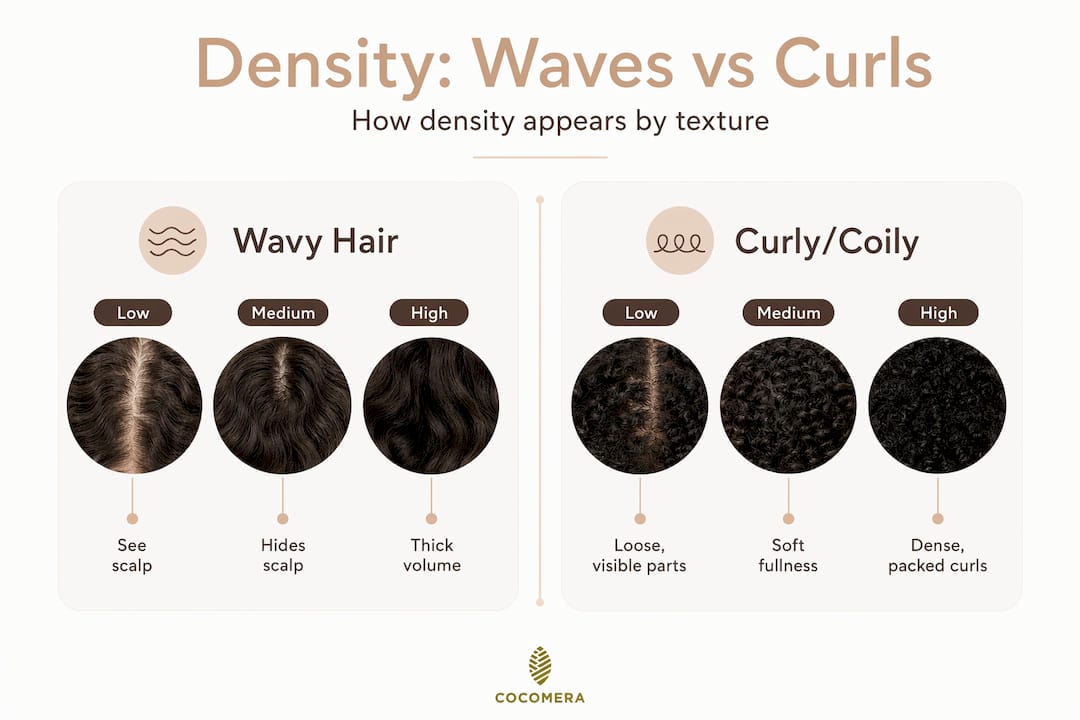
Most people mix up hair density with hair thickness, and that one confusion leads to years of buying the wrong products. If you have wavy, curly, or coily hair, getting this wrong hits differently because textured hair is already more complex to manage. Density determines how many hair strands grow from your scalp per square centimeter, while thickness is about how wide each individual strand is. These are two separate things, and they each influence how your hair looks, feels, and responds to products in very different ways. This guide will walk you through both concepts, help you assess your own density, and show you how to use that knowledge to build a smarter routine.
Table of Contents
Key Takeaways
| Point | Details |
|---|---|
| Density vs thickness | Hair density counts how many hairs you have, not how thick each strand is. |
| Measurement methods matter | Home tests are useful but professional imaging like trichoscopy gives the clearest results. |
| Curl pattern impacts look | Curly and coily hair can appear less dense due to shrinkage and strand stacking. |
| Product selection insight | Knowing your density helps you pick the right stylers and treatments for your hair’s needs. |
| Consult a pro if worried | Sudden shedding or thinning should be checked by a hair specialist for accurate diagnosis. |
What is hair density: the definition that matters
Hair density is the number of hair strands per square centimeter on your scalp, not how thick or fine they feel. According to Centre Clauderer, it explains how full hair appears. Two people can look equally voluminous for different reasons.
Here’s why this matters specifically for textured hair:
-
Your product weight depends on density. More strands per square centimeter mean products need to cover more area and contact more points.
-
Styling results change with density. High density wavy hair can feel heavy and clump unevenly. Low density coily hair can look flat even with good curl definition.
-
Volume is not the same as density. You can have multi-textured hair at the root and mid-shaft that looks full but is actually low density.
As Wimpole Clinic says, density and thickness are not the same. You can have lots of thin hair or fewer thick hair strands. Knowing this helps you understand why a product may not work, without blaming the wrong thing.
Average scalp density for adults is between 80 and 120 hairs per square centimeter. But this can change a lot based on genetics, age, and hair type. The fullness you see in the mirror depends on both how many hairs there are and how thick each strand is.
How density is measured: at home and by professionals
With the definition clear, many readers ask: how do you actually figure out your density, and how accurate are at-home versus professional techniques?
There are two broad categories of measurement: clinical and at-home. Clinical tools are significantly more precise. Clinically, hair density is assessed with trichoscopy and phototrichogram imaging and dermoscopy methods, which are quantitative and far more reliable than visual or home tests. These involve magnified scalp imaging that counts hairs per unit area with no guesswork.
At home, you have a few practical methods:
-
The scalp test. Pull a small section of hair at the crown to the side. Look at how much scalp you see. If you see a lot, you have low hair density. If you see some, it is medium. If you see very little, it is high.
-
The ponytail test. Gather all your hair into a low ponytail. Wrap two fingers around it. If the ponytail is less than one inch wide, you have low density. One to two inches is medium. More than two inches means high density.
-
The part test. Make a part in your hair. Look at how wide the part is. A wide part often means low density. A narrow part suggests high density.
-
Strand count method. Count the hairs shed over a week and compare against normal daily loss ranges, though this tests shedding rate more than fixed density.
| Method | Accuracy | Best for | Limitation for curly/coily hair |
|---|---|---|---|
| Trichoscopy (clinical) | Very high | Medical diagnosis | Requires professional visit |
| Phototrichogram | High | Tracking change over time | Expensive and specialized |
| Scalp visibility test | Moderate | Quick home estimate | Shrinkage distorts results |
| Ponytail test | Low to moderate | General idea | Curl volume inflates perception |
| Strand count | Low | Monitoring shedding | Doesn’t measure fixed density |
It is important to note that no single density number applies universally. Normal ranges differ depending on who was studied, what scalp area was measured, and which technique was used. This means you should not panic if you read one number somewhere and your home test seems to indicate something different.
Pro Tip: For curly and coily hair, the scalp visibility test works best when hair is freshly washed, detangled, and air dried without product. Shrinkage and product buildup can dramatically change what you see at the scalp.
You should consider seeing a professional if you notice sudden density changes, new patches of thinning, or significant ongoing shedding. Knowing when to seek a professional can save you from months of trying to solve a medical issue with styling products. For the purposes of choosing curly hair products, at-home estimates are usually enough to get you pointed in the right direction.
Density vs thickness: why you need to know the difference
Understanding your density is only half the equation. The other half is how it pairs with your individual hair thickness, which refers to the actual diameter of each strand.
Here is where it gets interesting. Two people can walk into a salon with seemingly identical hair volume, but one has high density fine strands and the other has low density coarse strands. Their hair looks similar at first glance, but it behaves completely differently. Thick strands with lower density tend to have more structural memory, meaning they hold curl shape well but can struggle to absorb moisture evenly. Fine strands with high density absorb products quickly but can go limp under heavy creams.
Wimpole Clinic’s research confirms that density and volume interact in ways that aren’t always intuitive. High density with fine hair creates a lot of surface area for products to coat, which means you need less product per application but need to distribute it more thoroughly. Low density with thick strands means fewer strands to coat, but each one needs more moisture and conditioning to stay pliable.
What this looks like practically:
-
High density, fine strands: Needs lightweight styling products. Gels and mousses work well. Heavy creams will weigh hair down and create buildup quickly.
-
High density, coarse strands: Can handle richer products but risks frizz if moisture is uneven. Focus on moisture’s role in fullness and seal well.
-
Low density, fine strands: Needs volume-building products. Avoid heavy oils and butters at the scalp. Focus on lightweight leave-ins.
-
Low density, coarse strands: Benefits from deep conditioning but should keep styling products minimal and concentrated on mid-lengths and ends.
Density tells you how many; thickness tells you what kind. You need both pieces of information before you start picking products.
What density looks like on wavy, curly, and coily hair
So, how do these concepts actually show up when you style or care for curls, coils, or waves? Let’s break down what density truly looks like for your hair pattern.
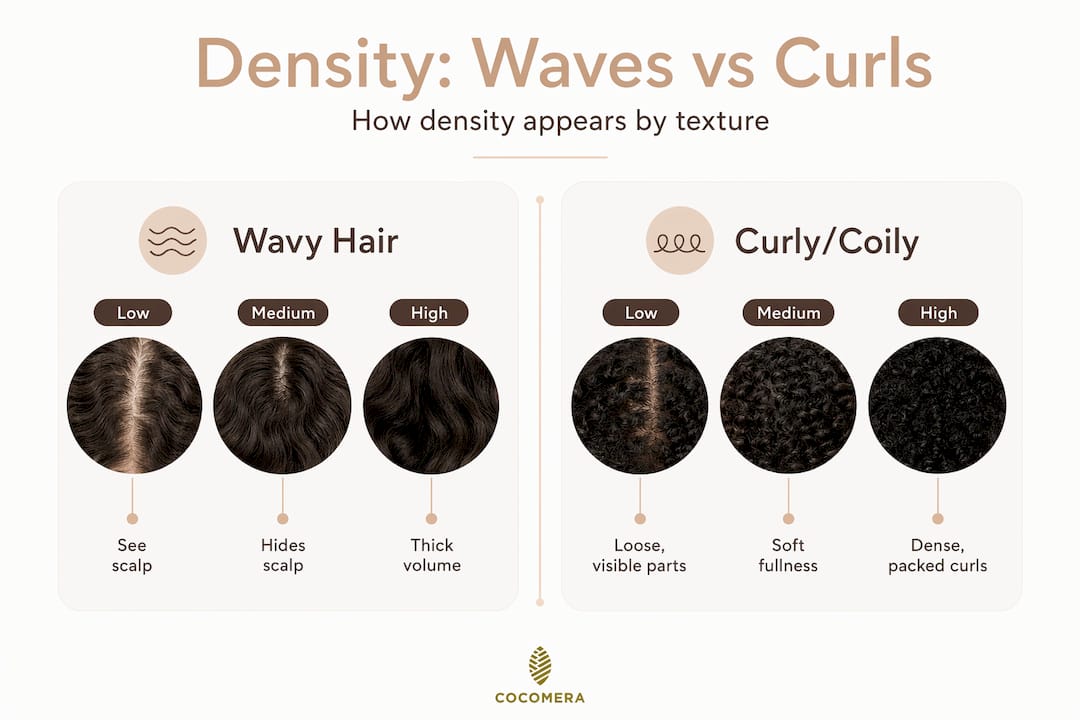
This is where textured hair completely changes the rules. For wavy, curly, and coily hair, density reads differently because curl shape affects how much scalp is visible and how hairs actually stack on top of each other. Shrinkage, part placement, and curl grouping can make low density hair look fuller than it is, and vice versa.

Consider this: a type 4C coil pattern shrinks up to 75% of the actual hair length. When those coils compress, they stack on top of each other and visually fill space in a way that straight or wavy hair simply cannot. This means a person with medium density coily hair may appear to have very high density when their hair is worn in a wash-and-go. The same person wearing a stretched style might suddenly see how their scalp is more visible than expected.
Here is how density presents across the major pattern types:
-
Wavy hair (type 2): Density is easiest to read because waves lie closer to the head and don’t stack as dramatically. Scalp visibility tests are fairly reliable here.
-
Curly hair (type 3): Curl clumping can hide sparse areas. High density type 3 hair can look incredible air dried but feel heavy and take forever to dry. How curl type changes density’s look depends heavily on how much product encourages clumping.
-
Coily hair (type 4): Shrinkage makes it nearly impossible to judge density by scalp visibility alone in a dry style. Stretch your hair to assess honestly. Focus on how why moisture matters for density and how your scalp looks on freshly washed, detangled hair.
Pro Tip: Take a photo of your scalp immediately after washing and detangling, before any shrinkage sets in. This gives you a much more accurate visual record of your true density than any post-style check will.
Your sense of touch also tells you a lot. Run your fingers across your scalp in small sections. Does it feel very packed and full of hair, or do you feel your scalp easily? This tactile check, combined with scalp photos, gives you a more complete picture than any single method alone.
Making density practical: choosing products and styling routines for your texture
Now that you can identify and interpret your own density, let’s put this knowledge to work in your actual routine.
The goal is not to memorize a number. It is to use density as a filter when making product decisions.
-
Start with your density category. Low, medium, or high. Even a rough estimate changes your product choices significantly.
-
Match product weight to your density. Low density hair needs products that won’t drag strands down. Think lightweight milks, foams, and airy gels. High density hair can tolerate and often needs richer formulas to coat every strand.
-
Adjust your application method. Low density hair benefits from applying products to soaking wet hair in thin sections. High density hair may need more product and more deliberate sectioning to ensure even coverage.
-
Think about drying time. High density hair takes longer to dry, which means it also stays in the moisture absorption window longer. This can work for or against you depending on your climate in Sweden, where humidity and temperature shift a lot between seasons.
-
Refresh routines need to change too. High density hair may need a heavier refresh spray with conditioning agents. Low density hair refreshes better with water alone or a light mist.
If you notice your hair thinning beyond normal variation, Mayo Clinic’s guidance on hair loss confirms that a trichologist or dermatologist can quantify density with dermoscopy rather than relying on home estimates. For everyday ingredient selection strategies, though, your home assessment is a solid starting point.
Pro Tip: When trying new styling products for curly hair, test them on a single section first. Notice how your hair responds in terms of weight, definition, and frizz. That response tells you more about your density and porosity combination than any product description will.
For styling sparse or fine hair, the priority is always lifting strands away from the scalp and using products that dry without residue. For high density hair, the priority shifts to even distribution and moisture retention.
One thing everyone misses about hair density for curls
Here is the perspective that most density guides skip entirely: density is not a fixed experience. It is a moving target that looks and feels different every single day depending on how you style it, what products you used, how much moisture is in the air, and even how rested you are.
Most guides treat density like a number you measure once and then apply forever. But curls, coils, and waves are living with that density differently in every context. A high humidity day in Stockholm in August makes your density look and feel completely different than a dry January indoors with the heating on full blast.
The real shift that helps is thinking about density alongside porosity, moisture levels, and your personal lifestyle. A curl that seems low density in a protective style might feel incredibly full in a wash-and-go because multi-texture realities mean different sections of your own head behave differently. Chasing one perfect density-based routine ignores the fact that your hair is not a controlled experiment.
Use density as a guide, not a box. It narrows your product choices in a useful direction, but your hair’s behavior in real conditions is always the final word.
Find the right products for your density and texture
Ready to get the most out of your texture and density? Cocomera curates products specifically for wavy, curly, coily, and afro hair types, which means you are not sifting through products formulated for straight hair and hoping for the best.
Whether your hair is low density and needs a lightweight lift or high density and craves rich conditioning, you will find targeted options in our collections. Browse our treatments for curly hair for formulas that address moisture and strength without weighing strands down. If you want defined, supported curls, check out our styling products for curly hair selected for real textured hair performance. For deep conditioning sessions that make a visible difference, our hair masks for curls are curated with your curl type in mind. Shop smarter by knowing your density first.
Frequently asked questions
What is a normal hair density range for curly and coily hair?
There is no single normal value. As Keratin.com notes, normal ranges depend on who was studied, what scalp area was measured, and the technique used, and textured hair often appears lower in density due to curl pattern.
How can I tell if my hair is high or low density at home?
Check scalp visibility on freshly washed, detangled hair, try the ponytail circumference test, or simply touch your scalp in small sections. Keep in mind that home tests are less precise than clinical measurement, especially for curly and coily types where curl shape skews visual results.
Does hair density affect which products I should use?
Absolutely. High density hair needs lighter products spread across more strands for even application, while low density hair benefits from volumizing or richer formulas that give strands more body. Product selection based on whether hair is sparse or full is one of the most practical applications of knowing your density.
When should I see a specialist about hair density?
See a dermatologist or trichologist if you notice new thinning patches, significant daily shedding beyond the normal range, or a sudden change in your hair’s fullness. Clinical assessment using dermoscopy gives far more accurate data than any home estimate and can catch conditions that need medical attention early.


