



Standing in a beauty aisle or scrolling through an online store, staring at dozens of curl creams, co-washes, and leave-ins, is genuinely exhausting. The advice online is just as chaotic: one influencer swears by a method, another says it ruined her hair. If you have wavy, curly, or coily hair and you live in Europe, finding products that actually work for your specific texture can feel like a full-time job. This guide cuts through the noise. We’ll walk you through identifying your curl type, understanding what each product category does, and building a routine that works for your hair, not someone else’s.
Table of Contents
- Know your curl pattern and porosity
- Curly hair product categories explained
- How to select the right formulas for your curls
- Top curly hair products in Europe by curl type
- Testing, troubleshooting, and tweaking your regimen
- Find your perfect curly hair essentials at Cocomera
- Frequently asked questions
Key Takeaways
| Point | Details |
|---|---|
| Know your curl and porosity | Start by identifying your hair’s curl type and porosity to guide product selection. |
| Match products to your needs | Choose formulas based on moisture, hold, and ingredient needs, not trends. |
| Test and tweak routine | Trial products for several weeks and adjust as you learn what works. |
| European options excel | There are excellent European brands for waves, curls, and coils—test minis before committing. |
Know your curl pattern and porosity
Before you spend a single euro on a new product, you need two pieces of information: your curl pattern and your hair porosity. These two factors determine almost everything about which products will work for you.
The curl typing system runs from type 2 (wavy) to type 3 (curly) to type 4 (coily). Each type has subcategories: 2a is a loose S-wave, 2c is a defined, frizzy wave. Type 3a gives you big, loose spirals, while 3c produces tight corkscrews. Type 4a has defined coils, and 4c has the tightest, most densely packed texture with little visible curl pattern when dry. To find your type, wet a single strand and watch what shape it forms naturally without any product.
Porosity is about how easily your hair absorbs and holds moisture. Low-porosity hair has tightly closed cuticles, so water and products sit on top rather than soaking in. High-porosity hair has open or damaged cuticles that absorb moisture fast but lose it just as quickly. To test yours, drop a clean, dry strand into a glass of water. If it floats, you likely have low porosity. If it sinks quickly, your porosity is high.
Here’s a quick reference to match your profile to the right product weight:
| Hair profile | Porosity | Best product weight |
|---|---|---|
| Type 2a/2b wavy, fine | Low | Ultra-light, water-based |
| Type 2c/3a curly | Low to medium | Light to medium creams |
| Type 3b/3c curly | Medium to high | Medium creams, butters |
| Type 4a/4b coily | High | Rich creams, heavy butters |
| Type 4c coily | High | Thick butters, oils, sealants |
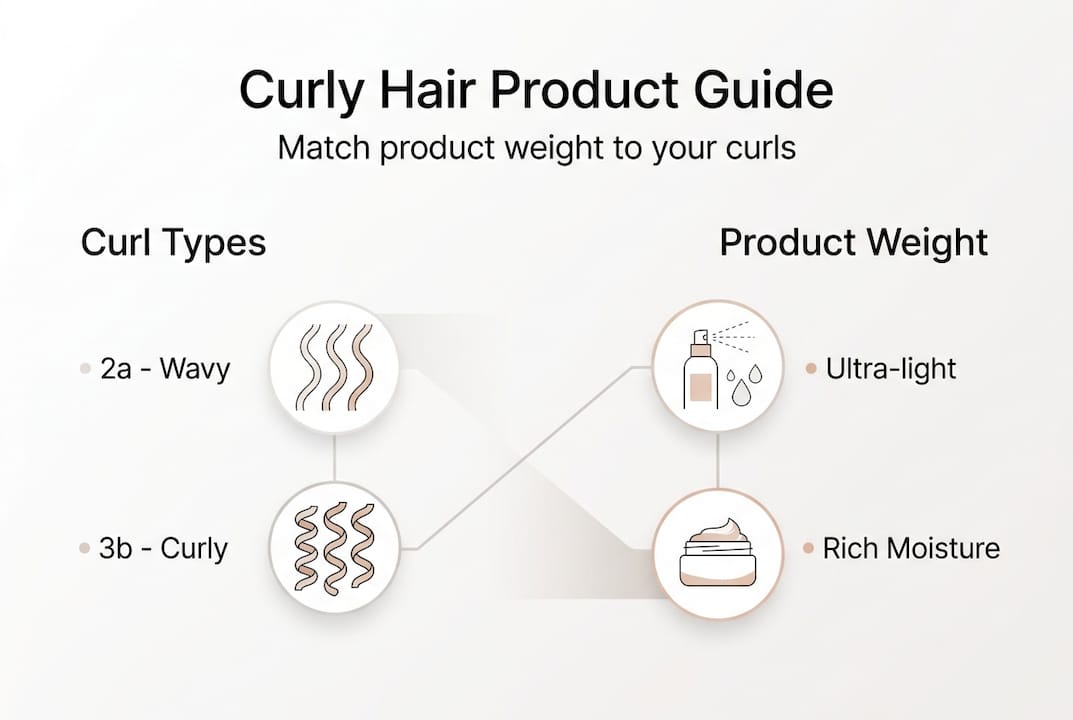
As a general rule, match product weight to porosity: light formulas for low-porosity or fine wavy hair, rich and heavy formulas for high-porosity coily textures. Getting this wrong is the number one reason products feel greasy or fail to moisturize.
Pro Tip: Check out these healthy textured hair tips to build a strong foundation before adding new products to your routine.
Curly hair product categories explained
Once you’ve assessed your curl pattern and porosity, it’s time to match them to the right product categories. There are more options than most people realize, and each one serves a specific purpose.
Cleansers come in three main types. Sulfate-free shampoos clean gently without stripping natural oils, making them ideal for most curl types. Co-washes (conditioner washes) cleanse with conditioning agents and work well for very dry, high-porosity coily hair. Clarifying shampoos contain stronger surfactants to remove buildup and should be used occasionally, not weekly.
Conditioners and leave-ins restore moisture after cleansing. Rinse-out conditioners detangle and soften. Leave-in conditioners stay in the hair and form the base of most styling routines. For coily hair, a leave-in is non-negotiable.

Stylers define and hold your curl pattern. Here’s how the main types compare:
| Styler type | Best for | Hold level | Texture |
|---|---|---|---|
| Curl cream | Moisture and definition | Light to medium | Thick, creamy |
| Mousse | Volume, fine or wavy hair | Light to medium | Airy, foam |
| Gel | Frizz control, strong hold | Medium to strong | Liquid to gel |
| Butter | Sealing moisture, coily hair | Light | Dense, rich |
The right layering order matters: apply leave-in first on wet hair, then your styler on top. This locks in moisture before the hold product sets. Skipping this step is why many people get crunchy or dry results.
Building a curly hair routine around these categories, rather than buying random products, is what separates a routine that works from one that wastes money.
How to select the right formulas for your curls
Now that you know what types of products exist, let’s walk through how to choose formulas and ingredients that best support your hair’s health and goals.
Start by identifying your primary hair concern. Is it frizz? Lack of definition? Dryness? Limpness? Each concern points to a different product focus. Frizz usually signals a need for more moisture or a stronger hold styler. Limpness often means your products are too heavy. Dryness in coily hair typically calls for richer leave-ins and sealants.
Here’s a practical approach to narrowing down formulas:
- Write down your top two hair concerns before shopping.
- Check the first five ingredients on any product. Water, aloe vera, or glycerin near the top signals a moisturizing formula.
- Look for humectants (glycerin, honey, panthenol) for moisture, and emollients (shea butter, argan oil, jojoba) for sealing.
- Avoid heavy silicones if you have low-porosity hair. They coat the strand and block moisture from entering.
- Buy travel or mini sizes first. Commit to testing for two to four weeks before judging results.
One of the most common traps is following the Curly Girl Method (CGM) as if it were law. The CGM bans sulfates and silicones entirely, but experts now critique this rigid approach. Avoiding all sulfates can cause scalp buildup, and for fine or oily hair, co-washing alone may not cleanse effectively. Science supports tailoring your routine to your actual hair, not a set of rules.
“The best curly hair routine is the one built around your specific hair, not someone else’s method.”
For a deeper look at what your hair actually needs, the guide on moisturizing essentials breaks down ingredient science in plain language.
Pro Tip: If a product feels amazing the first wash but leaves your hair heavy by the third, it’s likely too rich for your porosity. Swap it for a lighter version of the same product type.
Top curly hair products in Europe by curl type
Ready to shop? These curated product examples make real-world selection much easier. European availability matters, and these picks are accessible across the continent.
| Curl type | Product | Why it works |
|---|---|---|
| Wavy (2a/2b) | Curlsmith Weightless Air Dry Cream | Lightweight, no crunch, enhances waves |
| Wavy/curly (2c/3a) | Davines Love Curl Shampoo (~€30) | Gentle cleanse, defines without weighing down |
| Curly (3b/3c) | Keune Confident Curl Conditioner (~€33) | Rich moisture, detangles tight spirals |
| Coily (4a/4b/4c) | SheaMoisture Curl Enhancing Smoothie | Dense, rich formula for high-porosity coils |
These European-available picks cover the full spectrum from fine waves to dense coils. The key is matching the product’s weight and purpose to your curl profile, not just buying what’s trending.
A few things to keep in mind when shopping:
- Wavy hair benefits most from lightweight mousses and gels that add definition without flattening volume.
- Curly hair (type 3) often needs a balance of moisture and hold. Creams layered under a light gel work well.
- Coily hair (type 4) needs the most moisture. Rich leave-ins, butters, and sealants are essential, not optional.
For styling products specifically, the best gels for curls guide covers hold levels and application tips. If you prefer creams, browse curl creams and lotions to compare textures and weights side by side.
Testing, troubleshooting, and tweaking your regimen
Even with the right product picks, your process may require ongoing tweaks and troubleshooting for best results. No routine is perfect from day one.
Here’s how to read your hair’s feedback:
- Good signs: Defined curl pattern, reduced frizz, soft feel after drying, moisture that lasts two or more days.
- Warning signs: Limp curls, greasy roots, crunchy texture that doesn’t soften, or frizz that gets worse over time.
- Buildup signs: Dull hair, scalp itchiness, products that stop working as well as they used to.
If your curls feel limp, your products are likely too heavy. Swap your cream for a lighter mousse or reduce the amount you use. If your hair feels dry and brittle, you may need a richer leave-in or a protein treatment followed by deep conditioning.
“Buildup is one of the most overlooked causes of curl problems. A monthly clarifying wash can reset your hair and make every other product perform better.”
The CGM approach of avoiding all sulfates can actually worsen buildup over time, especially if you use heavy butters or silicone-containing products. A clarifying shampoo used once or twice a month is not the enemy. It’s maintenance.
Document your changes. Take photos in the same lighting every wash day. Note what products you used, how much, and in what order. This makes it much easier to identify what’s working and what isn’t. Patience matters too. Give any new product or routine change at least two to four weeks before deciding it doesn’t work.
For coily hair specifically, the coily wash day guide walks through a full workflow. And if you’re working with type 3 or 4 curls and want styling direction, the afro styling guide for 3 and 4 curls covers techniques that complement your product choices.
Find your perfect curly hair essentials at Cocomera
Building a routine that actually works starts with having the right products available in one place. At Cocomera, every product is carefully selected for wavy, curly, coily, and afro hair types, with a focus on what genuinely performs for textured hair in European climates.
Whether you’re just starting your curl journey or refining a routine you’ve had for years, Cocomera carries everything from curly hair styling products to curly hair treatments and strengthening shampoos. The range includes both international favorites and European brands, so you can find lightweight options for fine waves and rich formulas for dense coils, all without having to shop across five different websites.
Frequently asked questions
How do I know if a curly hair product is right for my hair?
Test for at least two weeks and observe whether your frizz decreases, your curl definition improves, and your hair feels comfortable. One wash is never enough to judge a product fairly.
Is the Curly Girl Method really necessary?
No. Experts now advocate for science-based, personalized choices over rigid rules, including occasional clarifying washes and adjusting ingredient guidelines to fit your actual hair type.
Which ingredient should I prioritize for moisture?
Look for humectants like glycerin and panthenol, which draw moisture into the hair shaft. Match your moisturizing ingredients to your porosity level for the best results.
Are European curly hair products different from US brands?
Often yes. European brands like Davines tend to use lighter formulas and follow stricter ingredient regulations, making them a great starting point for wavy to coily hair across the continent.


