


You know that sinking feeling when you reach for your hair and your fingers immediately hit a wall of knots? For anyone with wavy, curly, coily, or afro hair, detangling is one of the most time-consuming and potentially damaging parts of a hair care routine. Done wrong, it leads to breakage, pain, and a whole lot of shed hair on the bathroom floor. Done right, it’s the foundation of healthy, defined, thriving curls. This guide walks you through exactly what to do, what to use, and what to skip, so every detangling session works with your texture instead of against it.
Table of Contents
- What you need before you start detangling
- Step-by-step: How to detangle textured hair safely
- Troubleshooting and common mistakes
- How to know you’re done: Signs of a successful detangle
- Best products and ingredients for detangling textured hair
- The real secret to detangling: It’s not just the products
- Find your perfect detangling routine at Cocomera
- Frequently asked questions
Key Takeaways
| Point | Details |
|---|---|
| Prep is crucial | Proper sectioning and moistening your hair with slip products is the foundation of safe detangling. |
| Gentle technique matters | Go slowly and use fingers before tools to avoid unnecessary breakage. |
| Balance your products | Use enough slip for ease but avoid applying too much product to prevent buildup. |
| Know when to trim | Stubborn single-strand knots may need to be snipped rather than forced. |
| Healthy hair feels soft | Successfully detangled textured hair is soft, springy, and without pain or leftover large knots. |
What you need before you start detangling
Before a single finger touches your hair, having the right setup makes the difference between a smooth session and a frustrating one. Think of it like cooking: mise en place matters. Getting everything ready before you start saves time and protects your strands.
Here’s a breakdown of what you need by hair type:
| Hair type | Best detangling tool | Slip product | Extras |
|---|---|---|---|
| Wavy (2A, 2B, 2C) | Wide-tooth comb or fingers | Lightweight conditioner or detangling spray | Spray bottle with water |
| Curly (3A, 3B, 3C) | Wide-tooth comb or detangling brush | Creamy conditioner or leave-in | Sectioning clips |
| Coily (4A, 4B) | Fingers first, then wide-tooth comb | Rich conditioner or detangling butter | Spray bottle, clips |
| Afro (4C) | Fingers only or wide-tooth comb | Heavy butter or thick leave-in conditioner | Multiple clips, patience |
The ingredient list on your slip product matters just as much as the product category. Best ingredients for textured hair include humectants like glycerin and aloe vera, which draw moisture into the hair shaft, and emollients like shea butter and oils, which coat the strand and allow knots to slide apart. However, balance is key: too much product causes buildup that actually increases tangling over time, even though more slip sounds like a better idea.
Prep steps before you detangle:
- Wet or mist your hair thoroughly with water or a water-and-conditioner mix
- Divide hair into at least four sections using clips
- Apply your chosen slip product generously but not excessively to each section
- Work in a warm environment or use a shower cap to let the product penetrate for a few minutes
- Have your tools within reach before you start so you don’t have to stop mid-section
Pro Tip: Never start detangling on dry hair. Mist each section with water or a diluted detangling conditioner until it’s damp and pliable. Dry detangling is one of the fastest ways to cause breakage, especially with tighter curl patterns.
If you want to simplify your product routine, single-ingredient haircare solutions like pure aloe vera gel or raw shea butter can provide excellent slip without the risk of ingredient overload.
Step-by-step: How to detangle textured hair safely
Once you have your tools and prep done, here’s the safest way to detangle, no matter your texture. The sequence matters as much as the technique. Skipping steps, especially in the beginning, is where most people run into trouble.
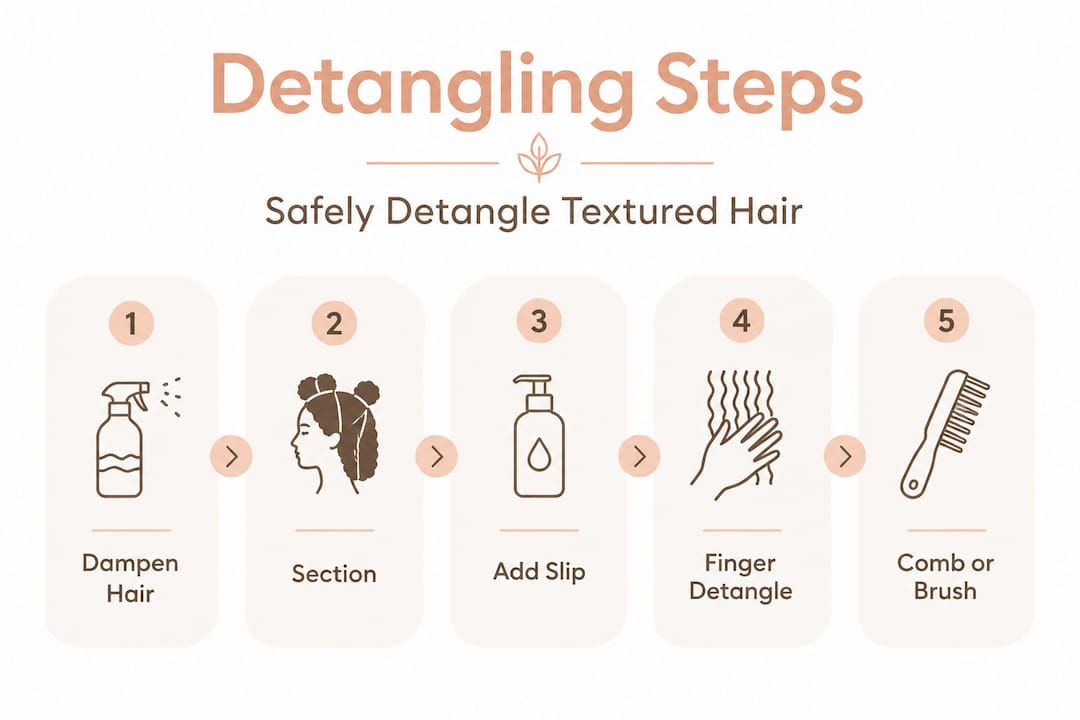
- Pre-moisturize your hair. Apply water and a slip product to each section before you begin. Hair should feel soft and pliable, not stiff or dry.
- Divide into manageable sections. Four sections minimum; eight sections for very thick or very coily hair. Clip each section out of the way as you work.
- Start with your fingers. Before any tool touches your hair, use your fingers to gently separate large clumps of tangles. This is especially important for 4B and 4C textures.
- Work from the ends upward. Always start at the tips of your hair and slowly work your way toward the roots. Going root-to-tip forces knots tighter and causes breakage.
- Apply more slip as needed. If you feel resistance, add more product or water. Never force a tool through a knot.
- Switch to a wide-tooth comb or detangling brush. Once your fingers have handled the major knots, a tool can smooth out smaller tangles more efficiently.
- Re-moisturize as you go. Long sections of coily or afro hair dry out quickly. Keep your spray bottle nearby and mist whenever the hair starts to feel dry.
- Check each section before moving on. Run your fingers through the section from root to tip. If they glide through without catching, you’re done with that section.
Important: Never rush through tangles or yank a tool through resistant hair. The breakage that results from one impatient moment can set your length retention back by months. If you feel strong resistance, stop, add more product, and gently work the knot with your fingers first.
For stubborn mats, the approach is different. Apply extra slip product, finger separate, and wait a few minutes before trying again. Sometimes covering the section with a plastic cap for five to ten minutes lets the conditioner really penetrate and loosen the mat. If a single-strand knot simply won’t budge after all of that, it’s better to snip it carefully with small scissors than to risk snapping a larger section of hair.

Pro Tip: Use your fingers for the first pass on every section, even if you plan to use a brush afterward. Finger detangling gives you direct feedback about where the knots are and how tight they are, which no tool can replicate.
For a full wash day workflow that incorporates detangling seamlessly, the coily hair wash day tips guide walks through timing and sequencing in detail. And if you’re working with type 3 hair, curly hair care tips covers texture-specific nuances worth knowing.
Troubleshooting and common mistakes
Even with a good plan, detangling can go wrong. Here’s how to spot issues and recover fast.
The most frustrating scenario is when your hair seems to get more tangled as you work. This usually happens for one of three reasons: you’re working on sections that are too large, you’re going root-to-tip instead of tip-to-root, or your product has created a sticky buildup that causes strands to clump together instead of separating. Too much product causes buildup that increases tangling, which is the opposite of what you want, even though the instinct is always to add more.
Common detangling mistakes and quick fixes:
- Hair getting more tangled: Section smaller, recheck your direction (always ends first), and rinse out any product buildup before reapplying
- Excessive shedding: This often signals dryness or that you’re rushing. Slow down, add more water, and use fingers only for a full pass before any tool
- Pain at the scalp: You’re likely pulling from the root. Hold the section firmly near the scalp with one hand while detangling the ends with the other
- Product buildup making hair stiff: Use less product next time, and consider a clarifying wash before your next detangling session
- Breakage with every stroke: Switch to a gentler tool or fingers only, and check that your hair is damp enough
The EdgeLift detangling brush is worth trying if you’re struggling with tool-related breakage. Its design is built to work with curl patterns rather than against them, which makes a real difference on tighter textures.
Pro Tip: Alternate between your fingers and a tool during a single session. Start with fingers, use a comb or brush for a few strokes, then check with fingers again. This back-and-forth helps you find the method causing least breakage for your specific texture on that particular day.
Ingredient choice also plays a role here. Heavy butters can be amazing for 4C hair but can weigh down and tangle wavy hair. Lightweight sprays that work perfectly for 2B curls may not provide enough slip for a dense 4B coil. Matching your top detangling ingredients to your actual texture is a non-negotiable step.
How to know you’re done: Signs of a successful detangle
Once you’ve finished detangling, here’s how to verify your success and prep for your next style.
| Tangled hair | Detangled hair |
|---|---|
| Fingers catch and snag | Fingers glide root to tip |
| Clumps feel uneven and rough | Sections feel uniform and smooth |
| Hair looks dull and undefined | Curl pattern is visible and consistent |
| Significant shedding with each pass | Minimal shedding, mostly loose hairs |
| Product feels patchy or uneven | Product is distributed evenly |
Signs your detangle was successful:
- Your fingers move through each section from root to tip without catching
- The hair feels soft and has visible slip, not stiff or dry
- Your curl pattern is starting to form naturally
- Shedding has reduced significantly compared to the first pass
- No visible knots or mats remain in any section
Once you’ve confirmed all sections are clear, you’re ready to move into styling or protective care. This is the moment to apply your styling products while hair is still damp and pliable. If you’re building a long-term routine, healthy curly hair routines gives a full picture of what comes next after detangling.
One final check: run through each section one more time with just your fingers. It takes two minutes and catches any spots you may have missed. For very long or very dense hair, moisture for textured hair explains why keeping hydration consistent through the whole process protects your results. And remember, snip unresolvable single-strand knots rather than forcing them out. One small snip is always better than snapping a full section.
Best products and ingredients for detangling textured hair
Results depend just as much on your product choices as your technique. Here are the best options and how to use them without overdoing it.
The most effective detangling products share one key quality: slip. Slip is the ability of a product to reduce friction between hair strands, allowing knots to slide apart instead of tightening. The slip from humectants and butters is essential for safe detangling, but the amount matters. Too little and your hair feels like velcro. Too much and you get sticky buildup that actually makes tangles worse.
Top ingredients by texture:
- Wavy hair (2A to 2C): Aloe vera, glycerin, lightweight conditioners with panthenol
- Curly hair (3A to 3C): Slippery elm, marshmallow root, creamy leave-ins with coconut oil
- Coily hair (4A to 4B): Shea butter, avocado oil, thick creamy conditioners
- Afro hair (4C): Raw shea butter, castor oil, heavy leave-in conditioners with multiple emollients
Signs you’ve used too much product:
- Hair feels sticky or gummy even after working it through
- Strands clump together in an unnatural way
- Product pills up or balls on the strand as you comb
- Hair dries stiff or crunchy without any styling product added
Signs you’ve used too little product:
- Fingers or tools catch immediately with the first pass
- Hair feels dry and rough even after misting with water
- You hear snapping sounds when a comb or brush moves through
- Shedding is heavy from the very first stroke
For a reliable everyday option, the As I Am detangling conditioner works well across curl types 3 and 4 and provides the kind of slip that makes a real difference without overloading the hair. If you’re detangling a child’s hair, the Kids Detangler by Not Your Mother’s is formulated for sensitive scalps and gentler textures, making wash day much less stressful for everyone involved.
Browsing by texture or purpose helps narrow things down fast. The full range of detangling conditioners at Cocomera is organized to make it easy to find what fits your specific pattern and needs. And if you want to go deeper on what’s actually in your products, ingredients for textured hair breaks down what each key ingredient actually does.
The real secret to detangling: It’s not just the products
Here’s something most detangling tutorials won’t tell you: the product is almost never the problem.
We see it constantly in the textured hair community. Someone buys a highly rated detangler, uses it, and still ends up with breakage and frustration. Then they buy a different product. Same result. The cycle continues. But the variable that never changes is the technique, and that’s where the real damage happens.
The best slip product in the world cannot compensate for rushing. When you yank a comb through a resistant section because you’re tired or in a hurry, you’re not just breaking a few strands. You’re potentially snapping multiple hairs at different lengths, which creates the short, frizzy pieces that make textured hair look uneven and feel rough over time.
What actually makes the biggest difference is understanding your unique texture pattern, not just your general type. Two people can both have 4C hair and need completely different amounts of product, different section sizes, and different tools. One might detangle beautifully with fingers and shea butter in eight large sections. The other might need sixteen small sections, a wide-tooth comb, and a lightweight leave-in to get the same result. No tutorial can tell you exactly which one you are. Only consistent practice and paying attention to how your hair responds will get you there.
There’s also a surprising truth about product amount: less is often more. The instinct is to pile on more conditioner when detangling is hard. But often the better move is to add more water, not more product, and then slow down. Water is the real slip agent. Product just helps it stay on the strand longer.
If you’re dealing with multi-textured hair, meaning different curl patterns on different parts of your head, this becomes even more important. The sections near your nape might need a completely different approach than the crown, and treating them all the same way is a recipe for uneven results.
Patience is the actual secret ingredient. It’s not glamorous, and it won’t sell products. But every experienced naturalista will tell you the same thing: the sessions where they slowed down, worked in smaller sections, and listened to their hair were the ones with the least breakage and the best results.
Find your perfect detangling routine at Cocomera
Ready to transform your detangling routine? At Cocomera, we’ve curated a range of detangling products specifically for wavy, curly, coily, and afro hair, so you don’t have to sort through hundreds of options that weren’t made with your texture in mind.
Whether you’re building a new routine from scratch, looking for a kid-friendly formula that makes wash day easier, or trying to find the right leave-in for your specific curl pattern, our collection is organized by texture and purpose. Browse the full selection of shop detangling conditioners to find products that match your hair type, your family’s needs, and your routine. Every product we carry is chosen because it actually works for textured hair, not just because it claims to.
Cocomera detangling brush: https://cocomera.se/products/cocomera-detangling-brush?_pos=1&_sid=c90e0659e&_ss=r
Frequently asked questions
Should you ever detangle textured hair when it’s dry?
No, always detangle textured hair when it’s moist or damp. Dry detangling dramatically increases friction and the risk of breakage, especially for tighter curl patterns where strands are already fragile at the curl points.
How often should I detangle my curly or coily hair?
Detangle at least once per wash cycle, or as soon as you feel significant tangles forming. Avoid over-manipulation between wash days, since excessive detangling sessions can cause more damage than the tangles themselves.
Which tool is least damaging: wide-tooth comb or fingers?
Fingers are gentler and best for initial detangling, especially with tight textures like 4B and 4C. A wide-tooth comb works well after finger separation has already handled the major knots.
Is it possible to detangle matted hair completely, or should I cut it out?
Most mats can be loosened with generous slip product, patience, and careful finger work. However, single-strand knots that won’t release after thorough conditioning should be carefully snipped out to avoid causing larger breakage.
Recommended
- Why hair needs moisture: essential guide for textured curls – Cocomera
- Best ingredients for textured hair: curly, coily & afro – Cocomera
- Single ingredient haircare: pure solutions for textured hair – Cocomera
- Curly hair care tips for healthy textured hair - Cocomera
- Metody doczepiania włosów: kompletny przewodnik 2026


