



Cocomera’s short list of CG-friendly picks for 2026 centers on eight products, including the Innersense Quiet Calm Curl Control, the Bounce Curl Curly Trial & Travel Kit, and the Black Girl Sunscreen SPF 30. Each meets the current 2026 ingredient checklist (no sulfates, no non-soluble silicones, no drying alcohols), and you can confirm that yourself with a quick ingredient checker. The rest of this guide walks through the criteria, routine-building, and verification steps.
Table of Contents
What Qualifies as CG Godkända Produkter 2026
A product earns Curly Girl status by what it leaves out, not by a badge on the bottle. The rules haven’t changed dramatically since the method’s early days, but the ingredient landscape brands work within has, and that’s exactly why a fresh look for 2026 matters. The Curly Girl Method works best as a flexible framework rather than a rigid checklist, since hair responds differently depending on texture and porosity.
Here’s what to screen for on any label:
-
Sulfates (sodium lauryl sulfate, sodium laureth sulfate): strip natural oils and leave curls dry and frizzy.
-
Non-water-soluble silicones (dimethicone, cyclopentasiloxane without a “PEG” or “PPG” prefix): coat the hair shaft and build up over time, blocking moisture.
-
Drying alcohols (alcohol denat, isopropyl alcohol, SD alcohol 40): evaporate fast and pull moisture out with them.
On the acceptable side: mild surfactants like cocamidopropyl betaine, humectants like glycerin and aloe vera, and emollients like shea butter or jojoba oil. Protein ingredients (hydrolyzed keratin, wheat protein) help some curl types and overload others. High-porosity hair usually tolerates protein well; fine or low-porosity strands often go brittle with too much of it.
Pro Tip: Never trust a front-label “CG-approved” claim at face value. Pull up the product page and read the full INCI list yourself. Reformulations happen quietly, and a brand’s marketing copy is usually the last thing to get updated.
Cocomera’s Curated CG-Friendly Picks for 2026
These eight products cover the core roles in a Curly Girl routine. Formulations shift, so treat the notes below as a starting point and confirm current ingredients on each product page before you buy.
Cleansers and prep
-
Innersense Hair Love Prep Spray works as a pre-wash detangler and light leave-in primer. Best for anyone who struggles with knots before a wash day, especially medium to coarse textures.
-
Innersense Color Awakening Hairbath is a sulfate-free cleanser that doubles as gentle color care. Best for color-treated wavy to curly hair (types 2 to 3) that needs cleansing without stripping.
Conditioners and leave-ins
-
Innersense Quiet Calm Curl Control is a leave-in built for frizz management in humid conditions. Best for normal to high porosity curls (types 3a to 3c) that swell and frizz fast.
-
The Bounce Curl Curly Trial & Travel Kit bundles a cleanser, conditioner, and styler in travel sizes. Best for anyone starting the method who doesn’t want to commit to full sizes before finding their fit.
Stylers
-
Innersense Inner Peace Whipped Creme Texturizer gives soft hold with a lightweight finish. Best for low to normal porosity waves and curls (types 2b to 3a) that go limp under heavier creams.
-
Innersense I Create Definition Styling Foam is a mousse for clump definition without crunch once scrunched out. Best for fine to medium curls (types 2c to 3b) that need lift without weight.
Tools
- The Bounce Curl Define EdgeLift Brush distributes product evenly through curl clumps and helps set definition at the root. Best for anyone doing the “rake and scrunch” technique on types 3a and up.
Sun protection
-
Black Girl Sunscreen SPF 30 is formulated for melanin-rich skin with no white cast, silicone-free. Best for daily scalp and skin protection without interfering with a CG routine.
-
Black Girl Sunscreen Make It Hybrid SPF 50 steps up SPF for longer outdoor days. Best for anyone who wants higher protection without a heavier, pore-clogging formula.
How Do You Build a Routine Around Curl Type and Porosity?
Porosity determines almost everything about product order and quantity, more than curl pattern does. Low porosity hair resists moisture and needs lighter, warmer application; high porosity hair absorbs fast and loses it just as fast, so it needs sealing.
-
Low porosity: Cleanse, apply a lightweight leave-in like the Hair Love Prep Spray while hair is soaked, then a small amount of a light cream (Whipped Creme Texturizer), and skip heavy gels that sit on top without absorbing.
-
Normal porosity: Cleanse, leave-in, cream, then a mousse or light gel (I Create Definition Styling Foam) for hold. This is the routine most people start with before adjusting.
-
High porosity: Cleanse, protein-light leave-in, a richer cream, then Quiet Calm Curl Control to manage frizz, and seal with a light oil if ends still feel dry.
The layering order matters: leave-in first while hair is wet, then cream for moisture, then gel or mousse last for hold. Skipping the cream step and going straight to gel is the most common reason curls end up crunchy without softness underneath.
Clarify every four to six weeks if you use heavier creams or live somewhere with hard water. Deep-condition weekly if you’re normal to high porosity, every other week if you’re low porosity and prone to protein overload. For a deeper breakdown of porosity testing and layering technique, Cocomera’s porosity guide walks through the strand test and adjustment tricks in more detail.
How Do You Verify a Product Is Actually CG-Friendly?
Community ingredient checkers are the fastest way to confirm a claim before you buy. Is It CG? lets you paste an ingredient list or search a product name and flags anything that violates CG rules, including borderline silicones and hidden alcohols.
-
Copy the full INCI list from the product page, not the marketing bullet points.
-
Paste it into a checker and read the flagged terms individually. Some tools flag ingredients that are technically fine in small amounts.
-
Cross-check against the brand’s own site and the retailer page, since formulations can differ by region.
-
Watch for red flags: a “CG-approved” badge with no ingredient list nearby, vague terms like “natural blend,” or a reformulation notice buried in fine print.
Community-maintained checkers and lists have become the default verification method precisely because brand labeling can lag behind actual reformulations. Sites like Curlscan’s approved list are a solid starting point, but always confirm against the current INCI before buying.
Why Trust Cocomera’s Product Curation?
Cocomera builds its catalog around ingredient transparency, not marketing badges. Every product page lists full ingredients, and the blog cross-references formulations against current CG standards each time the catalog refreshes for 2026.
-
Product pages show full INCI lists, not just marketing highlights.
-
Picks get reviewed against reformulation notices as brands update formulas.
-
Curation draws on both international brands and feedback from Swedish and Nordic curly hair communities.
What Ingredient Rules Are Changing for 2026?
Regulatory attention on personal care ingredients has been tightening in the EU, and that ripples into what “clean” and “CG-friendly” mean on shelves this year. Fragrance allergen labeling requirements have expanded, which means more brands now disclose specific allergenic components instead of hiding them under “parfum.” That’s good news for anyone with scalp sensitivity trying to narrow down what actually triggers a reaction.
Certain preservatives, including some parabens and formaldehyde-releasers, face continued restriction across EU markets, pushing formulators toward alternatives like phenoxyethanol blends or multi-functional preservative systems. These substitutions sometimes change how a product feels in the hand (thinner, less cushiony) even when the CG-relevant ingredients stay compliant.
There’s also growing scrutiny on microplastics in rinse-off products, which affects some exfoliating scalp scrubs and a handful of glossy stylers that used to rely on plastic-based shine agents. Brands reformulating away from those ingredients sometimes swap in silicones to maintain slip, so a product that was CG-friendly last year isn’t guaranteed to stay that way. This is exactly why relying on a fixed list from a year ago is risky, and why checking INCI at time of purchase matters more than ever.
None of this means the core CG rules are shifting. Sulfates, non-soluble silicones, and drying alcohols remain the same categories to avoid. What’s changing is the ingredient toolbox brands pull from to hit those same rules, which means familiar product names can carry different formulas than they did even a year ago.

How Are Formulations Adapting to Meet CG Standards by 2026?
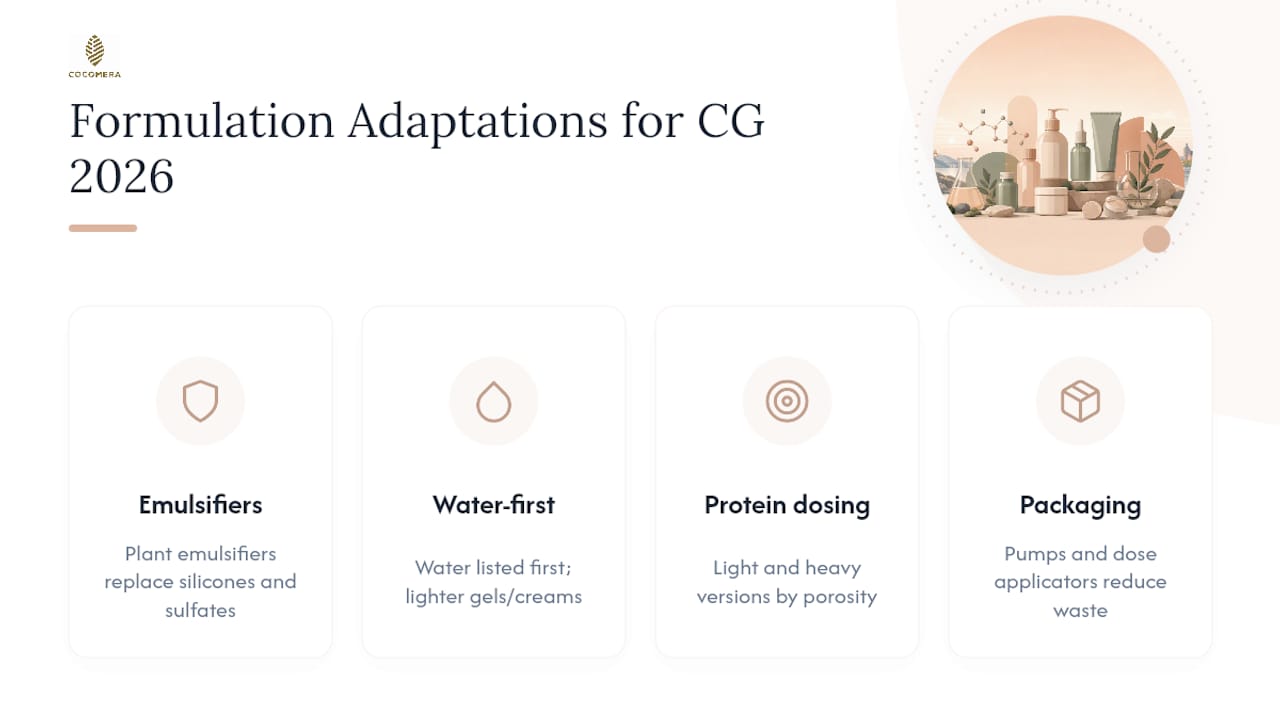
Formulators are leaning harder into plant-derived emulsifiers and multi-functional botanical extracts to replace the silicones and sulfates CG rules exclude. Ingredients like cetearyl alcohol (a fatty alcohol, not a drying one) and behentrimonium methosulfate now show up more often as conditioning agents that don’t leave residue.
There’s also a visible shift toward “water-first” formulas, where water sits at the very top of the ingredient list and oils or butters follow in smaller, more deliberate amounts. This trend responds directly to a common complaint: heavy CG-approved creams that leave curls coated rather than defined. Lighter, water-based gels and creams are replacing some of the thicker butter-based formulas that dominated the method’s early years.
Brands are also getting smarter about protein dosing. Instead of one-size-fits-all protein treatments, more lines now offer a light and a heavy version of the same product, letting shoppers match protein levels to their own porosity rather than guessing. This directly supports the porosity-first approach to routine building covered earlier.
Packaging and dispensing have adapted too. Pump bottles and precise-dose applicators are becoming more common on gels and creams, partly to reduce product waste and partly because CG rules reward smaller, controlled amounts over heavy-handed application. None of these shifts change the underlying CG criteria, but they do mean a “curl cream” bought today likely behaves differently on the hair than one bought even two or three years ago.
Does Clean Beauty Change What Counts as CG-Approved?
Clean beauty and CG rules overlap more than most people realize, but they’re not the same standard, and conflating them causes real confusion. Clean beauty generally targets parabens, phthalates, and synthetic fragrance; CG rules target sulfates, silicones, and drying alcohols. A product can be “clean” and still fail CG rules if it contains a non-soluble silicone for shine, and a product can pass CG rules while still containing a synthetic fragrance a clean-beauty shopper would reject.
Sustainability pressure is pushing brands toward recyclable packaging and concentrated formulas, which sometimes means smaller bottle sizes with the same product volume delivered through refill pouches. That’s a genuine upside for anyone buying multiples of a favorite leave-in.
The bigger shift worth watching is sourcing transparency. More brands now disclose where botanical ingredients like shea butter or jojoba oil come from, partly in response to consumer demand and partly ahead of anticipated EU sourcing disclosure requirements. For curly-haired shoppers, this mostly matters as a trust signal rather than a CG-compliance factor. A transparent sourcing page doesn’t make a product CG-friendly if it still lists dimethicone in the top five ingredients.
The practical takeaway: don’t assume “clean,” “sustainable,” or “eco” labeling means CG-approved. Check the INCI list regardless of what marketing language sits around it.
What Do People Get Wrong About CG Approval?
The biggest misconception is treating “CG-approved” as a fixed, permanent status rather than a snapshot of one formula at one point in time. Brands reformulate constantly, often without announcing it clearly, so a product praised as CG-friendly in a 2023 blog post can fail the same test today.
Another common mistake: assuming a badge or seal on packaging means an independent body verified the claim. There’s no official CG certification authority. “CG-approved” language on a bottle almost always means the brand’s own marketing team applied it, not a third party.
People also confuse “sulfate-free” with fully CG-compliant. A shampoo can be sulfate-free and still contain a drying alcohol or a non-soluble silicone elsewhere in the formula. Reading one line on the front label isn’t the same as reading the full ingredient list.
There’s also a tendency to treat CG rules as universal rather than a flexible starting framework, and experts on the method itself note that hair responds differently based on individual texture and porosity. A product technically compliant with every CG rule can still perform badly on your specific hair. Compliance and compatibility are two different questions, and skipping the second one is how people end up disappointed with a “correct” product.
The fix for all of this is the same: check current ingredients yourself rather than trusting a static label, a years-old blog list, or front-of-bottle marketing copy.
How Do You Transition Safely to 2026 CG-Approved Products?
Switching a whole routine at once makes it hard to tell which product change caused which result, good or bad. Swap one category at a time, starting with your cleanser, and give it two to three wash cycles before judging.
Expect a transition period if you’re moving off sulfate shampoos or silicone-heavy conditioners. Buildup from old products doesn’t disappear instantly, so hair might feel rougher or look less shiny for a week or two as residue clears. This is normal and not a sign the new product is wrong for you.
Patch-test new leave-ins and creams on a small section first, especially if you have a known protein or glycerin sensitivity. Glycerin-heavy products can misbehave in very low humidity or very high humidity, so climate matters as much as porosity when introducing humectant-rich formulas.
Keep your old products until you’re confident in the new routine. If curls start feeling gummy, weighed down, or unusually dry after two to three weeks, that’s your signal to check the new product’s INCI list again rather than assuming the CG method itself isn’t working for you. Most transition problems trace back to one mismatched product, not a flaw in the whole approach.
A Note From Cocomera on Curation and What Comes Next
Cocomera’s approach to curating CG-friendly picks starts with a simple belief: shoppers deserve full ingredient transparency, not a badge that asks for blind trust. Every product added to the catalog gets checked against current CG rules, and formulas get revisited as brands update them. If you spot a reformulation Cocomera hasn’t caught yet, or want a specific product checked before you buy, reach out. That feedback loop is what keeps a “2026 update” honest instead of just a new year slapped on an old list.
Pro Tip: Keep a simple note (a phone memo works fine) of which products you’ve tried, what porosity and curl pattern you have, and how each one performed. Patterns show up fast once you’re tracking more than two or three products.
— Cocomera
Shop Cocomera’s 2026 CG-Friendly Picks
Cocomera exists because building a Curly Girl routine from single-ingredient guesswork gets exhausting fast, and every product on this list has already been checked against current CG rules so you don’t have to start from zero.
Start with the Bounce Curl Curly Trial & Travel Kit if you’re new to the method and want to test a full routine before committing to full sizes. If frizz control is your main issue, go straight to Innersense Quiet Calm Curl Control. For definition without crunch, Innersense I Create Definition Styling Foam pairs well with the Bounce Curl Define EdgeLift Brush for root-to-tip clumping. Don’t skip scalp protection: Black Girl Sunscreen SPF 30 is silicone-free and built for melanin-rich skin.
Browsing the full styling collection or the leave-in category is the fastest way to compare current stock against your own porosity notes. Every product page lists the full ingredient breakdown, so you can verify CG compliance yourself before checkout.
Where to Verify CG Claims Yourself
-
Is It CG? checks an ingredient list against CG rules in seconds and flags borderline silicones and hidden alcohols.
-
Curlscan’s A–Z approved list catalogs many CG-friendly products as a starting reference, though entries can lag behind reformulations.
-
Retailer product pages with full INCI listings, cross-referenced against the brand’s own site, remain the most reliable way to catch formula changes before you buy.


