



TL;DR:
- Afro hair has unique structural features, including elliptical follicles and high density.
- Different Type 4 subtypes (4A, 4B, 4C) vary in curl pattern, fragility, and shrinkage.
- Proper care involves gentle cleansing, deep conditioning, moisturizing, sealing, and protective styling.
Afro hair is one of the most misunderstood hair types in mainstream beauty. Walk into most European drugstores and you’ll find shelves stocked with products designed for straight or loosely wavy hair, with maybe one small section labeled “ethnic.” That’s a problem, because [afro-textured hair](https://en.wikipedia.org/wiki/Kinky_hair#:~:text=Kinky hair is a human) has elliptical follicles, significant shrinkage of up to 80%, and structural traits that make standard advice not just unhelpful but sometimes damaging. If you’ve ever felt like generic hair tips weren’t written for you, they probably weren’t. This guide breaks down what afro hair actually is, how to identify your specific type, and what your strands genuinely need to thrive.
Table of Contents
- What defines afro hair?
- The different types of afro hair explained
- Why afro hair behaves differently: the science of shrinkage, dryness, and fragility
- Caring for afro hair: proven routines and essential products
- Why every routine should be tailored: what the beauty industry forgets about afro hair
- Find your perfect afro hair care products
- Frequently asked questions
Key Takeaways
| Point | Details |
|---|---|
| Afro hair basics | Afro hair features tight coils, high shrinkage, and unique fragility compared to other hair types. |
| Know your subtype | Identifying your 4A, 4B, or 4C hair helps personalize your care routine. |
| Science supports care | Understanding afro hair’s biology explains why it needs gentle, moisture-rich routines. |
| Tailored routines matter | Using suited products and personalized steps leads to healthier, stronger hair. |
What defines afro hair?
Afro hair isn’t just “curly hair turned up to eleven.” It’s a structurally distinct hair type with its own biology, terminology, and care logic. The term afro-textured is the most accurate umbrella label, covering everything from loose coils to the tightest, most densely packed strands. You might also hear it called kinky, coily, or Type 4 hair, which refers to the Andre Walker hair typing system.
What physically sets afro hair apart starts at the follicle. While straight hair grows from round follicles, [afro hair grows from elliptical follicles](https://en.wikipedia.org/wiki/Kinky_hair#:~:text=Kinky hair is a human), which cause the strand to curl tightly as it exits the scalp. This creates the signature tight coil pattern and also means the hair strand itself is flattened rather than round in cross-section. That shape affects everything: how oil moves down the strand, how light reflects off it, and how much tension it can handle before breaking.
Here are the key structural traits that define afro hair:
- Tight coil pattern caused by elliptical follicles at the root
- High density meaning more individual strands per square centimeter compared to other types
- Significant shrinkage ranging from 50% to 80% of actual length when dry
- Low natural oil distribution because sebum struggles to travel down tightly coiled strands
- Higher fragility at each curl bend point, where the strand is thinnest
“Afro-textured hair is characterized by its tight coils, elliptical follicle shape, and a tendency toward dryness and shrinkage that sets it apart from all other hair types.”
This is why advice like “just use a moisturizing shampoo” barely scratches the surface. The structure of afro hair demands a fundamentally different approach, from how you detangle to which ingredients you prioritize. For a deeper look at how to work with this structure in your styling routine, the afro hair styling steps guide is a great starting point.
The different types of afro hair explained
Not all afro hair is the same. Even within Type 4, there are meaningful differences that affect how your hair looks, behaves, and what it needs. The Andre Walker system divides Type 4 into three subtypes: 4A, 4B, and 4C. Knowing yours changes everything about how you shop for products and build a routine.
According to WebMD’s hair type breakdown, the subtypes break down like this:
| Subtype | Curl pattern | Coil size | Definition | Fragility |
|---|---|---|---|---|
| 4A | S-shaped coils | ~1 cm wide | High | Moderate |
| 4B | Z-shaped zigzag | Smaller, denser | Low | High |
| 4C | Tightly packed coils | Smallest | Very low | Highest |
4A hair has the most visible curl pattern of the three. The coils form a clear S-shape and tend to clump together, giving the hair more natural definition. It still experiences shrinkage, but the curl pattern stays somewhat visible even when dry.
4B hair bends in sharp angles rather than spiraling. The pattern looks more like a Z or zigzag than a curl. It’s denser and less defined, meaning it needs more product to show any shape. Shrinkage can reach 70% or more.
4C hair is the tightest and most fragile subtype. The coils are so small they’re often invisible without stretching. It has the most shrinkage of any type, sometimes up to 75% or more, and the least natural moisture retention. It also tangles easily and requires the gentlest handling.
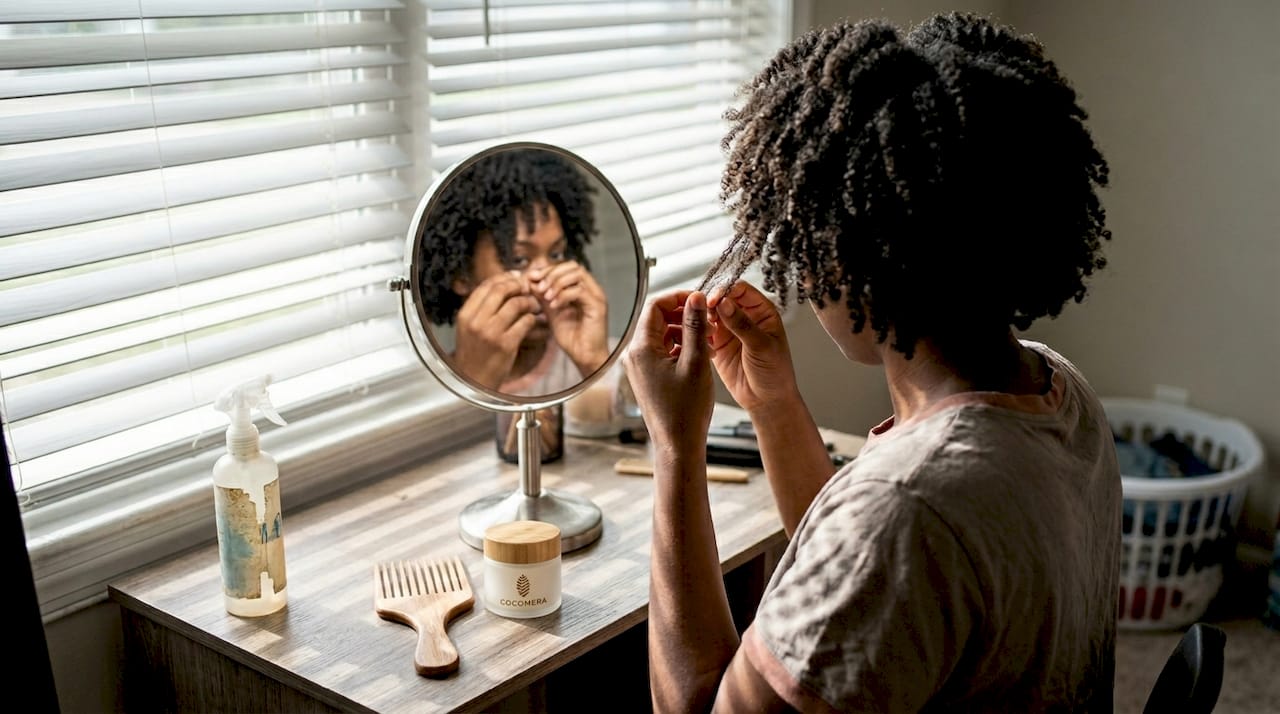
Many people have more than one subtype on their head, which is completely normal. If you’re navigating multi-textured hair care, the approach shifts slightly since different sections may need different amounts of moisture or hold.
Pro Tip: To identify your subtype, wash your hair without any products and let it air dry completely. Look at the pattern your strands form naturally. S-shapes point to 4A, angular bends suggest 4B, and minimal visible pattern with maximum volume is a strong sign of 4C.
Why afro hair behaves differently: the science of shrinkage, dryness, and fragility
Once you know your subtype, the next step is understanding why afro hair does what it does. The behaviors that frustrate most people, shrinkage, dryness, and breakage, aren’t random. They’re direct results of afro hair’s biology.
Shrinkage happens because tightly coiled strands are under constant tension from their own curl. When wet, the hair absorbs water and the coils relax slightly, appearing longer. As it dries, the coils spring back. The tighter the coil, the more dramatic the shrinkage. For 4C hair, this can mean hair that looks four inches long is actually twelve inches when stretched.
Dryness is built into the structure. Because the strand is coiled so tightly, the natural oils (sebum) produced at the scalp can’t travel efficiently down the length of the hair. [Flattened elliptical follicles](https://en.wikipedia.org/wiki/Kinky_hair#:~:text=Kinky hair is a human) also contribute to high porosity in many afro hair types, meaning moisture enters the strand quickly but escapes just as fast. The result is hair that feels dry within hours of moisturizing.
Here’s a quick breakdown of how these factors compare across subtypes:
| Trait | 4A | 4B | 4C |
|---|---|---|---|
| Shrinkage | 50-60% | 65-75% | 75-80% |
| Moisture retention | Moderate | Low | Very low |
| Breakage risk | Moderate | High | Very high |
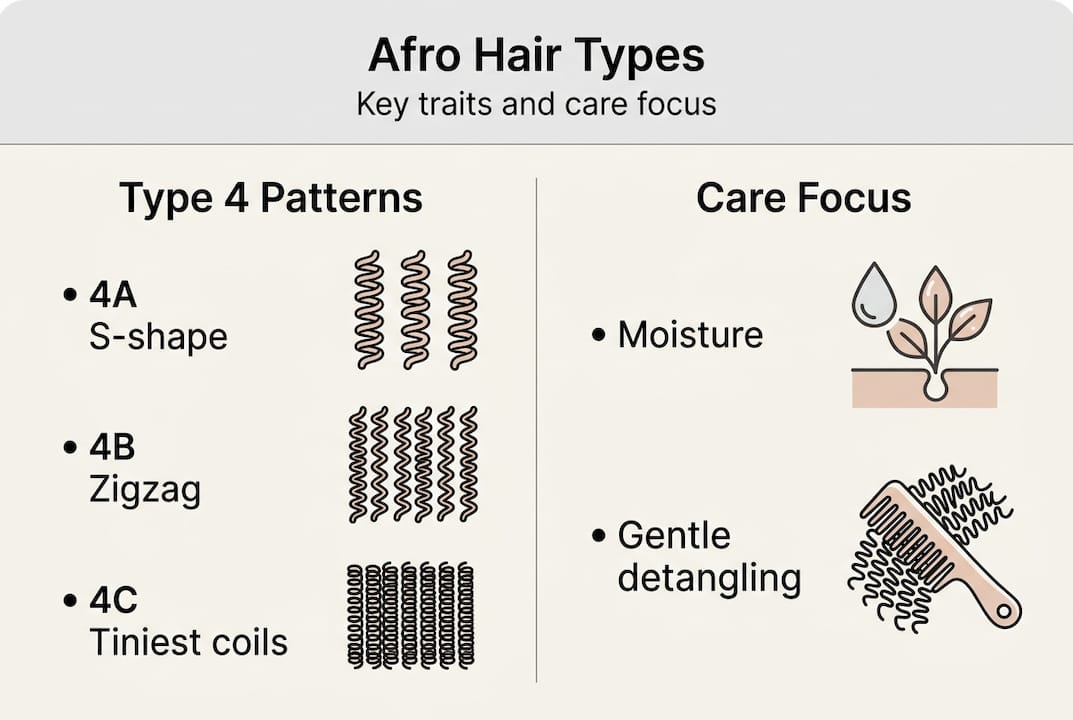
Breakage is the third challenge. Each bend in a coil is a potential weak point. The more bends per inch, the more stress the strand experiences during everyday handling like combing or even sleeping. Low elasticity, which means the strand doesn’t bounce back easily after stretching, increases the risk further.
Here’s what this means practically:
- Always detangle from ends to roots, never root to ends
- Use a wide-tooth comb or your fingers, not a fine-tooth brush
- Detangle only when the hair is wet and coated with conditioner
- Avoid tight hairstyles that pull at the edges and hairline
- Protect your hair at night with a satin or silk bonnet
Understanding these mechanics helps you stop blaming your hair and start working with it. For a deeper look at moisture retention for curls, that resource breaks down exactly how to keep your strands hydrated longer.
Caring for afro hair: proven routines and essential products
Knowing the science is only useful if it changes what you actually do. Here’s a practical routine framework built around afro hair’s real needs.
The foundational care steps:
- Cleanse gently. Use a sulfate-free shampoo for textured hair that removes buildup without stripping natural oils. Co-washing (washing with conditioner only) between shampoo days helps maintain moisture.
- Deep condition weekly. A rich, penetrating conditioner is non-negotiable for 4A, 4B, and especially 4C hair. Leave it on for at least 20 to 30 minutes under a heat cap.
- Apply leave-in conditioner while wet. This locks in moisture before it evaporates. Look for water as the first ingredient.
- Seal with an oil or butter. Because [high porosity causes rapid moisture loss](https://en.wikipedia.org/wiki/Kinky_hair#:~:text=Kinky hair is a human), sealing with a heavier product like shea butter or castor oil helps trap hydration inside the strand.
- Protective style regularly. Braids, twists, and buns reduce daily manipulation and protect ends from breakage.
Pro Tip: The LOC method (Liquid, Oil, Cream) works well for most afro hair types. Apply a water-based product first, then an oil, then a cream styler. This layering approach keeps moisture locked in far longer than any single product can.
Common mistakes to avoid include using too many products at once (buildup blocks moisture), skipping the deep conditioning step, and detangling dry hair. For moisturizing textured hair effectively, consistency matters more than the number of products you use.
Why every routine should be tailored: what the beauty industry forgets about afro hair
Here’s something the beauty industry rarely admits: most “curl-friendly” product lines are still designed with looser curl patterns in mind. The marketing says Type 4, but the formulas often perform best on 3C. That gap matters.
Afro hair isn’t a monolith. A 4A and a 4C person can sit next to each other and need completely different products, application techniques, and styling timelines. No single routine works for both. Yet most brand messaging still pushes a one-size-fits-all narrative because it’s easier to sell.
The real work is self-discovery. It means testing products on your own strands, paying attention to how your hair responds to humidity, heat, and protein, and being willing to adjust. Multi-pattern hair routines are especially important if your hair changes texture across different sections of your head. The brands worth trusting are the ones that acknowledge this complexity rather than flatten it.
Find your perfect afro hair care products
Building a routine that actually works starts with having the right products for your specific curl type. At Cocomera, we’ve curated a selection designed with Type 4 hair in mind, so you’re not sorting through products that weren’t made for your strands.
Explore our range of hair oils for afro hair to find the right sealant for your porosity level. For weekly treatments, our curly hair treatments collection includes deep conditioners and protein masks suited to high-porosity coils. And for your wash-and-go or twist-out days, browse our leave-in stylers for curls to find the hold and moisture balance your hair needs.
Frequently asked questions
How can I tell if I have type 4A, 4B, or 4C hair?
Type 4A has defined S-shaped coils, 4B forms sharp zigzag bends with less definition, and 4C has tightly packed tiny coils with almost no visible pattern when dry. Air-drying without product is the best way to see your natural pattern clearly.
Is shrinkage a sign of unhealthy afro hair?
No. [Shrinkage up to 75%](https://en.wikipedia.org/wiki/Kinky_hair#:~:text=Kinky hair is a human) in 4B and 4C hair is completely normal and actually signals that your hair has elasticity, which is a sign of health, not damage.
Why is afro hair often dry or brittle?
[Poor sebum distribution](https://en.wikipedia.org/wiki/Kinky_hair#:~:text=Kinky hair is a human) in tight coils means natural oils can’t travel down the strand efficiently, leaving the ends chronically dry. High porosity makes moisture loss even faster.
What products are most important for afro hair care?
Moisturizing shampoos, rich deep conditioners, leave-in creams, and sealing oils are the core four. [High porosity and low elasticity](https://en.wikipedia.org/wiki/Kinky_hair#:~:text=Kinky hair is a human) in afro hair make these steps essential rather than optional.
Recommended
- Afro hair styling steps for 3 and 4 curls in 2026 – Cocomera
- What is wavy hair? Complete 2026 guide for care – Cocomera
- What is multi-textured hair? Essential care guide – Cocomera
- Curly hair care tips for healthy textured hair - Cocomera
- Tame frizzy hair naturally: step-by-step defrizz guide – LUXEVA


