


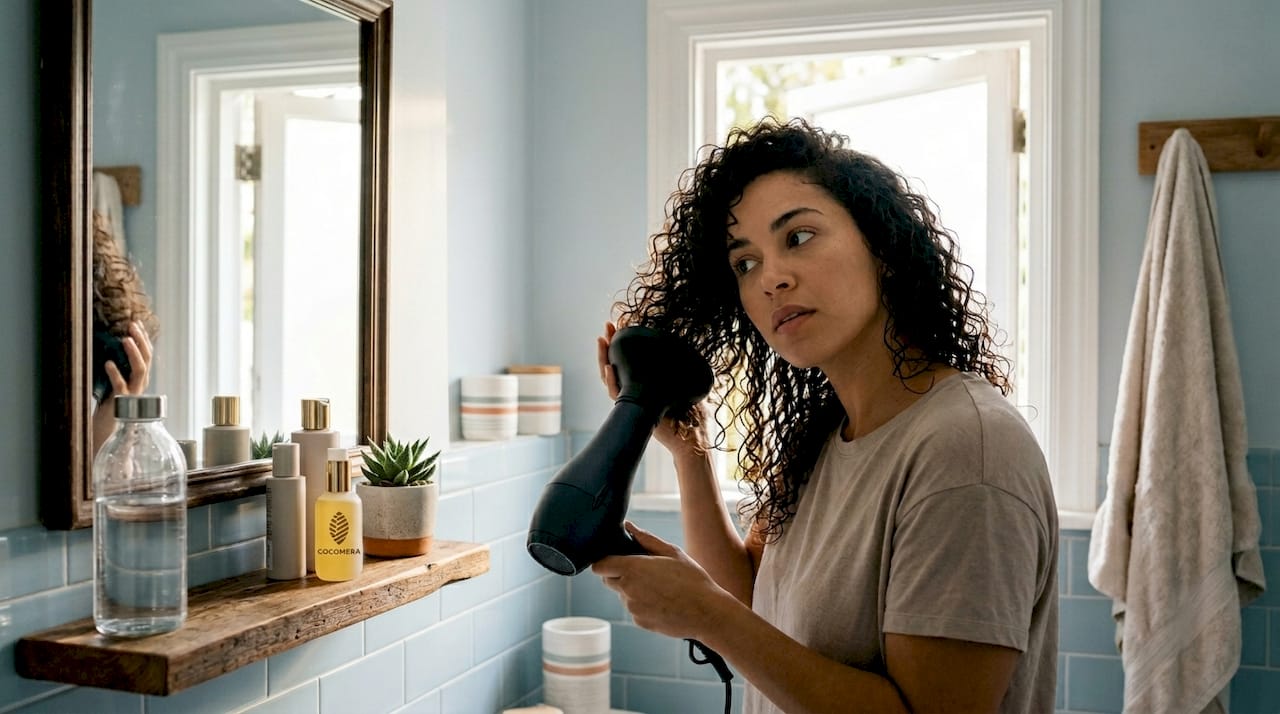
If you’ve ever assumed a diffuser was only for women with tight ringlets, you’re not alone. That misconception keeps so many wavy, curly, and afro-haired women away from one of the most effective tools in textured hair styling. A diffuser works across the full spectrum of textured hair, and it enhances waves, defines curls, and reduces frizz regardless of where your pattern falls. This guide walks you through what a diffuser actually is, how it works, who benefits most, and how to get the best results from it starting with your very next wash day.
Table of Contents
- What is a hair diffuser and how does it work?
- Diffuser benefits by hair type
- Diffuser vs. air-drying and other drying methods
- How to use a hair diffuser for best results
- Why most people underestimate the power of hair diffusers
- Take your curl styling a step further
- Frequently asked questions
Key Takeaways
| Point | Details |
|---|---|
| Diffusers preserve texture | A hair diffuser enhances and defines natural wave, curl, and coil patterns while reducing frizz. |
| Faster than air-drying | Diffusers can dry textured hair in a fraction of the time without sacrificing moisture or definition. |
| Suited for all types | From wavy to afro/coily, all textured hair benefits from targeted diffuser techniques. |
| Right routine matters | Prepping hair properly and using the right products maximizes shine, bounce, and health during diffusing. |
What is a hair diffuser and how does it work?
A diffuser is a bowl-shaped attachment that fits onto the end of a standard blow dryer. It spreads the concentrated stream of hot air into a wide, even flow that wraps gently around your curls instead of blasting through them. Think of it like the difference between a garden hose on full blast and the same hose set to a wide mist. Both deliver water, but one flattens everything in its path while the other nourishes.
Without a diffuser, a regular blow dryer forces a narrow jet of air at your hair, which disrupts the curl pattern, causes friction between strands, and triggers frizz almost instantly. A diffuser eliminates that problem by slowing down and dispersing airflow so each curl dries in place, exactly as it formed when wet.
Here’s why that matters for textured hair specifically:
- Preserves natural pattern: Curls and coils dry in their natural shape because they aren’t forced out of position by strong airflow.
- Reduces frizz: Gentle, even heat closes the cuticle layer instead of lifting it.
- Speeds up drying: Diffusing takes roughly 15 to 20 minutes vs. hours of air-drying, which is a real advantage on busy mornings.
- Less manipulation: The less you touch your hair while it dries, the less frizz you create.
- Gentler than brushing: Running a brush through textured hair to speed up drying breaks curl clusters and causes breakage.
“A diffuser is not just a convenience tool. For textured hair, it’s a technique that protects the structural integrity of each curl cluster from root to tip.”
One thing people often miss is that ingredients for textured hair matter just as much as the tool itself. A diffuser amplifies whatever you put in your hair, so pairing it with the right products gives you noticeably better results than using it on bare, product-free strands.
Diffusers also work with most standard blow dryers. You don’t need an expensive device. You need the right attachment, the right technique, and the right preparation.
Diffuser benefits by hair type
Once you know how diffusers work, understanding their specific benefits for your curl type makes a real difference in how you use them.
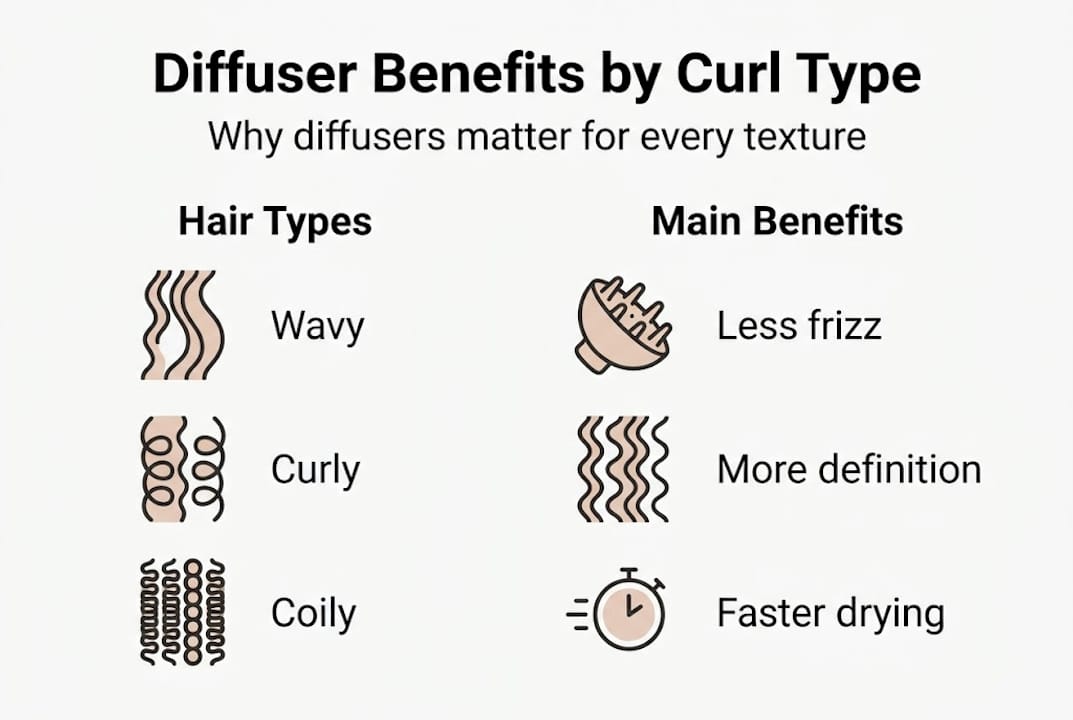
Diffuser results vary significantly across hair types, but every textured pattern gains something from the tool. The key is knowing what to expect so you can tailor your approach.
| Hair type | Main benefit | What it looks like |
|---|---|---|
| Type 2 (wavy) | Adds wave definition, boosts volume | Beachy, full waves with less flatness |
| Type 3 (curly) | Defines ringlets, prevents root poof | Bouncy, separated curls with hold |
| Type 4 (afro/coily) | Stretches coils, reduces shrinkage | Fuller shape, more visible length |
For type 2 wavy hair, the diffuser adds shape that air-drying rarely delivers. Wavy hair tends to go flat or frizzy without some help, and the gentle heat lifts the roots while encouraging waves to form and hold. If you want more on caring for this pattern, the guide for wavy hair covers the full routine in detail.

For type 3 curly hair, diffusing is where definition really happens. Ringlets can collapse under their own weight when air-dried, but the upward diffusing motion supports each curl cluster as it dries. The result is springy, defined curls that last longer and resist humidity better.
For type 4 afro and coily hair, the diffuser does something that air-drying simply cannot: it adds stretch. Coily hair shrinks dramatically as it dries, sometimes by up to 75 percent of its actual length. The diffuser’s airflow gently elongates each coil while it dries, giving you more visible length and a fuller shape. Pairing your diffuser session with quality hair moisturizers for curly hair means your coils stay hydrated through the heat.
A consistent diffuser benefit across all types, as noted in expert reviews, is enhanced texture and reduced frizz, regardless of whether your pattern is loose or tight.
Pro Tip: For afro and coily hair, apply a leave-in conditioner or a thick moisturizer before diffusing. The heat helps the product absorb more deeply, giving you softer, more defined coils without stiffness.
Diffuser vs. air-drying and other drying methods
You may wonder why not just let your hair dry on its own or use the blow dryer you already own. Here’s how each method actually performs for textured hair.
| Drying method | Time | Frizz risk | Definition | Heat damage risk |
|---|---|---|---|---|
| Diffuser | 15 to 30 min | Low | High | Low (on low heat) |
| Air-drying | 1 to 4 hours | Medium | Medium | None |
| Concentrator nozzle | 10 to 20 min | Very high | Low | High |
Air-drying is the gentlest method. No heat, no manipulation, no tools. But it has real drawbacks. It takes a long time, especially for thick or dense hair. It can also leave roots flat and limp because the weight of wet hair pulls curls down before they set. In humid climates, the extended drying window gives frizz more time to develop.
Concentrator nozzles are the standard attachment that comes with most blow dryers. They’re great for straight styles because they focus heat in a tight beam. For textured hair, that same focused beam disrupts curl patterns, dries strands unevenly, and frequently causes frizz and heat damage. Avoid them on wash days unless you’re doing a blowout.
Diffusers sit in the middle in the best way. According to testing and expert consensus, the diffuser is the strongest option for textured hair: faster than air-drying, far safer than a concentrator, and consistently better for curl definition.
- Use a diffuser when you want definition and volume with controlled drying time.
- Air-dry when your hair needs a complete break from heat.
- Avoid concentrators on wash days if you’re preserving your natural texture.
For those who style type 3 or type 4 hair, the styling steps for 3 and 4 curls pairs well with a diffuser routine to get the most from every wash day.
“Choosing the right drying method isn’t about the tool alone. It’s about matching the method to your hair’s specific needs on that specific day.”
How to use a hair diffuser for best results
With a clear picture of your options, here’s a straightforward diffuser routine that works across all textured hair types.
- Apply your styling products on soaking wet hair. Use a leave-in conditioner, curl cream, or gel depending on your hair type. Wet hair distributes product more evenly and helps products bond to the curl pattern.
- Add a heat protectant. This is non-negotiable. Using a heat protectant and diffusing on low heat significantly reduces the risk of damage over repeated use.
- Scrunch out excess water with a microfiber towel or cotton T-shirt. Avoid terry cloth, which creates friction and frizz.
- Set your blow dryer to low or medium heat and low speed. High heat breaks down the protein bonds in your hair over time. Low and slow is always the better approach.
- Flip your head forward and place curls into the diffuser bowl. Lift the diffuser up toward your scalp rather than moving it around. Hold for 20 to 30 seconds per section.
- Work in sections from the ends upward. Starting at the ends and moving toward the roots supports curl shape and prevents root poof.
- Stop when hair is 80 to 90 percent dry. Let the remaining moisture air-dry naturally. This is the single biggest tip for frizz-free results.
Pro Tip: Resist the urge to touch your hair while it’s drying or immediately after. Your curls need a few minutes to cool and set before you scrunch or shake them out. Touching too soon breaks the curl cast and creates frizz.
Finish your routine with a weekly deep conditioning treatment, especially if you diffuse regularly. Visiting the coily hair wash day tips page gives you a full workflow to build around your diffusing sessions. You can also find great moisturizers for curly hair that work perfectly as a pre-diffuse treatment.
Why most people underestimate the power of hair diffusers
Here’s the honest truth: diffusers have a reputation problem. Many women assume they create frizz, damage curls, or are only worth using if you have very defined ringlets. That perception stops a lot of people from ever giving them a real try.
But the frizz most people blame on diffusing usually comes from one of three things: heat that’s too high, products that aren’t right for their hair, or too much touching during and after drying. The diffuser itself is rarely the problem.
When used correctly, at low heat with the right products, a diffuser actually protects your texture. It locks in shine and bounce in a way that air-drying rarely achieves. Expert use 2 to 3 times per week with deep conditioning in between consistently delivers better volume and shine than air-drying alone.
The real shift happens when you stop treating the diffuser as a shortcut and start treating it as part of your full routine. That means good curly hair moisturizers, the right prep, and a consistent method. Once those pieces are in place, the diffuser does exactly what it’s meant to do.
Take your curl styling a step further
Now that you know how to diffuse like a pro, finding the right products to support your routine makes all the difference.
At Cocomera, we’ve curated a collection of styling products for curly hair that work beautifully with diffusing, from curl creams to gels that hold definition without crunch. Pair them with our selection of curly hair treatments to keep your strands strong between heat sessions. And for deeper nourishment on wash days, explore our hair masks for curls to restore moisture and boost elasticity. Everything is selected specifically for wavy, curly, and afro hair types, so you can build a routine that actually works for your texture.
Frequently asked questions
Is a diffuser suitable for all textured hair types?
Yes. Diffusers work across wavy, curly, and afro/coily hair, with each type seeing improved definition and reduced frizz when used correctly.
How often should I use a hair diffuser?
Diffusing 2 to 3 times per week is the recommended frequency, with a deep conditioning treatment used regularly to maintain moisture and hair health.
Can I diffuse hair without creating frizz?
Absolutely. Using low heat, a heat protectant, and minimal touching post-diffuse are the three biggest factors that keep frizz under control.
Do diffusers replace air-drying?
Not completely, but they offer a faster and superior option for definition. Air-drying is still useful for rest days, but the diffuser wins on definition and time efficiency.
Recommended
- Why hair needs moisture: essential guide for textured curls – Cocomera
- Curly hair care tips for healthy textured hair - Cocomera
- Hair Treatments for Curly Hair - Cocomera
- Best oils for curly hair: science, porosity & results – Cocomera
- Pomade vs wax vs gel: Best natural hair styling choice – Moose’s Tallow


