


TL;DR:
- Mousse for curls is a lightweight foam that defines natural patterns, adds volume, and provides flexible hold without stiffness. It works across all curl types from wavy to coily, delivering soft, movable, and shiny curls, especially when applied properly on damp, sectioned hair. The right mousse, combined with proper technique and alcohol-free formulas, enhances curl definition and reduces frizz effectively.
Mousse for curls is a foam-based, lightweight styler that defines natural curl patterns while delivering volume and flexible hold without the crunch of gels or the heaviness of creams. If you have textured hair and you have been reaching for heavy creams or stiff gels, mousse deserves a serious look. It works across curl types from wavy 2A to coily 4C, making it one of the most versatile products in any curl routine. The right mousse gives you soft, defined curls that move naturally, and that is exactly why use mousse for curls has become one of the most searched questions in the textured hair community.
What are the main benefits of using mousse for curls?
Mousse is a versatile, lightweight styler ideal for curl types 2A through 4C, providing definition, volume, and frizz control without heaviness or crunch. That range matters because most styling products are formulated with one curl type in mind. Mousse fills the gap.
Here is what mousse actually does for your curls:
-
Adds volume at the roots. Mousse lifts hair from the scalp without weighing it down, which is a common problem with heavy creams and butters.
-
Defines and groups curls. It encourages individual curl clumps to form, giving your style a polished, uniform look rather than a frizzy cloud.
-
Controls frizz. Mousse coats the hair shaft and smooths the cuticle, forming a light barrier against humidity.
-
Preserves natural movement. Unlike stiff gels, mousse delivers flexible hold. Your curls bounce and move rather than sitting in a frozen cast.
-
Enhances shine and softness. Modern mousse formulas with marine and wheat proteins create curls and waves without sticky residue or alcohol. That means softer, shinier results after drying.
Pro Tip: Scrunch your hair upward while applying mousse to encourage curl clumping from the ends toward the roots. This single habit makes a visible difference in definition.
The benefits of mousse for curls go beyond just hold. Because the formula is foam-based, it distributes evenly through wet hair without pulling or tangling. That makes the application process gentler on fragile, textured strands.
How does mousse compare to gel and cream for curly hair?
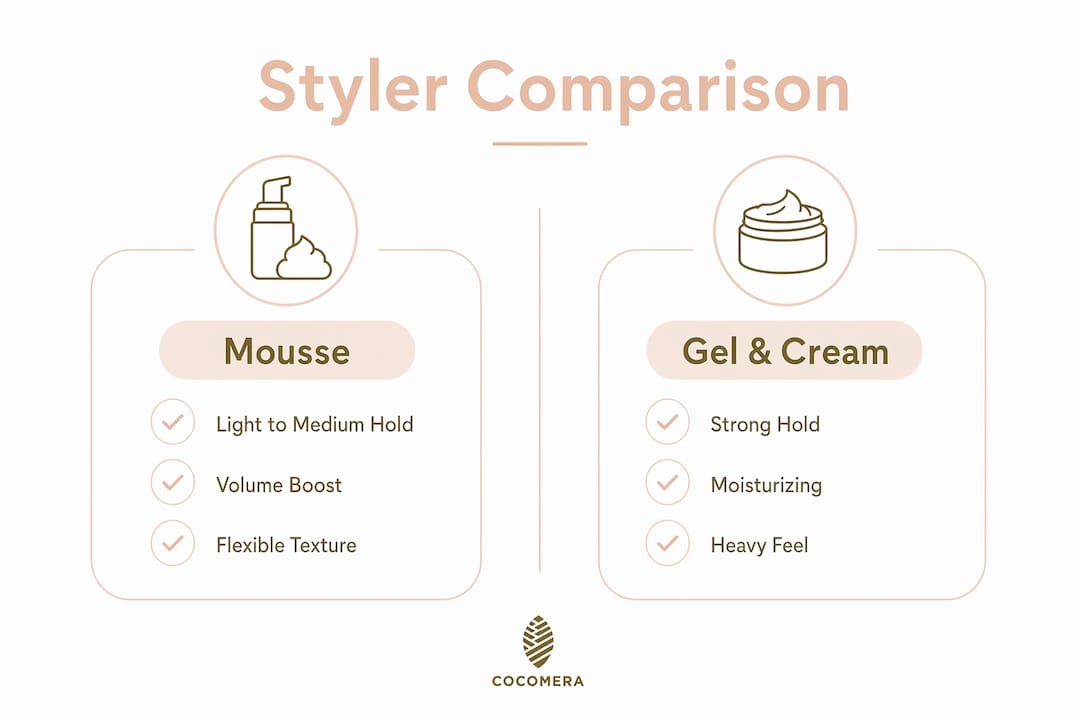
Mousse sits in a unique position among curl stylers. Understanding where it fits helps you decide when to use it alone and when to layer it with other products.
Hold and texture
Gel delivers stronger hold and is better suited for tight curl patterns like 3C through 4C that need lasting structure. The tradeoff is a firm cast that can feel stiff until you scrunch it out. Mousse provides lighter, more flexible hold. It is the better choice for fine to medium curls that need definition without weight. For a deeper look at how gel compares for hold, the difference in texture and finish is significant.
Moisture and weight
Creams and butters focus on deep hydration and are excellent for very dry or coily hair. The downside is weight. Heavy creams can flatten fine or wavy curls, reducing volume at the roots. Mousse balances moisture and hold without the greasiness that creams sometimes leave behind.
| Product type | Hold level | Best for | Main drawback |
|---|---|---|---|
| Mousse | Light to medium | Wavy to medium curls (2A–3C) | Less hold for very tight coils |
| Gel | Medium to strong | Medium to tight curls (3A–4C) | Can feel stiff or crunchy |
| Cream | Low | Dry, coily hair needing moisture | Can weigh down fine curls |
Mousse also layers well. Applying mousse first, followed by a gel, creates a protective curl cast that holds longer and resists humidity better than either product alone. This layering method is popular among people with 3B through 4A curls who want both definition and lasting hold.
What is the best way to apply mousse for defined curls?
Technique matters as much as product choice. Follow these steps for the best results:
-
Start with damp, towel-blotted hair. Apply mousse to hair that is damp to the touch but not dripping. Too much water dilutes the product. Too little prevents even distribution.
-
Section your hair into 2–4 parts. Sectioning before application leads to fuller, more even curl definition, especially at the nape of the neck where curls tend to lose shape fastest.
-
Measure your amount. Use about a golf ball-sized amount for shoulder-length curls and build up if needed. Overuse causes greasy or crunchy patches.
-
Apply with praying hands, then scrunch. Smooth mousse down the hair shaft with your palms pressed together, then scrunch upward to encourage curl formation.
-
Diffuse on low to medium heat. Drying time varies from 1 to 3 hours depending on hair density and length. A diffuser on low to medium heat preserves curl pattern and reduces frizz compared to air drying in a humid room. Learn more about why diffusing works for textured hair.
-
Scrunch out the crunch after drying. Once your hair is fully dry, gently scrunch to break the cast and release soft, touchable curls.
Pro Tip: Apply mousse in smaller staged amounts rather than all at once. Staged application helps you customize hold precisely and avoids greasy or crunchy buildup.
How do you choose the best mousse for your curl type?
Not every mousse works for every curl pattern. Choosing the right formula for your hair’s specific needs prevents dryness, buildup, and disappointing results.
Check the ingredient list first. Moisture-rich formulas free of high concentrations of alcohol are non-negotiable for curly and coily hair health. Avoid any mousse that lists “alcohol denat” or SD alcohol near the top of the ingredients. These dry out curls and cause frizz. Look instead for humectants like glycerin and conditioning agents like panthenol. Checking for silicone-free formulas is also worth your time, since silicone buildup can block moisture from reaching the hair shaft.
Match the formula to your curl pattern:
-
Wavy to light curls (2A–3A): Choose a volumizing mousse with a light hold. These formulas lift at the root without flattening your wave pattern.
-
Medium curls (3A–3C): A curl-defining mousse with medium hold gives structure without stiffness.
-
Coily and dry curls (3C–4C): Layer mousse over a leave-in conditioner and under a gel for maximum moisture and hold. A standalone mousse may not provide enough hydration for very dry strands.
Consider your hair porosity. High-porosity hair absorbs product quickly but loses moisture just as fast. A mousse with film-forming ingredients like flaxseed extract or aloe vera helps seal moisture in. Low-porosity hair benefits from lighter, water-based mousses that do not sit on top of the strand.
| Curl type | Mousse formula | Key ingredient to look for |
|---|---|---|
| Wavy (2A–2C) | Volumizing, light hold | Glycerin, aloe vera |
| Curly (3A–3C) | Defining, medium hold | Panthenol, flaxseed extract |
| Coily (4A–4C) | Moisturizing, used in layers | Shea butter derivatives, humectants |
A product like The Doux Mousse Def Texture Foam is a strong example of an alcohol-free, moisture-forward formula that works across multiple curl types without leaving residue.
Key Takeaways
Mousse is the most versatile curl styler available because it delivers definition, volume, and frizz control across all curl types without the stiffness of gel or the weight of cream.
| Point | Details |
|---|---|
| Mousse suits all curl types | Works for wavy 2A through coily 4C with the right formula and technique. |
| Damp hair is the starting point | Apply to towel-blotted hair for even hold without dilution or patchiness. |
| Sectioning improves results | Divide hair into 2–4 sections to cover the nape and roots evenly. |
| Avoid alcohol in formulas | High alcohol content dries curls and causes frizz; choose moisture-rich formulas. |
| Layering extends hold | Applying mousse under gel creates a longer-lasting, humidity-resistant curl cast. |
What mousse has taught me about curly hair styling
Mousse is one of the most misunderstood products in the textured hair world. At Cocomera, we hear from people who tried mousse once, got a crunchy or flat result, and never touched it again. That experience almost always comes down to two things: the wrong formula and the wrong amount.
The real power of mousse shows up when you treat it as a base layer rather than a finish product. Mousse first, then gel on top, gives you a hold that lasts through humidity and sleep without feeling like a helmet. That combination works for a wide range of curl patterns, and it is the approach we recommend most often.
What I find genuinely underrated is the sectioning step. Most people apply mousse all at once and wonder why their nape curls are undefined. Dividing your hair into sections before you start takes an extra two minutes and makes a visible difference in how even your final style looks.
The ingredient conversation also matters more than people realize. Alcohol-free, moisture-rich formulas are not a marketing claim. They are the difference between curls that feel soft at the end of the day and curls that feel brittle by noon. If you are building a curl routine from scratch, start with the formula, then refine the technique.
— Cocomera
Curl styling products curated for textured hair
Cocomera carries a carefully selected range of styling products for curly hair, including mousses, gels, leave-ins, and diffusers chosen specifically for wavy, curly, coily, and afro hair types. Every product in the collection is evaluated for formula quality, ingredient safety, and real-world performance on textured strands.

Whether you are building your first curl routine or refining one that is already working, Cocomera’s collection covers hair types 2, 3, and 4 in one place. Browse the full range to find the mousse, leave-in, or styling set that fits your curl pattern and porosity.
FAQ
Why use mousse for curls instead of gel?
Mousse delivers lighter, more flexible hold than gel, making it better for fine to medium curls that need definition without stiffness. Gel is stronger and suits tighter curl patterns that need lasting structure.
Is mousse good for curly hair every wash day?
Yes, mousse is safe for regular use when the formula is alcohol-free and moisture-rich. Avoid formulas with high concentrations of drying alcohols to keep curls hydrated and healthy.
How much mousse should I use for curly hair?
A golf ball-sized amount works well for shoulder-length curls. Build up in small stages rather than applying a large amount at once to avoid greasy or crunchy patches.
Can I use mousse on coily or 4C hair?
Yes, but layer it over a leave-in conditioner and under a gel for best results. Coily hair needs extra moisture, and mousse alone may not provide enough hydration for very dry strands.
Does mousse cause frizz in curly hair?
Mousse with high alcohol content can cause frizz and dryness. Choosing an alcohol-free, humectant-rich formula and applying it to properly damp hair prevents frizz and keeps curls defined.


