



Your hair belongs to one of 12 curl patterns (Andre Walker Types 1–4, A–C) and one of three strand textures (fine, medium, or coarse). Knowing both is the only way to pick products that actually work. Curl pattern tells you the shape your hair forms. Strand texture tells you how heavy or light your products need to be. Get one without the other and you’ll keep buying the wrong things.
Here’s where to start right now:
- Spot your dominant curl pattern. Wash your hair with a gentle shampoo, skip all products, and let it air-dry completely. Look at the shape your strands form on their own. Compare that shape to the 12-type chart below.
- Run the product-weight check before you buy anything. Pull a single dry strand and roll it between your fingers. If you can barely feel it, you have fine hair and need lighter formulas. If it feels thick and almost wiry, you have coarse hair and need richer, heavier products. Medium falls in between.
Both pattern and strand texture must guide every product decision. Pattern alone is not enough.
Table of Contents
- What’s the difference between hair type and hair texture?
- The Andre Walker curl chart: all 12 types at a glance
- How to find your true curl pattern at home
- How to test your strand texture and porosity
- Care basics and product-weight guidance for each hair type
- Why your hair type or texture can change over time
- Three starter routines by pattern and texture
- Key Takeaways
- Why product weight matters more than chasing a label
- Shop Cocomera’s curated collections by hair type and weight
- Authoritative sources and further reading
What’s the difference between hair type and hair texture?
These two terms get swapped constantly, and the confusion costs people money. Hair type (or curl pattern) describes the overall geometry of your hair at the head level: whether your strands fall straight, bend into waves, spiral into curls, or coil tightly. Hair texture, on the other hand, describes the diameter of a single strand.

Fine hair has two layers: the cortex and the cuticle. Medium and coarse hair typically have three layers, adding the medulla. That structural difference changes everything about how a product behaves on your hair. Fine strands get weighed down fast. Coarse strands resist moisture and need heavier formulas to stay hydrated. The same curl-defining cream that gives a coarse 3B gorgeous definition will flatten a fine 3B completely.
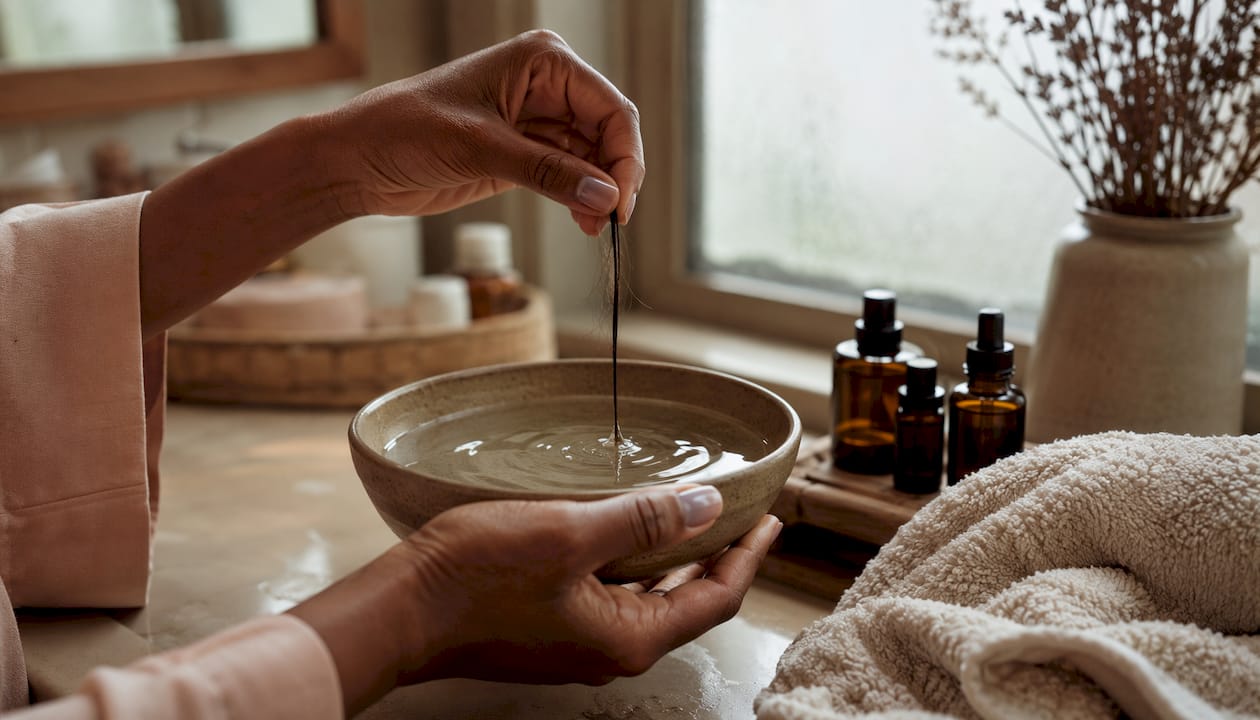
Porosity is a third dimension worth understanding. It measures how easily your hair absorbs and holds water. Low-porosity hair repels moisture initially but holds it well once it’s in. High-porosity hair soaks up water fast but loses it just as quickly, which is why it often feels dry even after conditioning. Porosity affects how long your products take to absorb and whether you need a sealant to lock moisture in.
Pro Tip: Test your curl pattern on sopping wet hair, before it starts to dry. Test your strand texture and length observations on fully dry hair. Wet hair reveals the true geometry; dry hair shows you the real volume, shrinkage, and shape.
The Andre Walker curl chart: all 12 types at a glance
The Andre Walker system is the global standard for classifying hair textures, used by stylists, product developers, and editorial guides worldwide. It organizes hair into four main categories (Types 1–4) with three subtypes each (A, B, C), giving you 12 distinct patterns. Within each number, A is the loosest and C is the tightest.
| Type | Subtype | Pattern Name | Visual Cue (Wet) | Visual Cue (Dry) |
|---|---|---|---|---|
| 1 | 1A | Pin-straight, fine | Falls flat, zero bend | Silky, no volume |
| 1 | 1B | Straight with body | Slight bend at ends | Soft body, holds styles |
| 1 | 1C | Straight, thick/coarse | Faint surface wave | Heavy, resistant to curl |
| 2 | 2A | Loose S-waves | Gentle S from mid-length | Barely-there wave, easy to straighten |
| 2 | 2B | Defined S-waves | Clear S-shape along length | Moderate volume, some frizz |
| 2 | 2C | Deep S-waves | Strong S bordering on curls | Significant volume, frizz-prone at crown |
| 3 | 3A | Loose spiral curls | Open spirals, chalk-width | Bouncy, shiny ringlets |
| 3 | 3B | Springy corkscrew curls | Tighter spirals, marker-width | Dense ringlets, high volume |
| 3 | 3C | Tight corkscrews | Pencil-width coils | Maximum volume, visible shrinkage |
| 4 | 4A | Tight S-coils | Crochet-needle-width S | Significant shrinkage, defined coils |
| 4 | 4B | Z-pattern coils | Sharp zigzag angles | Extremely fragile, dense |
| 4 | 4C | Tightest coils | Minimal visible loop | Shrinkage can exceed 75%, appears much shorter than actual length |
A few things worth knowing about Type 4 specifically: shrinkage is dramatic and should shape your length expectations from the start. Type 4A can experience significant shrinkage when dry. Type 4C can shrink even further, which affects protective style decisions and how you track length retention over time.
Here’s a quick orientation by category:
- Type 1 (Straight): No curl or wave. The main challenges are sebum buildup and heat damage, not definition.
- Type 2 (Wavy): S-shaped bends that don’t complete a full loop. Humidity and product buildup are the main enemies.
- Type 3 (Curly): Defined spirals and corkscrews. Moisture and frizz control are the central concerns.
- Type 4 (Coily): Tight coils or zigzag patterns with high shape memory when wet. Moisture retention and gentle handling are non-negotiable.
For a deeper look at how neighboring types compare, the types of curly hair guide on Cocomera walks through pattern matching and routine building side by side.
How to find your true curl pattern at home
Styled hair lies. Product buildup, heat damage, and silicone coatings all mask your natural pattern. The only reliable way to identify your curl type is to start completely clean.
- Clarify first. Use a clarifying shampoo to strip away any product residue, silicones, or mineral buildup. This step matters more than most people realize. Skipping it means you’re reading a distorted pattern.
- Wash with a gentle, sulfate-free shampoo. Follow with a lightweight conditioner, then rinse thoroughly.
- Assess while sopping wet. Experts recommend evaluating curl pattern while hair is fully saturated. Gently squeeze out excess water with your hands. Do not towel-rub. Do not add any product.
- Observe the shape immediately. Look at individual strands and sections. Are they falling flat? Forming an S? Spiraling into a coil? This is your true pattern.
- Photograph your hair from multiple angles. Take photos of the crown, nape, and sides. These areas often differ.
- Compare to the 12-type chart. Match what you see to the table above. Focus on the shape of the strand, not the volume or frizz.
- Let it air-dry completely without touching it. Once dry, note any shrinkage and whether the pattern tightened or loosened.
Pro Tip: If your hair looks different at the nape than at the crown, you likely have mixed patterns. That’s completely normal. Most people have a combination of curl patterns across their head. Build your routine around the section that needs the most care, usually the most fragile or driest area, not the loosest section.
What to do if your pattern is unclear
If your hair sits between two types (say, 2C and 3A), lean toward the tighter type when choosing products. Tighter patterns need more moisture and more hold. Choosing products for the looser type risks under-conditioning the sections that need the most support.
How to test your strand texture and porosity
Knowing your curl pattern is step one. Knowing your strand texture and porosity is what turns that information into the right product choice.
The strand texture test
Pull a single strand from your head (from the middle, not the hairline). Hold it between your thumb and index finger and roll it slowly.
- Fine: You can barely feel it. The strand may be almost invisible against a white background.
- Medium: You can feel it clearly but it’s not stiff or wiry.
- Coarse: It feels thick, almost rough. It may look visibly wide against a light background.
You can also hold the strand up to the light. Fine strands are nearly translucent. Coarse strands look opaque and substantial. At a barbershop or salon, professionals use this same visual check before recommending treatments or cuts.
The porosity float test
Drop a clean strand into a glass of room-temperature water and watch it for two to four minutes.
- Low porosity: The strand floats on top. Cuticles are tightly closed; products sit on the surface rather than absorbing.
- Medium porosity: The strand sinks slowly to the middle. Balanced absorption and retention.
- High porosity: The strand sinks quickly to the bottom. Cuticles are open or damaged; moisture absorbs fast but escapes just as fast.
Porosity and density both affect how quickly hair absorbs product and how much you need. High-porosity hair often needs a sealant (an oil or butter) layered over a water-based product to lock moisture in.
Product weight by strand texture and porosity
| Strand Texture | Porosity | Recommended Product Weight | Why |
|---|---|---|---|
| Fine | Low | Light (mists, light leave-ins) | Heavy products collapse fine strands; low porosity needs heat or steam to open cuticles |
| Fine | Medium | Light to medium (light creams) | Balanced absorption; avoid butters and heavy oils |
| Fine | High | Light with a light sealant | Needs moisture fast but can’t handle weight |
| Medium | Low | Medium (creams, light butters) | Can handle more weight; still benefits from steam |
| Medium | Medium | Medium (creams, curl activators) | Most versatile combination |
| Medium | High | Medium with a sealant | Needs moisture locked in |
| Coarse | Low | Medium to heavy (rich creams, butters) | Needs penetrating moisture; steam or warm water helps |
| Coarse | Medium | Heavy (butters, rich conditioners) | Coarse strands need richer formulas to stay soft |
| Coarse | High | Heavy with a sealing oil | Maximum moisture and sealing to prevent rapid loss |
When to see a trichologist: If your strand texture has changed suddenly (strands feel thinner or coarser than they used to), or if you’re experiencing excessive breakage that doesn’t improve with better products, those are signs worth getting checked by a professional. Sudden texture shifts can signal hormonal changes, nutritional deficiencies, or scalp conditions that products alone won’t fix.
Care basics and product-weight guidance for each hair type
Type 1: straight hair
Straight hair’s main challenge is oil. Sebum travels from root to tip without any curl to slow it down, which means hair gets greasy fast and product buildup is a constant issue.
- Wash frequently with a gentle clarifying or balancing shampoo.
- Avoid heavy oils, butters, or thick creams anywhere near the roots.
- Use lightweight volumizing products if you want body.
- Fine straight hair (1A/1B): stick to mists, light sprays, and volumizing mousses. Anything heavier will flatten it.
- Coarse straight hair (1C): you can handle a light smoothing serum or heat protectant, but still keep it off the roots.
Type 2: wavy hair
Wavy hair lives in a constant negotiation between definition and frizz. Too little product and the waves fall flat. Too much and they look greasy and limp.
- Use a light leave-in conditioner and a curl-enhancing cream or mousse.
- Apply products to sopping wet hair and scrunch upward, never brush when dry.
- Clarify regularly since buildup flattens the wave pattern fast.
- Fine wavy hair (2A/2B): light mousses and sea salt sprays work well. Skip heavy creams entirely.
- Coarse wavy hair (2C): you can use a medium-weight curl cream, but layer it over a light leave-in first.
Type 3: curly hair
Curly hair needs consistent moisture and products that provide hold without crunch. The tighter the curl, the more moisture it needs and the heavier the formula can go.
- Apply products in sections to sopping wet hair for even distribution.
- Use the squish-to-condish method to encourage clumping.
- Diffuse or air-dry. Avoid touching hair while it dries.
- Fine curly hair (3A/3B): light to medium creams and a light gel for hold.
- Coarse curly hair (3C): medium to heavy creams, butters, and a stronger gel or custard.
For ingredient-level guidance on what to look for in curl products, the best ingredients for textured hair guide on Cocomera is a useful next read.
Type 4: coily hair
Coily hair is the most moisture-hungry and the most fragile. Detangling dry Type 4 hair causes breakage. Manipulation should be minimal and always done on wet, conditioned hair.
- Deep condition weekly or biweekly.
- Use the LOC method (liquid, oil, cream) to layer moisture and seal it in.
- Protective styles like braids, twists, and updos reduce daily manipulation. Braids are especially effective for retaining length in Type 4 hair.
- Fine coily hair (4A fine): medium-weight creams and light oils. Heavy butters can still weigh fine coils down.
- Coarse coily hair (4B/4C coarse): heavy butters, rich creams, and sealing oils are non-negotiable.
Product-weight matrix by curl pattern and strand texture
| Curl Pattern | Fine Strands | Medium Strands | Coarse Strands |
|---|---|---|---|
| Type 1 | Light mists, volumizing spray | Light serum, heat protectant | Light smoothing serum |
| Type 2 | Light mousse, sea salt spray | Light cream, light gel | Medium curl cream |
| Type 3 | Light-medium cream, light gel | Medium cream, defining gel | Heavy cream, strong gel |
| Type 4 | Medium cream, light oil | Heavy cream, butter, oil | Heavy butter, rich cream, sealing oil |
Dos and don’ts:
- Do detangle Type 3 and 4 hair on wet, conditioned strands with a wide-tooth comb or fingers only.
- Do apply all products to wet hair, not damp or dry.
- Don’t use heavy oils on fine straight or fine wavy hair near the roots.
- Don’t brush Type 3 or 4 hair when dry. It destroys curl clumps and causes frizz.
- Don’t skip clarifying. Buildup from heavy products blocks moisture from reaching the strand.
Why your hair type or texture can change over time
Hair type is not fixed. Trichologists and stylists note that pattern and strand behavior can shift significantly over a lifetime, sometimes gradually, sometimes almost overnight.
Common causes of hair type or texture changes:
- Hormones: Pregnancy, postpartum shifts, menopause, and thyroid changes all affect strand diameter and curl pattern. Postpartum hair loss followed by regrowth often comes in with a different texture.
- Aging: Strands tend to get finer with age. Curl patterns can loosen or tighten depending on the individual.
- Chemical treatments: Relaxers, perms, and color (especially bleach) alter the protein structure of the strand permanently. Repeated heat damage has a similar effect over time.
- Medication: Certain medications, including chemotherapy, some blood pressure drugs, and hormonal treatments, can change hair texture as a side effect.
- Stress: Prolonged physical or emotional stress can trigger shedding and affect the quality of new growth.
- Heat damage: Repeated high-heat styling without protection gradually loosens curl pattern and weakens strand integrity.
Quick action plan by cause:
- Hormonal change: retest your pattern three to six months after the hormonal shift stabilizes. Adjust product weight if strands feel finer or coarser than before.
- Chemical or heat damage: focus on protein treatments and deep conditioning before worrying about pattern. Damaged hair needs strengthening before it can hold a routine.
- Medication-related change: speak to your doctor first. A trichologist can help you manage the hair symptoms, but the root cause is medical.
- Aging-related change: if strands are getting finer, move one step lighter in product weight. Fine aging hair collapses under the same formulas that worked at 25.
The key principle: identify your current need state (hydration, strengthening, thinning) alongside your baseline pattern. Treating damaged hair the same way you’d treat healthy hair of the same type is one of the most common mistakes people make.
Three starter routines by pattern and texture
These are plug-and-play templates. Adjust product weight up or down based on your strand texture and porosity results.
Routine 1: 2B fine wavy hair (light-weight routine)
- Shampoo: Gentle sulfate-free shampoo, focus on scalp only.
- Conditioner: Lightweight conditioner, mid-lengths to ends. Rinse fully.
- Leave-in: A few pumps of a light leave-in mist or spray, applied to sopping wet hair.
- Styler: Light mousse or a small amount of a light curl cream, scrunched in.
- Dry: Air-dry or diffuse on low heat. Do not touch until fully dry.
- Frequency: Wash every 2–3 days. Clarify weekly.
Routine 2: 3C coarse curly hair (heavy-weight routine)
- Pre-poo: Apply a light oil (like jojoba or argan) to dry hair before washing to prevent moisture loss during cleansing.
- Shampoo: Moisturizing sulfate-free shampoo.
- Conditioner: Rich conditioner, leave on for 5–10 minutes. Detangle with fingers or wide-tooth comb while conditioner is in.
- Leave-in: A generous amount of a creamy leave-in, applied section by section.
- Styler: Medium to heavy curl cream or butter, followed by a strong-hold gel to seal.
- Dry: Plop with a microfiber towel for 20 minutes, then diffuse or air-dry.
- Frequency: Wash weekly. Deep condition every 1–2 weeks.
Routine 3: 4A medium coily hair (medium-to-heavy routine)
- Pre-poo: Coconut oil or a penetrating treatment applied overnight or for 30 minutes before washing.
- Shampoo: Moisturizing or co-wash, depending on scalp needs.
- Conditioner: Rich conditioner with slip for detangling. Work in sections.
- Leave-in: Creamy leave-in applied to each section while still dripping wet.
- LOC method: Layer a light oil over the leave-in, then seal with a medium-weight cream or butter.
- Style: Twist-out, braid-out, or wash-and-go with a strong gel over the cream.
- Dry: Air-dry under a satin bonnet or diffuse on low.
- Frequency: Wash every 7–10 days. Deep condition weekly.
Product-weight quick reference
| Need | Light | Medium | Heavy |
|---|---|---|---|
| Moisture | Water-based mist, light leave-in | Creamy leave-in, light curl cream | Rich conditioner, heavy cream |
| Definition | Light mousse, light gel | Curl cream, medium gel | Butter, custard, strong gel |
| Sealing | Light oil (argan, jojoba) | Medium oil (sweet almond) | Heavy oil (castor), shea butter |
| Treatment | Protein mist | Protein conditioner | Deep conditioning mask |
Pro Tip: Matching product weight to strand texture rather than curl label alone is the single most impactful change most people can make. A fine 3C and a coarse 3C share the same curl code but need completely different formulas. Cocomera’s collections are organized by both curl type and product weight so you can filter by what your strands actually need, not just what your pattern looks like.
For a practical checklist to build your full routine, the natural hair checklist for textured curls on Cocomera covers routine order, frequency, and product layering in one place.
Key Takeaways
Your curl pattern and strand texture together determine which products will actually work for your hair. Neither dimension alone is enough.
| Point | Details |
|---|---|
| Test pattern on wet hair | Wash clean, skip products, and observe the shape while hair is sopping wet for an accurate reading. |
| Test texture and porosity separately | Use the single-strand roll test for diameter and the float test for porosity before choosing product weight. |
| Match weight to strand, not label | Fine 3C needs lighter formulas than coarse 3C; product weight follows strand texture, not curl pattern alone. |
| Retest after major changes | Hormones, chemical treatments, heat damage, and aging all shift hair type or texture; retest and adjust accordingly. |
| Cocomera collections | Cocomera organizes products by curl type and product weight so you can shop by what your strands need, not just your pattern. |
Why product weight matters more than chasing a label
The hair typing system is a useful starting point, not a destination. What Cocomera sees repeatedly is that people find their curl type, buy products marketed to that type, and still get mediocre results. The missing variable is almost always product weight relative to strand texture.
A 4C with fine strands does not need the same heavy butters that a 4C with coarse strands does. Applying a thick shea butter formula to fine coils will seal them shut and block moisture rather than deliver it. The curl label is the same. The strand is completely different. That gap between label and result is where most hair care frustration lives.
The more useful question is not “what type am I?” but “what does my strand need right now?” Hydration, strengthening, or moisture retention? Start there, then filter by weight. Test a new product on a small section before committing to a full routine. One wash tells you more than any chart can.
Hair typing is a tool for better care, not a hierarchy. Correct identification helps prevent damage from incorrect products and techniques. Use it that way.
Shop Cocomera’s curated collections by hair type and weight
Cocomera’s collections are organized by curl type (wavy, curly, coily) and product weight (light, medium, heavy) so you’re not left guessing which formula fits your strands. Whether you’re building a first routine for 2B fine waves or looking for a richer treatment for 4C coils, the products are filtered to match your actual needs.
Start with styling products for curly hair if you’re working on definition and hold, or go straight to hair masks and treatments if your strands need a moisture reset before anything else. Every product in the store is curated for textured hair specifically, not adapted from a generic formula. Browse by type, pick by weight, and build from there.
Authoritative sources and further reading
The claims in this article draw from the following sources. If you’re retesting after a hormonal shift, chemical treatment, or significant texture change, cross-checking against these primary references is worth the time.
- Andre Walker Hair Typing System — HairstyleMojo: the original 12-type classification with visual subtype descriptions.
- Hair Type Chart: All 12 Types (1A to 4C) — HairTypes.org: a comprehensive reference table covering all 12 patterns with key features and care notes.
- Hair Texture vs. Hair Type — Prose: explains strand-layer differences (fine/medium/coarse), porosity, and why texture drives product weight decisions.
- Curl Hair Type Guide — Allure: editorial guide covering wet-hair identification, mixed patterns, and at-home testing methods.
- How to Know Your Hair Type — Real Simple: covers biological causes of hair type changes and when to consult a professional.
- Hair Types Guide — Cosmopolitan: corroborates the four-category system and emphasizes identification as a tool for preventing product-related damage.
- Hair Damage Prevention — American Academy of Dermatology: primary medical reference for hair damage, breakage, and when professional consultation is warranted.
Retest your pattern and texture after any major hormonal event, after stopping or starting a chemical treatment, or if your hair’s behavior changes noticeably. The 12-type chart and the strand tests in this article are the same methods cited across all primary sources above.


