


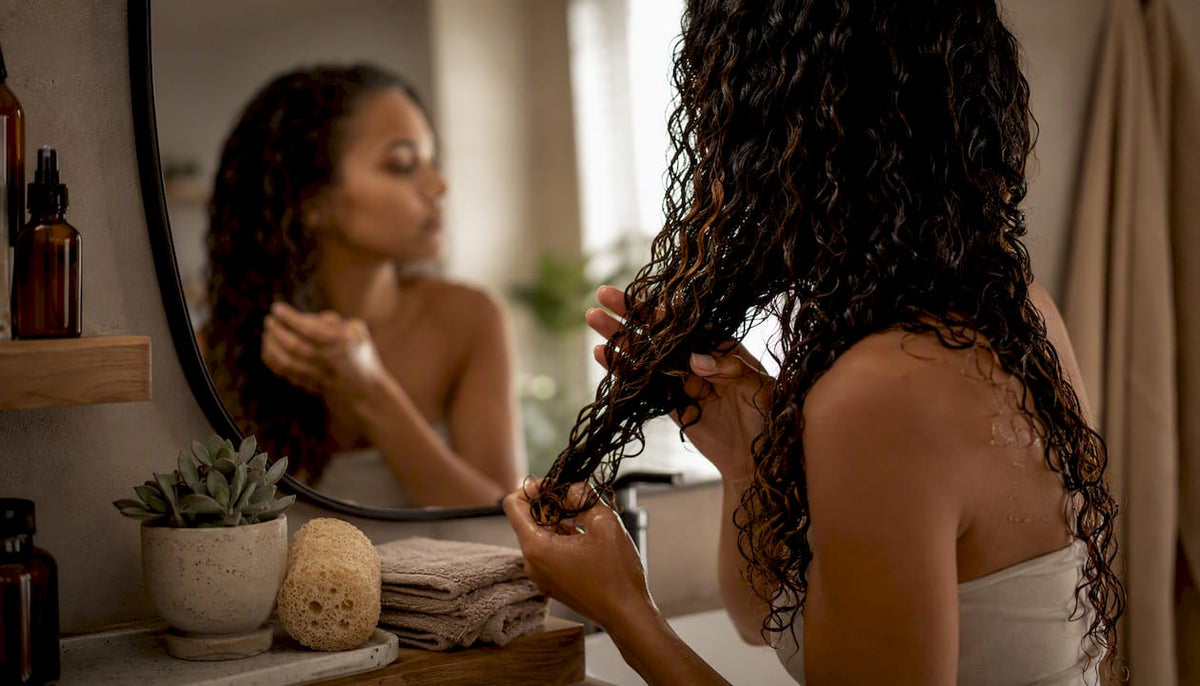
Natural oils do not hydrate your hair. That surprises most people who have spent years slathering coconut oil on their curls hoping for “moisture,” but the real function of a plant oil is traffic control for water. Oils either slip inside the hair shaft and slow how fast water escapes, or they sit on top and seal that water in. Neither process adds a single drop of hydration on its own, which is why oil applied to bone-dry hair usually makes frizz and dullness worse, not better.
For wavy, curly, coily and Afro-textured hair, that water-management function still delivers real, noticeable payoffs:
- Less friction between strands, which means less mechanical breakage during detangling and sleep.
- Frizz control and shine, since a thin oil film smooths the cuticle and reflects light more evenly.
- Targeted sealing on damp hair, which locks in the water your leave-in or cream just deposited.
- A better scalp ritual, especially for coily and Afro textures where sebum struggles to travel down a tightly coiled strand.
If you try one thing this week, make it this: pick one penetrating oil (coconut is the classic) for a pre-wash treatment, and one lighter oil for sealing damp hair after your leave-in. That single pairing solves most of the “my oil isn’t doing anything” complaints Cocomera hears from curly and coily customers.
Key Takeaways
Natural oils work by managing how water moves in and out of the hair shaft, not by adding moisture themselves, so matching oil type to porosity and timing determines whether curls thrive or feel weighed down.
| Point | Details |
|---|---|
| Match timing to oil type | Use penetrating oils like coconut before washing; use coating oils like grapeseed after styling. |
| Test porosity first | A float test tells you whether your hair needs a light sealer or a heavier one. |
| Never seal dry hair | Apply sealing oils only over damp hair or a water-based leave-in, never onto dry strands. |
| Patch test and watch for buildup | Check for scalp irritation early and clarify every two to four weeks if oils feel heavy. |
| Shop porosity-matched pairs | Cocomera’s hair oil collection pairs penetrating and sealing oils for curl-specific routines. |
Table of Contents
- Benefits of Natural Oils for Textured Hair: The Water-Movement Explanation
- Which Natural Oils Work Best for Curly and Coily Hair?
- How Do You Use Natural Oils in a Curly Hair Routine?
- How Do You Choose the Right Oil for Your Porosity and Goal?
- What Mistakes Ruin an Oil Routine (and How to Fix Them)?
- Cocomera’s Take on Choosing Natural Oils for Curls
- Where to Start Shopping for Natural Oils and Curl Definers
- Sources
Benefits of Natural Oils for Textured Hair: The Water-Movement Explanation
Here’s the direct claim: every natural oil falls somewhere on a spectrum between “penetrating” and “coating,” and where it falls determines what job it can actually do for your curls. Smaller, more polar molecules slip between the cuticle scales and into the cortex. Bulkier, less polar molecules stay on the surface. That’s it. That’s the whole mechanism behind most of what gets marketed as “deep moisturizing oil treatment.”
The science behind this got a useful reframe recently: oils don’t add water, they manage its movement, as explained in this natural oils benefit skin guide. Hair swells when it absorbs water and shrinks when it releases it, and repeated fast swelling and shrinking is what causes hygral fatigue, the weakening that leaves curls limp, stretched, and prone to snapping. An oil that penetrates, like coconut oil, can reduce protein loss and limit that swelling during washing. An oil that coats, like grapeseed, slows water from leaving after you’ve applied it, which is a completely different job.
Molecular size and fatty-acid structure decide which category an oil lands in. Coconut, palm kernel and sunflower oils penetrate more readily because of their smaller molecular footprint and fatty-acid profile, lauric acid in coconut’s case being a well-studied example. Oils with bulkier lipid chains, like jojoba and rice bran, tend to stay put on the cuticle surface instead. Porosity changes the equation further: a strand with lifted cuticles absorbs and loses water faster, so it often needs a heavier sealant, while tightly closed low-porosity cuticles resist oil penetration altogether and do better with something lighter.
| Oil behavior | Typical oils | What it does | Best timing |
|---|---|---|---|
| Penetrating | Coconut, olive, avocado | Reduces protein loss, slows swelling | Pre-wash treatment |
| Coating/sealing | Grapeseed, jojoba | Slows water loss, adds slip and shine | Post-style finish |
Moisturizing and sealing oils genuinely behave differently, and mixing up their jobs is the single most common mistake in curly hair routines, according to comparisons of the two categories.
Pro Tip: Warm a small amount of oil between your palms and apply it to one test strand. If it absorbs within a minute and the strand feels softer rather than coated, you’re looking at a penetrating oil. If it sits visibly on the surface and adds shine without sinking in, it’s a sealer. Run this test before committing a whole bottle to the wrong step in your routine.
Which Natural Oils Work Best for Curly and Coily Hair?
Not every oil in your cabinet deserves the same job. Some are built to slip into the strand before you wash; others are built to sit on top after you style. Here’s the quick read on the ones that show up most in curly hair routines.
Coconut oil penetrates well thanks to its fatty-acid profile, and it’s the most studied option for reducing protein loss during washing. It works best as a pre-poo on medium to high porosity hair, but it can build up fast on fine, low-density curls and it’s not the right pick if your hair reacts poorly to heavy protein-adjacent treatments.
Olive oil penetrates moderately. It’s gentler than coconut oil and a reasonable middle-ground pre-wash oil, though it carries a stronger scent that not everyone loves on a leave-in basis.
Avocado oil penetrates to a degree and carries a heavier, richer texture, making it a solid pick for high-porosity or coarser strands that can handle more weight without going limp.
Jojoba oil behaves almost identically to natural sebum in molecular structure, which makes it an excellent lightweight sealer and scalp oil. It rarely clogs pores and suits low-porosity hair that resists heavier oils.
Grapeseed oil is thin, low-odor, and a classic surface sealer. Great for fine, low-porosity curls that go limp under anything richer.
Castor oil is thick, tacky, and mostly used for scalp massage and edge control rather than strand sealing. It’s not a leave-in oil for most textures.
Argan oil sits closer to the sealing end but still adds meaningful shine and softness without much greasiness, useful as a light finishing gloss.
Shea and cocoa butters are technically solid fats rather than oils, but they function as heavy sealers for very high-porosity or very dry ends.
| Oil | Best for | Porosity fit | Weight | Typical use | Caution |
|---|---|---|---|---|---|
| Coconut | Penetration, protein loss | Medium to high | Medium | Pre-poo | Can feel heavy on fine hair |
| Olive | Mild penetration | Medium | Medium | Pre-poo | Strong scent |
| Avocado | Penetration, richness | High | Heavy | Pre-poo, deep condition | Too heavy for fine, low-porosity hair |
| Jojoba | Sealing, scalp health | Low | Light | Scalp massage, sealant | Minimal, well tolerated |
| Grapeseed | Sealing, shine | Low | Light | Finishing gloss | Limited hold on very dry ends |
| Castor | Scalp health | Any | Heavy | Scalp massage, edges | Sticky, hard to rinse |
| Argan | Shine, softness | Medium | Light to medium | Finishing | Can be pricey per ounce |
| Shea/cocoa butter | Sealing very dry ends | High | Heavy | Ends, protective styles | Buildup risk if overused |
Always patch test a new oil on your inner arm before adding it to your scalp routine, especially if you have nut allergies (coconut is technically a drupe, not a tree nut, but sensitivities vary) or a history of scalp breakouts. Coconut oil’s protein-adjacent effect can also aggravate protein-sensitive hair, so if your curls already feel stiff after protein treatments, skip it or limit contact time.
How Do You Use Natural Oils in a Curly Hair Routine?
Timing decides whether an oil helps or hurts. Penetrating oils belong before you wash, when they can work their way into the strand while your hair is still coated in natural oils and undisturbed by water. Coating oils belong after you’ve styled, when there’s already water and product underneath for them to seal in. Getting this timing backward is why so many people feel like oils “don’t do anything” for their curls.
A. Pre-poo for high porosity hair. Apply a small amount of coconut oil to dry or slightly damp hair, focusing on mid-lengths and ends. Leave it for some time before shampooing as usual. This is where coconut oil’s penetration performs best, since it gets uninterrupted contact time before water disrupts the process.
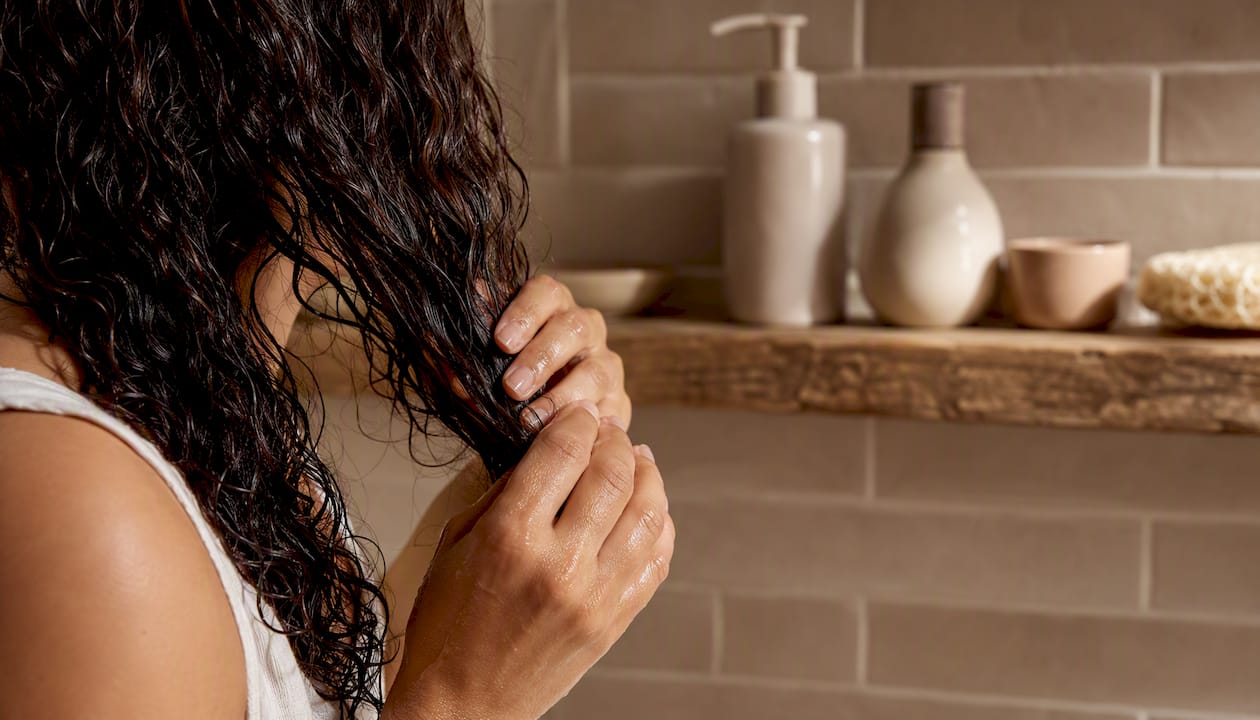
B. LOC method for high porosity hydration retention. Liquid (water-based leave-in), Oil (a sealing oil like grapeseed or argan), Cream (a heavier styling cream). The oil layer traps the water from step one before the cream adds hold and definition.
C. LCO method for low porosity hair. Liquid, Cream, then Oil last, in a thin layer, since low-porosity cuticles resist oil penetration and a heavy oil applied too early just blocks the cream from absorbing.
D. Light finishing gloss. Rub two or three drops of jojoba or argan oil between your palms and smooth over dry, styled curls for shine and frizz control without disturbing your curl pattern.
Hot-oil treatments work by gently warming a penetrating oil before application, since heat can speed uptake for oils that already tend to penetrate. Warm the oil to comfortably warm, not hot, apply to dry hair, cover with a shower cap for 20 to 30 minutes, then shampoo out.
A quick wash-day checklist:
- Detangle dry or lightly damp hair first.
- Apply your pre-poo oil if your hair is high porosity or protein-friendly.
- Shampoo and condition as usual.
- Apply leave-in and cream while hair is still damp.
- Seal with a light oil on mid-lengths and ends, avoiding the scalp if you’re prone to clogged pores.
How Do You Choose the Right Oil for Your Porosity and Goal?
Start with a 30-second porosity check: drop a clean strand of hair in a glass of water. If it sinks fast, you’re likely high porosity. If it floats for several minutes, you’re likely low porosity. That single test tells you more about which oil will actually work than any product label.
- Low porosity, goal = light hold without buildup: jojoba or grapeseed, applied thinly, used post-style.
- Low porosity, goal = scalp health: jojoba scalp massage, since it mimics sebum and rarely feels greasy.
- High porosity, goal = reduce breakage: coconut oil pre-poo, since heavier sealing oils trap hydration better on porous strands.
- High porosity, goal = all-day frizz control: avocado or shea butter on ends only.
- Coily or Afro texture, goal = manageability: any penetrating oil pre-wash plus a sealing oil finish, since oils here effectively stand in for sebum that struggles to travel down tight coils.
Pro Tip: If a single oil feels too heavy or too light on its own, mix a few drops of a penetrating oil into a lighter carrier like grapeseed before applying. You get some strand benefit and some sealing without the greasy buildup a straight heavy oil can leave on fine or low-porosity curls.
What Mistakes Ruin an Oil Routine (and How to Fix Them)?
The single most common mistake is sealing dry hair. If there’s no water underneath, an oil has nothing to seal in, and you end up locking dryness against the strand instead of protecting hydration. Always apply oil to damp hair or over a water-based leave-in, never straight onto dry, thirsty curls.
Patch testing matters more than most routines account for. Apply a small amount to your inner forearm, wait 24 hours, and check for redness or irritation before using any new oil on your scalp. If you notice small bumps or increased oiliness at the roots within a few days of starting a new oil, that’s a sign of pore clogging, not normal scalp oiling, and it’s worth switching to a lighter, less comedogenic option like jojoba or grapeseed.
Buildup shows up as dullness, limp curls, or hair that feels coated no matter how much you wash it. A clarifying shampoo once every two to four weeks, depending on how often you use heavier oils, resets your strands without stripping them daily.
Coconut oil’s protein-adjacent effect makes it a poor match for protein-sensitive hair. If your curls feel stiff, straw-like, or snap easily after protein treatments, skip long coconut oil leave-ins and reserve it for short pre-poo sessions you rinse out completely.
Cocomera’s Take on Choosing Natural Oils for Curls
Cocomera’s approach is simple: test small, then commit, and always pair the oil to the porosity, not the marketing claim on the bottle. Too many curly hair routines get built around whatever oil is trending rather than what a person’s actual strand behavior calls for, and that mismatch is behind most of the “this didn’t work for my curls” frustration we hear about.
That’s why the oil collection is curated to include both penetrating options for pre-wash treatments and lighter sealing oils for finishing, rather than a single all-purpose bottle promising to do everything. Pairing the right oil with a water-based leave-in or styling cream matters just as much as the oil choice itself, since an oil without water underneath has nothing to seal.
Where to Start Shopping for Natural Oils and Curl Definers
The easiest starting point is a two-product pairing: one penetrating oil for pre-wash treatments and one lightweight styler to lock in definition afterward. You don’t need eight bottles on your shelf to get this right, just the two that match your porosity and your goal.
For definition without weight, the Innersense Inner Peace Whipped Creme Texturizer works well layered over a light finishing oil, giving curls hold and softness without the greasy look heavier oils alone can leave behind. If you’re after foam-based styling that pairs with an oil finish for defined, bouncy curls, The Doux Mousse Def Texture Foam is built for exactly that combination. Browse the full hair oil collection to find a penetrating and sealing oil suited to your porosity, and check the styling products that complete the routine.
Sources
- How To Use Oil For Curly Hair: A Science-Backed Guide (Without The Myths) | The Mestiza Muse
- Moisturizing Oils Vs. Sealing Oils – What’s The Difference? | StyleCraze
- Is that Oil a Moisturizer or a Sealer? You Should Know the Difference | NaturallyCurly
- The Ultimate Guide: How to Choose the Perfect Carrier Oils for Your Hair Type - Aroma Monk
- Are natural oils good for coily hair? - Blog - Sanhe


